The AI industry has reached a major turning point in how interfaces work. For the past two years, Markdown text chat was the standard: you asked a question, and the model replied with formatted text, bullet lists, and static tables.
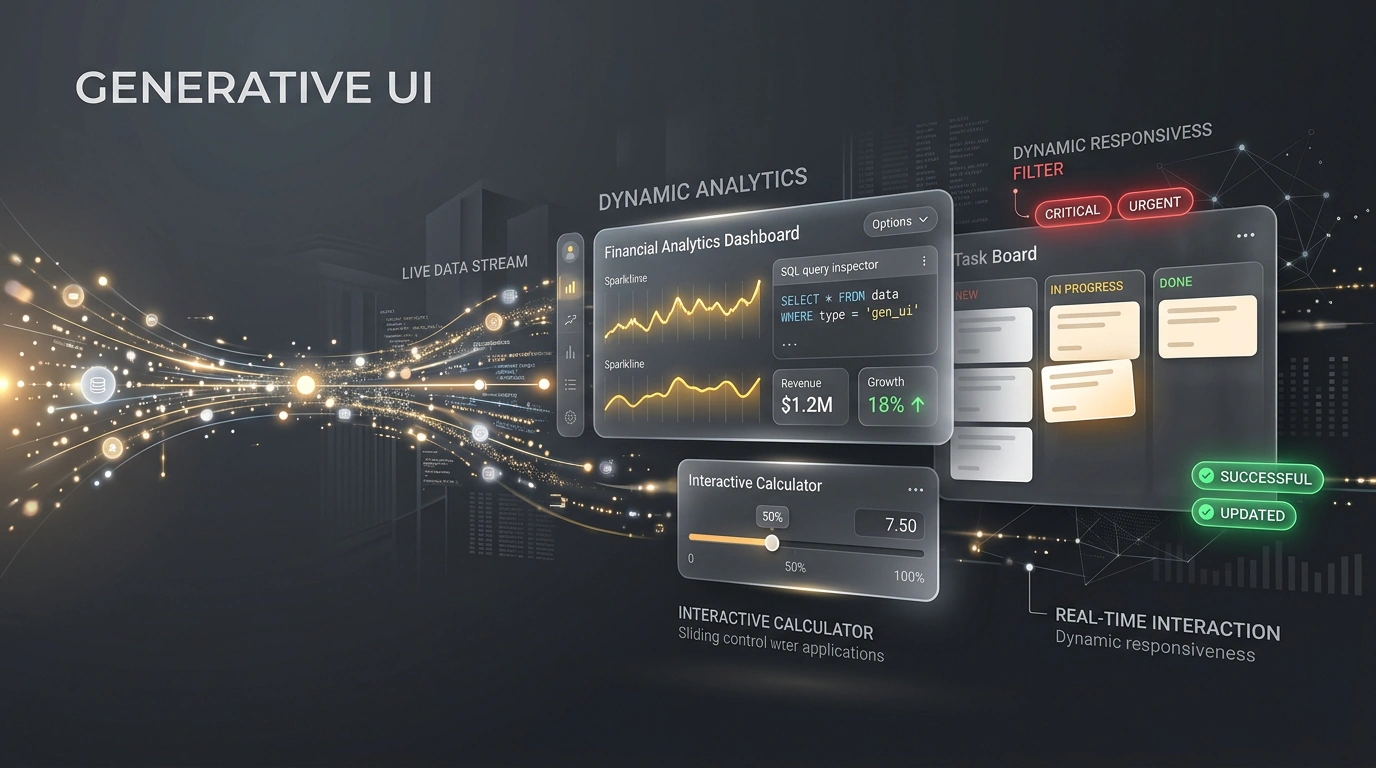
That format falls short for complex practical tasks. Static text replies are now giving way to Generative UI, a technology where a model compiles disposable interactive micro-apps, forms, and analytics panels on the fly to match the exact data structure of your request. Leading AI companies have rolled out updates at the same time, marking a clear shift in the industry.
Claude Dashboards and Motion
Anthropic introduced a major analytics upgrade for Claude, launching two connected tools in public beta: Claude Dashboards for interactive analytics and Claude Motion for video animations.
Dashboards tackles a classic enterprise pain point: slow report building in traditional BI tools. Claude connects directly to major corporate data warehouses, including Snowflake, Databricks, ClickHouse, Amazon Redshift, and Salesforce. You describe what you need in plain language—for example, analyzing lead conversion by ad source over the last quarter.
Instead of printing dry numbers, the model generates an interactive dashboard with live charts, date filters, and segment selectors. A key engineering detail is full logic transparency. Under every generated widget, an expandable block shows the exact SQL query and the data export timestamp. That addresses businesses' biggest worry about generative AI: math hallucinations.
The second tool, Claude Motion, turns raw spreadsheet exports into dynamic MP4 explainer videos. Unlike heavy video-generation models such as Runway or Sora, Motion doesn't invent pixels from scratch. Instead, the model writes compact executable animation code that drives vector graphics, captions, and moving charts. Developers or marketers can tweak colors, timing, or labels at any time using the /motion command. The feature is available on Team and Enterprise plans.
ChatGPT Intelligent UI
Around the same time, OpenAI began rolling out Intelligent UI for paid ChatGPT subscribers, focusing on interactive forms, widgets, and micro-tools.
The core engine here is a built-in streaming UI compiler. Previously, a model generated component code inside an artifact block and you had to wait for it to compile. Now, the interactive interface appears directly as tokens stream in.
Instead of giving text advice on budgeting, ChatGPT renders a clickable ROI calculator with interest-rate sliders. When planning a project, the chat turns into a drag-and-drop kanban board. When gathering requirements, it generates a multi-step qualification form with field validation.
The model chooses the output format automatically: simple questions get a brief text answer, while structured tasks get wrapped into micro-widgets. Currently, the feature works across most standard modes, though it is temporarily disabled when deep logical reasoning (Pro Reasoning) is active.
Multi-Model Routing
Dynamic interfaces are changing not just user interactions, but also the internal architecture of multi-model platforms, as seen in the GrokBot ecosystem and similar agent orchestrators.
A single generative screen becomes a control panel for a fleet of specialized models. The architecture uses a "Team Bot" (Chief of Staff) pattern:
- A front-line agent receives a complex request and breaks it into specialized subtasks;
- Analytical calculations, complex scripts, and animations are routed automatically to Claude 3.7 Sonnet or Opus 5.5;
- Media generation tasks, illustrations, and audio jingles go to Midjourney and Suno;
- The final output is stitched together and presented to the user inside an interactive Generative UI window.
These parallel releases from Anthropic and OpenAI signal a structural shift in software development. Tens of thousands of narrow micro-services—from mortgage calculators and content planners to basic BI dashboards—are losing their viability as standalone commercial products.
The user interface is no longer a hardcoded monolith. Models are becoming generators of dynamic, contextual UI, building an app's layout on the fly for a user's immediate need. For engineers, value is shifting away from coding standard layouts toward designing reliable APIs, securing data pipelines, and optimizing multi-model routing.