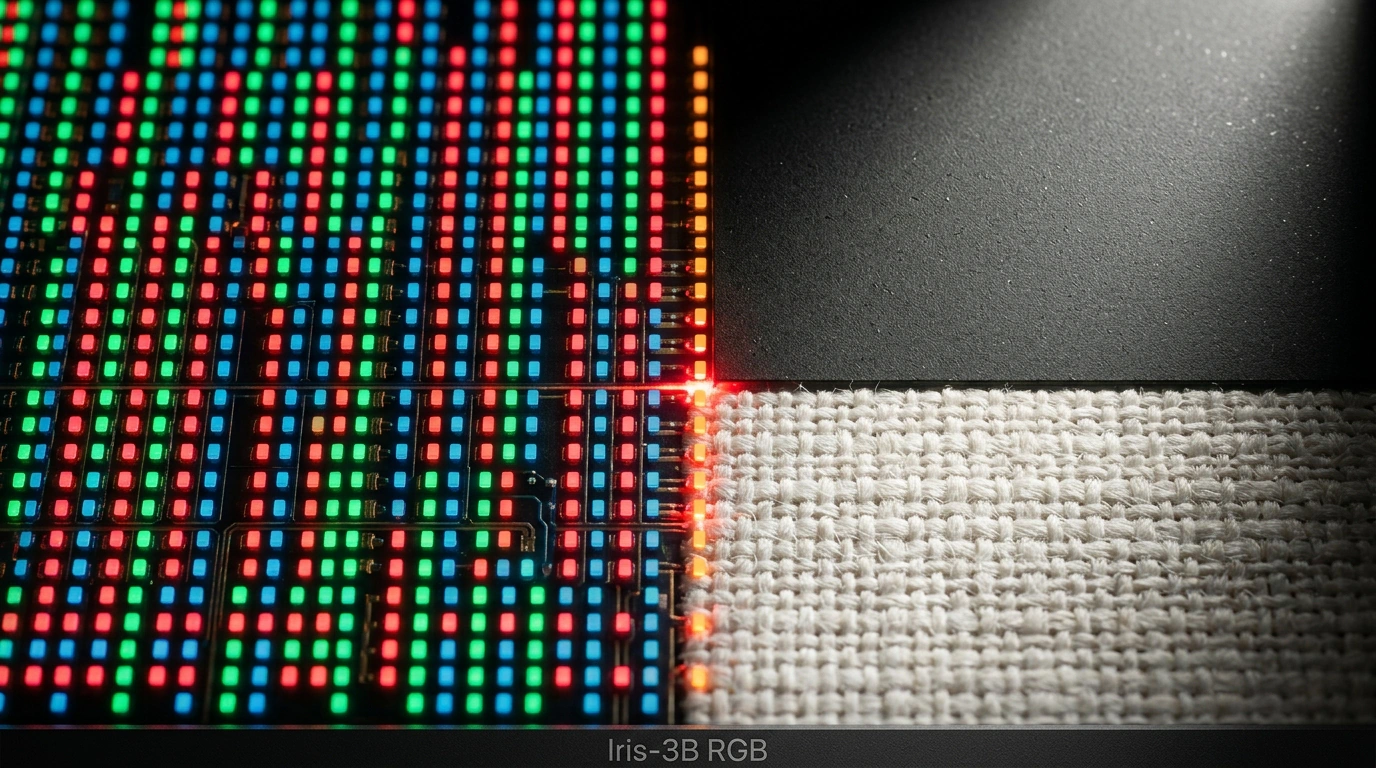
If you've ever zoomed in on images from Midjourney, Stable Diffusion, or FLUX, you've probably noticed a telltale flaw. Faces and landscapes look stunning, but look closely at skin pores, linen weave, wood grain, or tiny label text, and a strange blurriness jumps out.
That's not random. It's an architectural limit of Latent Diffusion Models (LDMs). To keep GPUs from choking on millions of pixels, a variational autoencoder (VAE) compresses the image by 8x or 16x into a compact 'latent' feature space. The neural network generates the image there, then tries to decode it back into pixels. Micro-geometry gets lost in that round trip: text melts, and fine lines turn into plastic mush. Earlier we saw developers tackle text rendering with complex networks like Qwen-Image 3.0. Now, the research team at speridlabs has made a bolder move.
They open-sourced Iris-3B, a model that ditches latent space and variational autoencoders altogether, generating images directly in true RGB pixels.
How Pixel Diffusion Works at 3 Billion Parameters
Instead of latent compression, Iris-3B operates directly on pixel patches at native 1024×1024 resolution. How did the team get a 3-billion-parameter model to do this fast without blowing through VRAM?
The secret comes down to two engineering choices:
- Curriculum Scaling: the model was trained in stages. First it learned composition and shape at tiny $256 \times 256$ resolutions, then moved to $512 \times 512$, and only in the final phase trained on full pixel-by-pixel $1024 \times 1024$ synthesis.
- Qwen-VL Vision-Language Encoder: instead of a standard CLIP text encoder, it uses a powerful multimodal encoder that understands spatial relationships ('the mug sits to the right of the laptop, with text engraved on the center of the handle').
As a result, one model handles three practical tasks: classic Text-to-Image (T2I), 4x Super-Resolution upscaling, and photo restoration (Inpainting).
Hands-On: Generation and Upscaling in Python
With open weights on Hugging Face (speridlabs/iris-3b), you can run direct pixel generation locally in PyTorch on any GPU with 16 GB of VRAM:
import torch
from PIL import Image
from iris import IrisPixelPipeline

# 1. Load the direct pixel inference pipeline
device = "cuda" if torch.cuda.is_available() else "cpu"
pipe = IrisPixelPipeline.from_pretrained(
    "speridlabs/iris-3b",
    torch_dtype=torch.bfloat16,
)
pipe.to(device)

# 2. Prompt focused on tactile physical micro-textures
prompt = (
    "A close-up studio photograph of an artisanal ceramic coffee mug, "
    "rough matte clay texture with tiny mineral speckles, crisp typography reading 'ROAST 2026', "
    "sharp focus, macro photography, natural morning daylight."
)
negative_prompt = "blurry, low resolution, plastic skin, compression artifacts, distorted letters"

# 3. Direct 1024x1024 frame synthesis without a VAE decoder
with torch.inference_mode():
    image = pipe(
        prompt=prompt,
        negative_prompt=negative_prompt,
        height=1024,
        width=1024,
        num_inference_steps=30,
        guidance_scale=4.5,
    ).images[0]

image.save("ceramic_mug_pixel.png")
If you already have a low-resolution image, the exact same checkpoint works as a top-tier texture restorer:
from iris import IrisRestorationPipeline

restore_pipe = IrisRestorationPipeline.from_pretrained(
    "speridlabs/iris-3b",
    torch_dtype=torch.bfloat16
).to("cuda")

low_res_input = Image.open("input_256.png").convert("RGB")

with torch.inference_mode():
    upscaled = restore_pipe(
        image=low_res_input,
        scale_factor=4,
        num_inference_steps=20,
    ).images[0]

upscaled.save("output_1024_restored.png")
If you need e-commerce product shots, labels, electronics mockups, or jewelry photos, Iris-3B delivers unmatched edge sharpness and readable fonts. There are zero VAE decoder artifacts around letters because pixels render straight to the grid.
Honest Comparison with FLUX and Weak Spots
Let's be honest: pixel space isn't a free lunch. Without VAE compression, the transformer has to process dozens of times more tokens. On an RTX 4090, one 1024×1024 frame takes 12–18 seconds to generate, while distilled latent models finish in 3–5 seconds.
The second trade-off is volumetric cinematic lighting. In sweeping, atmospheric scenes—like sunset fog over a city or neon rain in a forest—flagship FLUX.2 still looks deeper and moodier thanks to its rich latent distribution. Iris-3B leans toward razor-sharp macro detail rather than cinematic haze.
Even so, Iris-3B proves that the monopoly of latent autoencoders is ending. The community has already built an iris-3b-metal port for Apple Silicon and ComfyUI nodes, so you can test pure pixels today.