Picture a classic support or lead-routing pipeline. An incoming customer request lands in your system, and you just need to know which team gets it: billing, engineering, or general support. It sounds trivial. Yet if you put a large language model like GPT-4o or Claude 3.5 Sonnet on that step, you hit a paradox: generating two words takes 800 to 2,500 milliseconds.
While an autoregressive giant slowly predicts one token at a time, your entire agent pipeline stalls. If you have several branching steps like that, delays stack up into seconds. We've already covered how Celeris 1's diffusion approach replaces token-by-token generation and how to integrate decision models into personal AI. Today, startup Celeris AI officially launched Celeris-1 Decision, taking decision speed to a whole new level.
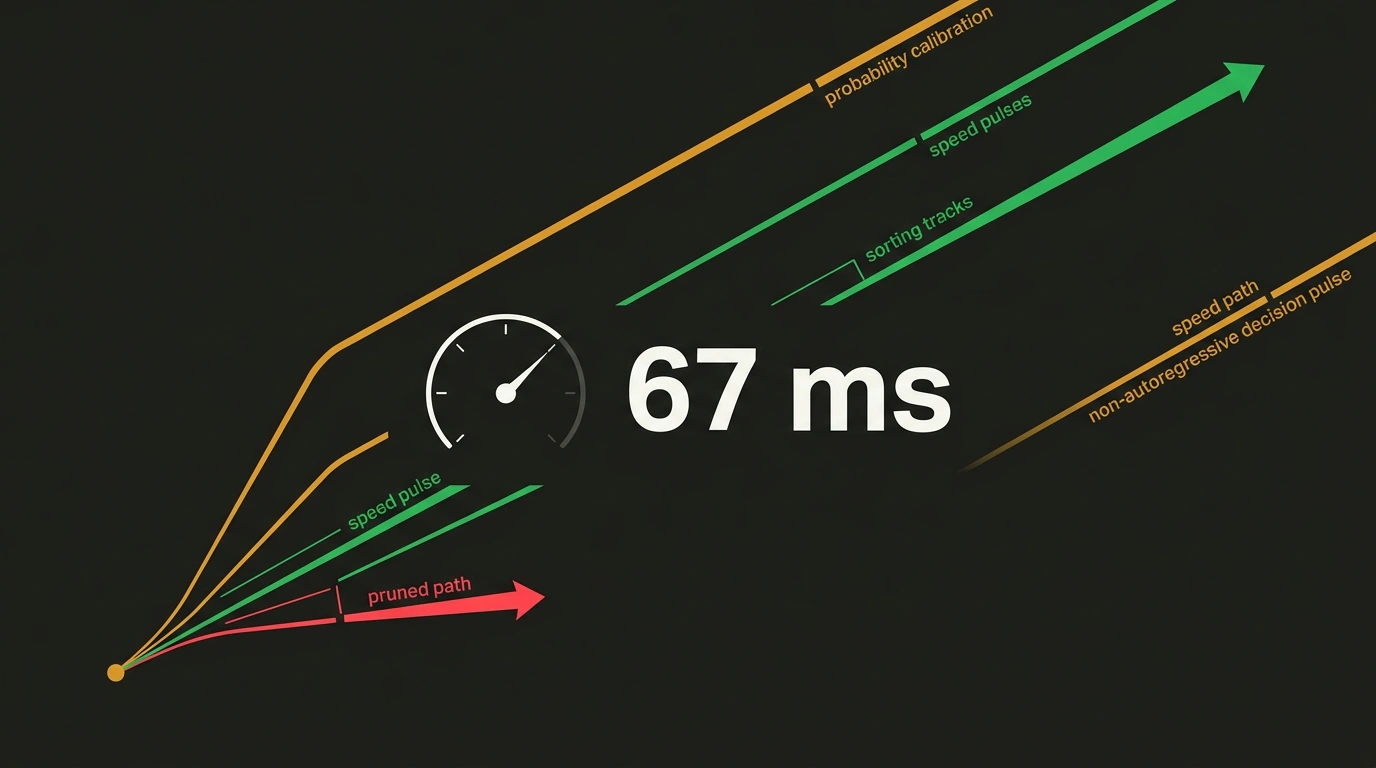
The model returns a strictly typed decision in an average of just 67 milliseconds. To put that in perspective, a human eye blink takes 150–400 ms. The model decides several times faster than you can blink.
Diffusion Instead of Token-by-Token Generation
How did engineers squeeze latency down to 67 ms? They ditched classic autoregression. Standard LLMs generate answers sequentially: first word, second word, third word.
Celeris-1 Decision runs on non-autoregressive diffusion (Diffusion-based Language Generation):
- The model starts with a tensor of random noise in latent space;
- Over a few parallel denoising steps, it computes the entire decision vector at once;
- Instead of a chatty monologue, it outputs a clean structure in one of three types:
- Null Decision: no action needed (skip the event);
- Choice Decision: pick one or more classes from a provided list;
- Score Decision: a continuous risk or priority score from 0.0 to 1.0.
The model is also trained to minimize the quadratic error of probability forecasts, known as the Brier score. Instead of the blind overconfidence common in standard LLMs ('I am 99% sure this is spam'), Celeris outputs mathematically calibrated probabilities. On the jev-bench algorithmic decision benchmark, it hit 80.0% accuracy, beating competing routers at 10–20x lower latency.
Calling the API and Parsing the Response
Integration uses a standard REST API. Here is a working Python script to route incoming customer support tickets:
import requests
import json
import time

CELERIS_API_URL = "https://api.celeris.ai/v1/decision"
API_KEY = "celeris_live_key_sample"

payload = {
    "model": "celeris-1-decision",
    "context": (
        "User reports: 'When paying for the annual Enterprise plan by Visa, "
        "my card was charged, but my profile still shows Free, error INV-9482.'"
    ),
    "decision_type": "choice",
    "choices": [
        {"id": "billing_urgent", "description": "Transaction failure or billing error"},
        {"id": "technical_bug", "description": "Technical bug in UI or frontend"},
        {"id": "general_inquiry", "description": "General questions on pricing and features"}
    ],
    "return_brier_calibration": True
}

start_time = time.perf_counter()
response = requests.post(
    CELERIS_API_URL,
    headers={
        "Authorization": f"Bearer {API_KEY}",
        "Content-Type": "application/json"
    },
    json=payload,
    timeout=2.0
)
latency_ms = (time.perf_counter() - start_time) * 1000

result = response.json()
print(f"API Round-Trip Latency: {latency_ms:.1f} ms")
print(json.dumps(result, ensure_ascii=False, indent=2))
The server returns a concise, typed JSON payload:
{
  "decision_id": "dec_8f7b2a194c",
  "selected_choice": "billing_urgent",
  "confidence": 0.984,
  "brier_score": 0.016,
  "latency_server_ms": 67.2,
  "routing_metadata": {
    "recommended_queue": "tier_2_finance",
    "auto_escalate": true
  }
}
Celeris AI has a very friendly pricing policy: output decision tokens are completely free. You only pay for input context. Use the model as an ultra-cheap frontline microcontroller. Let Celeris filter spam and route events in 67 ms, and bring in heavy, expensive Claude or GPT models only when you truly need creative text generation.
Where the Method Hits Its Limits
Don't try to use Celeris-1 Decision to write polite customer replies or generate code. By design, it has no 'chatty' generative layer. Its domain is pure boolean logic and classification.
Also, keep network physics in mind: that 67 ms figure is measured inside the same data center (AWS us-east-1). If your servers sit in Frankfurt or Tokyo, transcontinental TCP/TLS overhead will add 100–180 ms. For latency-critical loops, host your calling services close to the provider's endpoints.