Anyone who has tried deploying AI on real corporate paperwork—accounting statements, contracts with handwritten notes, customs forms, or bank records—hits a harsh reality fast.
At first, you rely on template-based OCR like Abbyy or Tesseract. Then a vendor shifts their logo two centimeters to the right, and your template breaks. Next, you decide to just feed the scans into a flagship multimodal model. We've already tested GPT-6 Astra in real-world workflows and run an independent audit of GPT-6 Astra's architecture. While it shines on simple tasks, feeding it a 50-page balance sheet makes token bills explode, and the model starts mixing up rows in nested tables.
NACE.AI built a specialized way out with NDI 1.0 (Neural Document Intelligence). Positioned as a dedicated Perception Layer for AI agents, it beats heavy multimodal models on extraction accuracy while cutting compute costs by 10x.
Why General-Purpose LLMs Trip Over Tables
Look at the mechanics. A general multimodal model like GPT Astra was trained on the entire internet: paintings, website screenshots, memes, and code. When you upload a multi-page PDF, it slices the image into hundreds of patches and burns huge amounts of attention trying to connect unrelated visual regions. A token from a table header can easily get matched with a value in the next column.
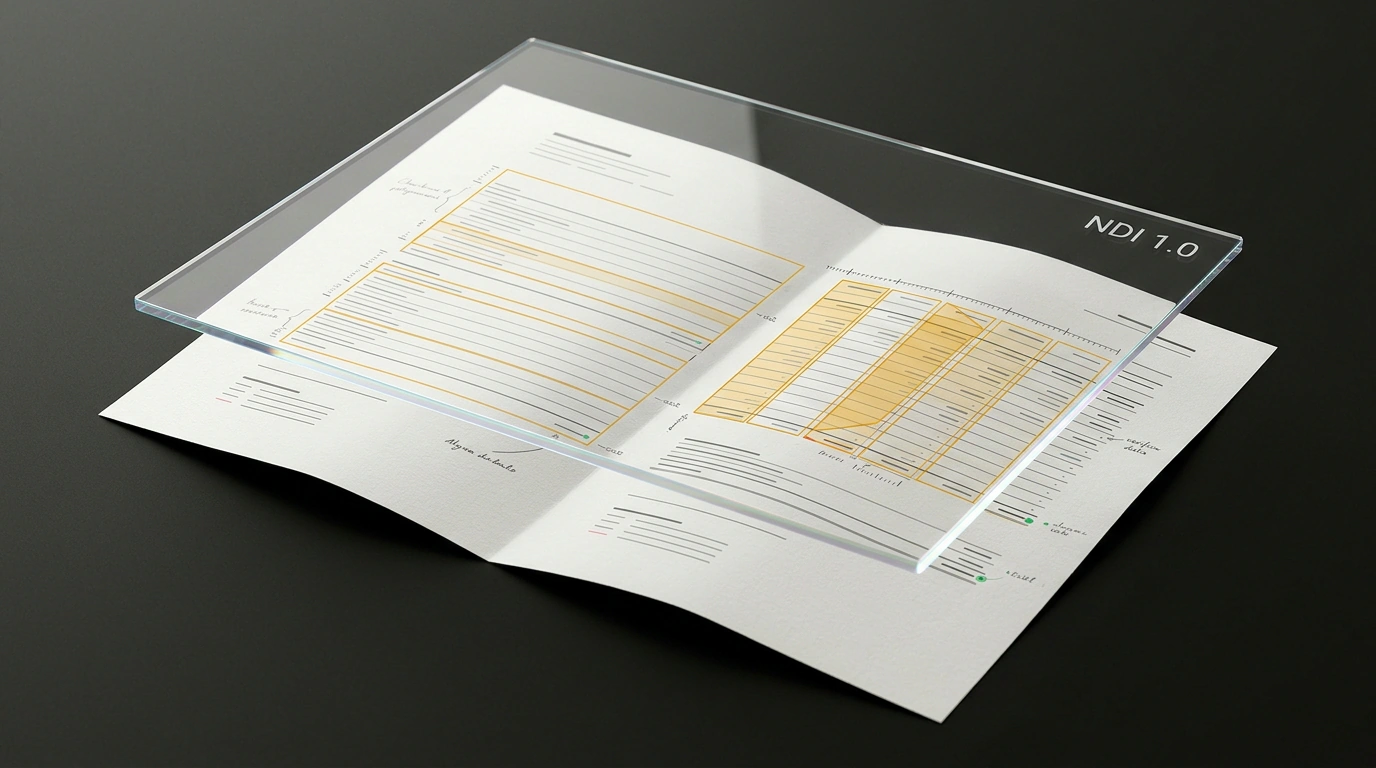
NDI 1.0 was designed from the ground up for document geometry. Instead of flat raster analysis, it aligns visual OCR tokens directly with layout structure. It doesn't just see pixels; it sees a mathematical grid of row coordinates, column borders, and logical nesting. That's why processing a page costs 10 times less than running heavy multimodal inference.
5-in-1 Architecture: How the Pipeline Works
NACE.AI engineers packed five practical tools into NDI 1.0 that previously required separate libraries:
- Parse: converts over 36 formats (PDFs, scans, TIFF, DOCX, Excel sheets, crumpled receipts) into clean structured Markdown while keeping nested tables intact.
- Split: if an accountant scans a contract, a delivery note, and an invoice into one PDF, NDI finds the boundaries and splits them into three separate documents.
- Classify: instantly identifies document types against an internal taxonomy without brittle regular expressions.
- Extract: pulls fields strictly matching a target JSON schema, honestly reporting status (
found,missing, orambiguous). - Ground: the most valuable feature for accountants and lawyers. Every extracted number includes exact polygon coordinates (Bounding Box) on the original scan page.
Parsing a Complex Customs Invoice
Imagine a scanned customs declaration with an addendum number handwritten in the margin and an item table spanning three pages. When you call NDI 1.0, it doesn't just return a JSON list of SKUs. It links every number to a physical box on the scan. In the web UI, an operator clicks a tax total, and the system highlights the exact line at the bottom of page two in yellow. Auditing takes seconds.
Integrating Into Agent Workflows via MCP
NDI 1.0 wasn't built as an isolated web app; it's an automation building block. It ships with its own ndi CLI utility and a ready-to-use Model Context Protocol (MCP) server. That means coding assistants in Claude Code or Cursor can call document parsing straight from their terminal like a native OS function.
Where are the limits? NDI 1.0 is a narrow specialist. You can't ask it to write marketing copy or debate philosophy. Also, on heavily degraded scans—like a page soaked in coffee or photographed in the dark at a 45-degree angle—handwritten digit accuracy drops. In those edge cases, the system flags ambiguous and routes the file to a human reviewer. For 95% of standard corporate paperwork, though, it's the exact missing link agent pipelines needed.