Admit it: you've tried giving an AI a prompt like 'Write a viral blog post about artificial intelligence.' What did you get back? Most likely, smooth, polished, completely lifeless text packed with clichés like 'AI is changing the game' and 'the future is already here.'
The problem isn't that modern models are dumb. It's trying to cram an entire editorial newsroom into one system prompt. When a single model hunts for news, brainstorms ideas, filters noise, fact-checks numbers, and writes the final draft all at once, it cuts corners and turns out generic filler.
Marketer Kieran Flanagan (SVP at HubSpot and co-host of Marketing Against The Grain) showed what a serious alternative to one-click copywriting looks like. Inside xAI's Grok Bot, he built an autonomous editorial board of five specialized bots. Each runs in an isolated context and follows strict external taste and editorial manifests.
Factory Architecture: Five Roles Without Cross-Noise
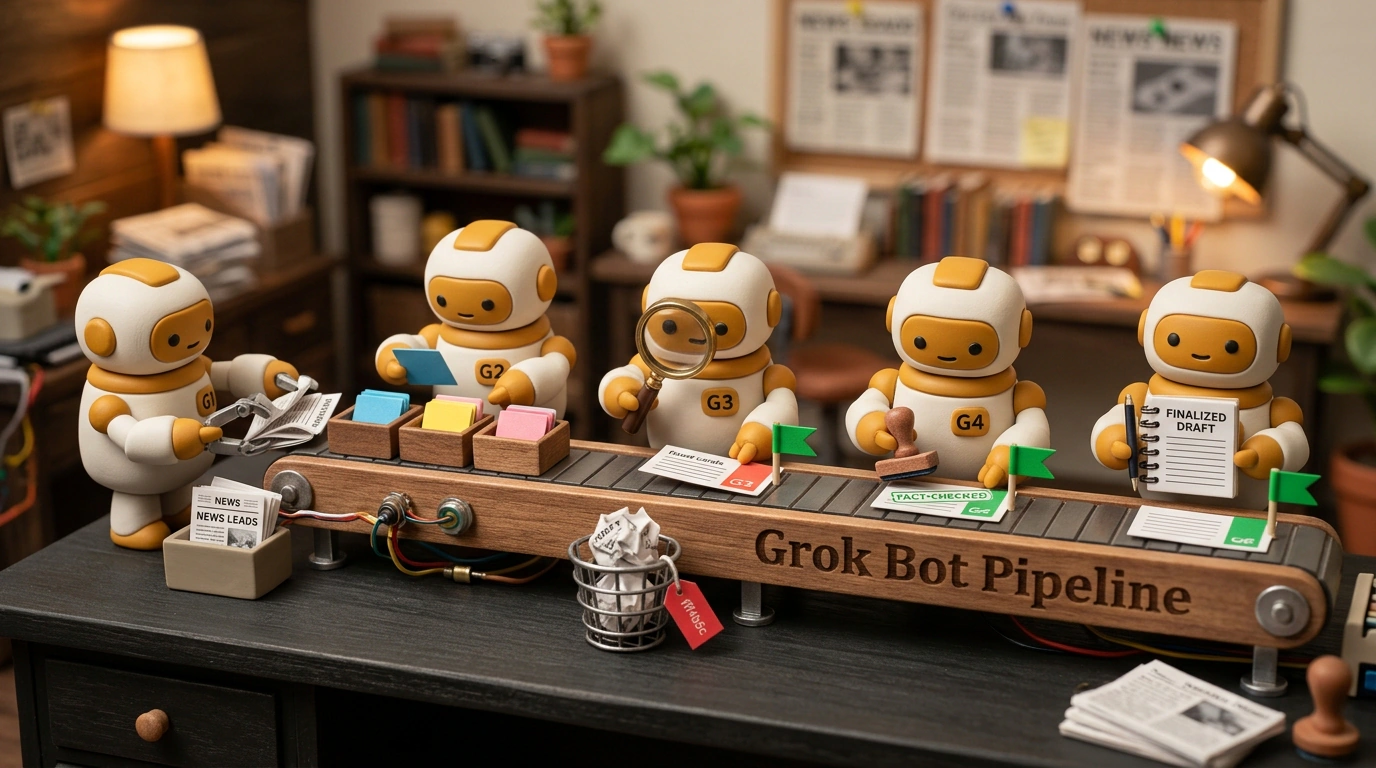
Grok Bot doesn't run agents as disposable chats. It runs them like digital employees on secure cloud VMs with their own filesystems, browsers, and terminals. The pipeline splits into five independent stages:
- Monitor Bot: scans a set list of industry YouTube channels, podcasts, and competitor blogs, pulling fresh transcripts and spotting emerging trends.
- Ideas Bot: takes the raw material and generates 10–15 draft post ideas, strictly following the
audience.mdtarget audience manifest. - Taste Bot: a critical gatekeeper. This bot invents nothing. It scores colleagues' ideas on a 10-point scale against the author's
creator.mdmanifest. Anything smelling like clickbait or rehashed truisms gets tossed. Only the top 1–2 ideas survive. - Research Bot: once an idea passes, this bot runs fact-checking. It connects to the Monid tool router, unlocking over 2,400 APIs—including Apify scrapers for Reddit and X, academic search, and stats databases—without juggling individual keys. To keep it from surfing paid APIs forever, there's a hard fuse: a $2 max budget per topic.
- Draft Bot: writes the final script or article, weaving the topic's logic together with the verified facts.
Calibration Manifests: Teaching Agents Your Taste
Instead of bloating system prompts into unreadable walls of text, Flanagan moved the rules into separate Markdown files at the root of the workspace.
Here is what the target audience calibration manifest looks like:
# Target Audience Manifest: AI Builders & Technical Founders

## Core Audience Profile
- **Who reads this**: Technical founders, CPOs, senior engineers, and agency leads.
- **Maturity level**: Can read code, have tested local models, and have hands-on deployment experience.

## What Builds Trust
- Concrete latency numbers (ms), token spend in dollars, and error tracebacks.
- Architectural trade-off breakdowns: why option X beats option Y.
- Ready-to-use config files, data schemas, and checklists.

## Instant Rejections (Editorial Ban List)
- Empty filler phrases: 'AI is changing the game,' 'the future is here,' 'incredible breakthrough.'
- Shallow 'Top 10 ChatGPT Prompts' listicles.
- Advice that omits API costs and edge-case limits.
And here is the key file—the author taste manifest that Taste Bot uses to filter out fluff:
# Creator Voice & Taste Manifest: Kipp & Kieran Style

## Our Editorial Focus
We don't chase one-day hype cycles. We only cover tools that can plug into a real business pipeline right now.

## Topic Scoring Filters for Taste Bot (1 to 10 Scale)
1. **Practical Reproducibility (40% weight)**: Can a subscriber deploy this in 30 minutes using our guide?
2. **Contrarian Angle (30% weight)**: Does it expose hidden flaws in a popular approach?
3. **Economic Impact (30% weight)**: Does it save real team hours or thousands of dollars in software?

## Taste Bot Output Format
For each reviewed idea, return:
- Title and hook;
- Taste Score (/ 10);
- Reason for rejection or approval citing the manifest rule.
The Verification Loop and Stopping Endless Debates
The smartest piece of this factory is the Research-Validates-The-Draft Loop. When Draft Bot finishes a piece, it doesn't go straight to publishing. It goes back to Research Bot, which checks every claim against the gathered facts. If the draft contains an unverified number or unsupported claim, the bot either finds a primary source or cuts the line.
There is one big risk here: if your critique thresholds are too strict, the bots will bounce the draft back and forth forever. That's why the pipeline enforces a hard rule: a maximum of two revision cycles. If disagreements remain after two rounds, the task goes to a human editor for review.