Do you know the single most common mistake people make when trying to 'bring AI into the business'? They try to automate an unstructured mess.
It usually goes like this: an excited founder or team lead opens Claude or ChatGPT, types a long, rambling prompt, gets back pretty but useless fluff, sighs, and says, 'It's just a toy—doing it by hand is faster.'
The issue isn't what agentic models can do. It's a lack of engineering discipline around processes. A model can't guess the gut calls you make, the unspoken rules you follow, or which steps in your workday actually drain most of your energy.
Entrepreneur Nick Saraev (founder of LeftClick, who has worked on contracts with Anthropic and OpenAI) ran a radical experiment. He handed his operational routine over to Claude Code and built a seven-step framework to turn chaos into repeatable automation.
Step 1. Uncompromising Screen Audits and Micro-Interviews
Automation doesn't start with code. It starts with capturing reality. A lightweight screen-capture script runs on your workstation, snapping a screenshot every 5 seconds (about 12 frames a minute) for an entire workweek.
Screenshots alone are blind, though—they show what you clicked, not why. So the script adds regular micro-interviews. Ten to fifteen times a day, Claude pops up in the terminal with short questions:
- 'What are you doing right now?'
- 'What exact problem are you solving in this interface?'
- 'Why did you pick that specific filter, table, or tool?'
- 'What decision did you make based on this data?'
The key safety rule here is local privacy filtering: banking apps, password managers, and personal chats must be masked automatically before any frame goes to analysis.
Step 2. Cataloging Hidden Routine
After a week of tracking, you have a detailed task log. That's usually when the realization hits: founders discover up to 40% of their time goes to micro-routine rather than strategy:
- manually searching profiles in LinkedIn Sales Navigator and running scrapers;
- deduplicating contact lists and verifying corporate emails;
- monitoring domain warm-up for cold outreach;
- sorting incoming leads and coordinating calendar slots.
To capture 'tacit knowledge'—the things you do on autopilot—Saraev uses voice dumping. You turn on a voice recorder and talk through the logic of every step for an hour, instead of painfully writing long SOPs in Notion.
Step 3. Architectural Design in MaxThinking Mode
The task log and voice transcripts go into a fresh Claude Code session with MaxThinking enabled. The model's job is to break each task into atomic steps, identify required external APIs, and design the pipeline architecture.
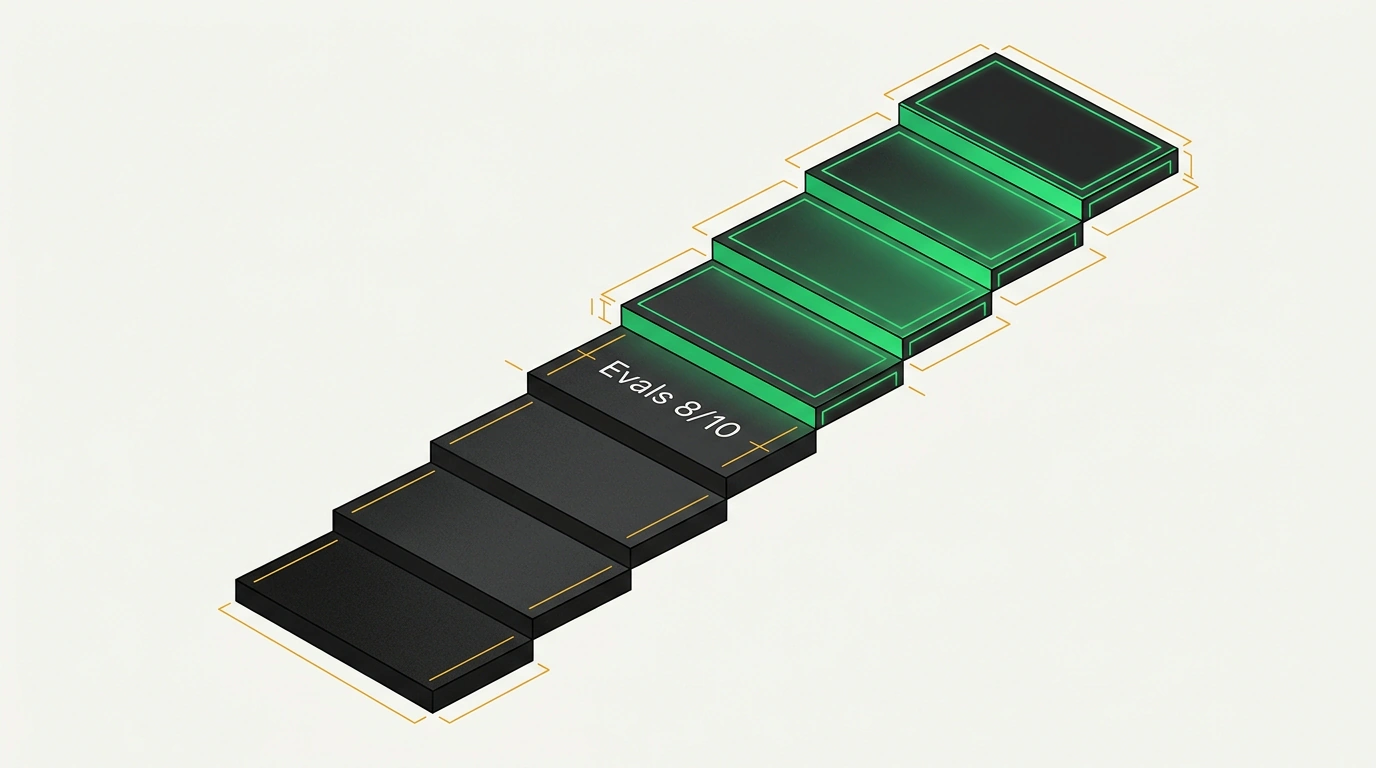
Step 4. Benchmarks and Evals: The Hard 8-out-of-10 Bar
This is the dividing line between hobby prompts and production tools. You never ship a workflow after one lucky terminal run.
Every scenario gets a test suite (Evals):
- The agent runs against 10 real input sets (such as 10 varied prospect profiles or 10 tricky incoming emails).
- A human reviews each run and scores it from 1 to 10.
- The iron threshold rule: if the average score is below 8 out of 10 (80%), the pipeline is rejected and sent back for better system instructions and edge-case handling. Only workflows that run reliably 8 times out of 10 earn trust.
Step 5. Compiling Into Permanent CLI Skills
Scenarios that clear the 8/10 bar don't stay as loose text. They are packaged as official Claude Code skills. From then on, any routine task runs via one short command with parameters, backed by filesystem, terminal, and network access.
Step 6. Batch Stress-Testing
Before trusting a skill with live data, you stress-test it against hundreds of edge cases: weird encodings, blank fields, broken links, and rare file formats. Whenever a script crashes, you catch and handle the exception.
Step 7. Scheduling and Clear Boundaries
The final step is running polished skills on a system schedule (cron). Here, it's vital to draw a hard line:
- Full AI Autonomy Zone: data scraping, email filtering, lead validation, system metric aggregation, and competitor monitoring.
- Untouchable Human Control Zone: live pricing negotiations, strategic calls with key clients, signing partner agreements, and resolving legal disputes.
This turns Claude Code from a trendy chatbot into a quiet operational backend, freeing up dozens of hours for the founder every week.