Picture the classic way people try to get into e-commerce: you take out a loan or empty your savings for half a million rubles, drive out to a major wholesaler or wait months for a shipping container from China, rent a damp storage unit on the edge of town, and stack it to the ceiling with cardboard boxes. One month passes, then two, then three. Half of those boxes are still gathering dust, your cash is frozen solid in dead stock, rent keeps chewing through your working capital, and you're sitting in the middle of it all frantically figuring out how to dump the leftover inventory just to break even.
You're probably thinking right now: "Well, how else can you do it? Selling physical goods always means a warehouse, boxes, and the risk of misjudging demand." For a long time, that felt like an ironclad rule. On top of that, a stubborn myth floats around among Avito beginners that selling on classifieds is a penny-ante race to the bottom where sellers claw each other's eyes out for a 200-ruble margin.
I decided to check how modern e-commerce on classifieds actually works under the hood. The trigger was a detailed practical breakdown from a field tour of Moscow's largest wholesale hub — the Yuzhnye Vorota market at the 19th kilometer of the Moscow Ring Road (MKAD) — led by classifieds expert Nikolay Toropov alongside active sellers, complex administrators, and logistics operators. What came out of it flips the usual assumptions upside down: when you pair trusted wholesale pavilions with an on-site fulfillment partner, you can pocket 1,000 to 20,000 rubles in net margin on every single order without keeping a single box at home or tying up a kopeck of working capital in inventory. Let's take this mechanism apart bolt by bolt.
Why a Traditional Warehouse Drags You Down — and How Yuzhnye Vorota Changes the Game
In traditional e-commerce, the biggest brake on scaling is the cash-flow crunch hiding inside unsold stock. When you buy a batch upfront, you're placing a blind bet. If a trend shifts, a season wraps up, or competitors bring in the same item for less, your money turns into dead weight. Renting even a modest heated storage space in Moscow or another major city runs tens of thousands of rubles a month, and hiring a warehouse worker to pack and ship orders immediately saddles your business with fixed overhead.
Avito has built a fundamentally different buying environment. Millions of people come here every day with immediate, high-intent demand: from weekend gardeners looking for a chainsaw or a set of cooking pots to construction crews that urgently need a 5 kW power generator on-site. And the buyer couldn't care less whether the item is sitting in your personal garage or shipping straight out of a wholesale terminal. They care about three things: a fair price, an accurate description, and fast delivery.
In that setup, the Yuzhnye Vorota market turns into a giant external warehouse of ready-to-ship goods. Thousands of wholesale pavilions across the complex already hold containers full of power tools, garden equipment, cookware, and travel gear. Wholesalers have zero interest in the retail hassle of dealing with one-off buyers on classifieds — their business runs on steady bulk turnover. So when a seller offers them regular single-unit pickups backed by confirmed orders, both sides win. In our breakdown of unit economics and migrating off marketplaces, we already saw how sellers are walking away from punishing FBO warehouse fees toward on-demand fulfillment, and on classifieds that model hits peak efficiency.
The Gears of the Model: How Seller, Wholesaler, and Fulfillment Fit Together
Many people confuse this setup with "wild" dropshipping, where a seller grabs a random contact from a messenger app, asks them to ship a parcel to a customer's name, and spends every day sweating that the supplier will pack the wrong color, forget the warranty card, or simply vanish offline. In the structured workflow at Yuzhnye Vorota, every gear turns by the book.
Isometric diagram and step-by-step pipeline linking seller, wholesaler, and fulfillment with quality checks and delivery.
Here is how the roles split across the chain:
- The wholesale supplier on the market floor: holds physical inventory in the hub's warehouses and releases single units at wholesale pricing to trusted partner logistics teams.
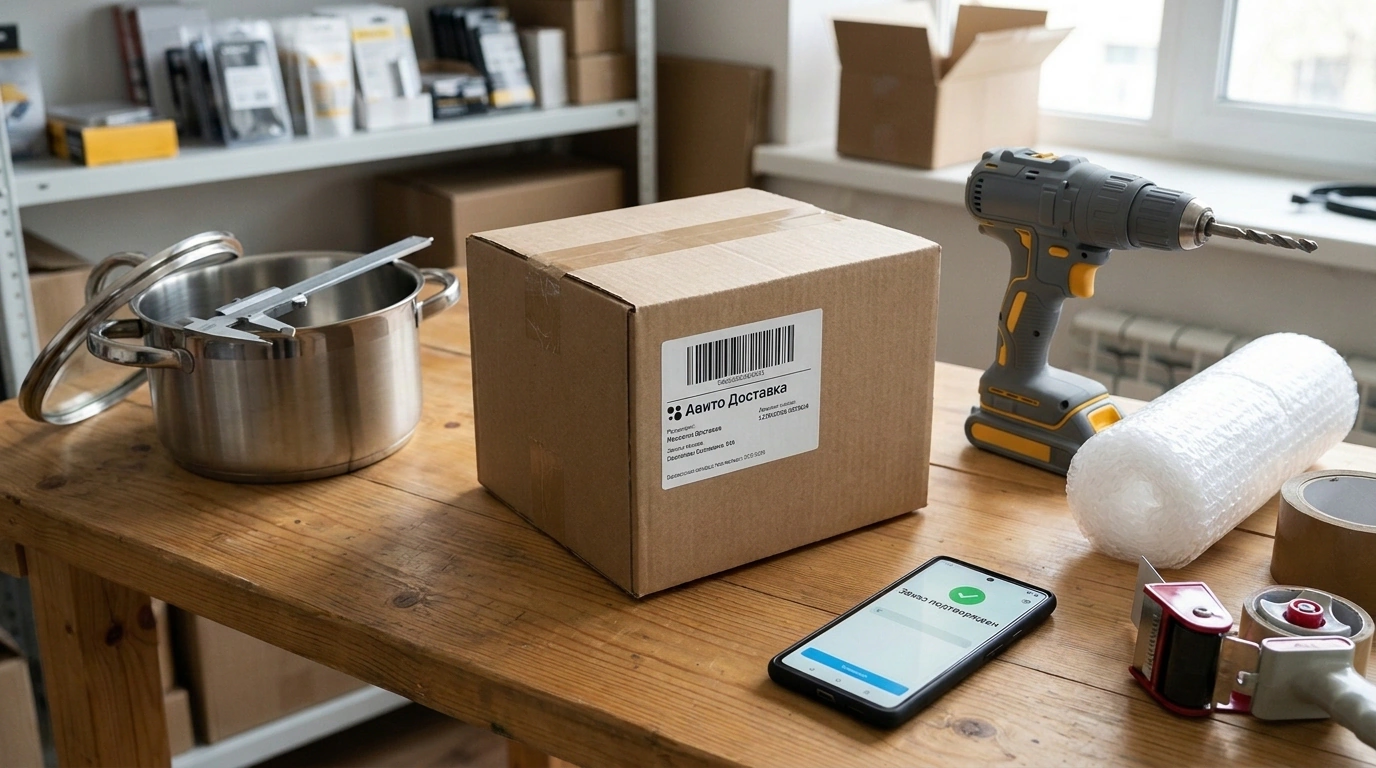
- The partner fulfillment operator inside the market: physically based right on the Yuzhnye Vorota grounds. Once the seller sends over the daily batch of confirmed orders, fulfillment staff walk to the right pavilion, buy the items using a small working deposit or post-payment arrangement, run an incoming quality check (verifying completeness, casing integrity, and no scratches), wrap each item in bubble wrap and a shipping box, apply the label, and hand the parcel off for delivery.
- Logistics channels (Avito Delivery and freight carriers): fulfillment dispatches packed boxes the same day to partner sorting centers (CDEK, Russian Post, Boxberry, DPD) or drops heavy, oversized orders at freight terminals like PEK and Baikal Service.
- You (the Avito seller): completely freed from physical logistics. Your job is analyzing demand, building high-converting listings, setting prices, chatting with buyers, and tracking orders from your phone.
You don't touch a single box, don't wait in line at pickup points, and don't risk getting stuck with unsold stock. If a niche catches fire, you scale your ad spend. If demand cools off, you pause the ads and pivot to another category in a single evening. In an earlier piece on how to find suppliers at Yuzhnye Vorota, we covered the first steps of single-unit sourcing; now let's put the exact numbers in specific niches under the X-ray.
X-Ray of Four Profitable Niches: From Stockpots to Power Generators
The #1 rookie mistake is picking niches by gut feel ("I like phone cases"). In warehouse-free e-commerce, you look strictly at absolute ruble margin, weight, dimensions, and year-round demand stability. Field research across the wholesale rows spotlighted four clear winners with transparent unit economics.
1. Stainless Steel Cookware and Kitchen Gear
Cookware is an evergreen workhorse. Quality stockpots with thick induction-ready capsule bottoms, sauté pans, and skillets are bought by home cooks, cottage owners, boutique hotels, diners, and coffee shops.
Let's look at the real numbers:
- Wholesale price at the market: a large stainless-steel pot with an induction bottom costs 620 rubles at the pavilion. Three-to-five-piece sets run 1,400 to 2,200 rubles.
- Retail price on Avito: a single pot sells for 2,000 to 3,000 rubles, while sets go for 4,500–7,000 rubles.
- Per-order unit economics:
- Sale price: 2,500 ₽.
- Supplier cost: 620 ₽.
- Fulfillment fee (pavilion pickup, inspection, bubble wrap, box, drop-off at pickup point): 250 ₽.
- Platform commission for a completed Avito Delivery order (7%): 175 ₽.
- Ad spend per sale: 200 ₽.
- Net profit on one pot: 1,255 rubles.
Let that sink in: that's over a 200% markup on wholesale cost. In one documented case from Toropov's tour, a participant posted a cookware set listing featuring a short video that proved the steel thickness with a magnet and a caliper — and pulled in 72 orders in a single 24-hour stretch. Under the old model, you would've broken your back taping up seventy boxes in your kitchen; with partner fulfillment, the entire batch went out to buyers without you lifting a finger.
2. Construction Power Tools and Garden Equipment
The tools category stays hot on Avito twelve months a year, driven by independent contractors, renovation crews, auto mechanics, and home garage tinkerers.
- Rotary hammers, impact drills, and cordless screwdrivers: reliable Chinese factory-built models (vetted replicas of well-known brands) wholesale at 900 to 1,300 rubles. On Avito they sell for 2,700 to 4,000 rubles, leaving 1,300 to 2,100 rubles in net profit per box.
- Cordless lawnmowers and string trimmers: a seasonal blockbuster from May through September. Mower kits with two 4–6 Ah lithium batteries wholesale at 4,500 to 7,000 rubles and sell on Avito for 11,000–14,500 rubles. Average net margin per sale sits around 5,000 rubles. Based on documented results from community members, sellers pull in up to 900,000 rubles in net profit over the spring-summer season on cordless mowers alone, moving roughly 180 units with moderate spend on automated ad strategies.
3. Power Generators: Gasoline and Diesel Units
This is heavy artillery with the highest ticket size. Demand spikes the moment autumn frosts and high winds knock out power lines in suburban settlements and dacha communities.
- Wholesale price at the market: a 3–5 kW gasoline generator (with copper alternator windings, wheel kit, and electric starter) runs 11,000 to 15,000 rubles wholesale.
- Retail price on Avito: at peak season these units move for 35,000–38,000 rubles.
- Per-order unit economics:
- Sale price: 38,000 ₽.
- Supplier cost: 14,000 ₽.
- Oversized pickup and palletized packing by fulfillment: 800 ₽.
- Inter-terminal freight shipping: 1,800 ₽.
- Paid listing promotion: 1,400 ₽.
- Net profit on one generator: up to 20,000 rubles. Close just five of those sales a month and you're pocketing 100,000 rubles net — while a 45-kilogram machine never spends a single second blocking your hallway.
4. Suitcases and Luggage Sets
Impact-resistant polypropylene suitcases on four dual rubberized 360-degree spinner wheels.
- The popular carry-on size (Size S / 20 inches) wholesales for 1,200–1,500 rubles and sells on Avito for 3,200–4,500 rubles.
- Nesting three-piece sets (S, M, L) cost 3,500–4,200 rubles wholesale and sell for 8,500–11,900 rubles. The huge logistics bonus: all three suitcases ship nested inside one box, keeping delivery costs low.
Listing Packaging and Buyer Psychology: The "Drive Your Neighbor Crazy" Hook and Real Photos
Even the fattest-margin product won't sell itself if the listing looks slapped together. Most beginners make one fatal blunder: they download sterile, airbrushed white-background renders straight from marketplace listings. Avito buyers spot that fakery immediately — a white-background render screams either spam reseller with slow shipping or an untrustworthy seller.
Here is what actually cuts through banner blindness and pulls in ready-to-buy leads:
- Real, hands-on product photography: shoot the rotary hammer on a wooden workbench next to a chunk of concrete, or snap the generator in the trunk of a station wagon in natural daylight. Real-world visuals deliver 2.5–3x higher click-through rates (CTR) than sterile 3D renders because the buyer sees a tangible physical object.
- Benefit callouts on slides two through four: add clean, readable badges highlighting key specs ("100% copper windings", "Two 48V batteries included", "Honest 12-month warranty"). That knocks out basic objections before the buyer even reads the description.
- Mandatory video: attach a short clip showing an unboxing, a metal-thickness measurement, or the engine running. Listings with video get a noticeable algorithmic boost in Avito search rankings.
- Punchy, emotional copy: ditch dry spec sheets. In Nikolay Toropov's case study for heavy-duty rotary hammers, a cheeky, dead-on hook — "Drive Your Neighbor Crazy" — crushed it. The description playfully noted that the drill punches straight through reinforced concrete walls in older apartment buildings on the first hit. People smiled, remembered the listing, and bought from him.
- Value-stacking freebies: "Order a trimmer today and get a reinforced spool of line plus safety goggles free." At the wholesale market that bundle costs you 100 rubles, while in the buyer's eyes the perceived value jumps dramatically.
- Chat response speed: remember the iron rule of classifieds — roughly 70% of buyers message three or four similar listings at once. Whoever replies within 2–5 minutes takes the deal. Set up quick-reply templates in Avito Pro so hot leads don't slip away while you're busy.
Paperwork, Chestny Znak, and Compliance: How Not to Get Banned
Running aboveboard is the only way to build a durable business instead of flinching at every moderation check. There are strict regulatory rules you need to know cold:
- Russia's Chestny Znak track-and-trace system: if you sell goods subject to mandatory serialization (clothing, footwear, perfume, bed linen, tires, certain electronics), you must have a registered sole proprietorship (IP) or LLC (OOO) connected to electronic document interchange (EDI). When selling via Avito Delivery, you are required to scan and retire the unique Data Matrix code in your Chestny Znak dashboard under "Remote Sale" the moment you hand the parcel to the carrier.
- Label-free starter niches: that's exactly why beginners have a much easier time starting in categories exempt from Chestny Znak codes — stainless cookware, hand and basic power tools, generators, and luggage. It cuts out heavy compliance overhead on day one.
- Certificates and declarations of conformity: for any electrical equipment running on 220V mains power (rotary hammers, circular saws, gas generators), suppliers at Yuzhnye Vorota are required to provide copies of valid certificates or declarations under Customs Union technical regulations (TR CU 004/2011 on low-voltage equipment safety and TR CU 020/2011 on electromagnetic compatibility). Request those scans from your wholesaler before publishing listings: Avito moderation runs periodic spot-checks on technical listings.
Avito Freight Delivery: Shipping Heavyweights Up to 200 kg
Compact parcels like cookware or suitcases are easy — they fit cleanly inside standard Avito Delivery limits. CDEK, Russian Post, Boxberry, and DPD drop-off points accept parcels up to 15–20 kg with combined dimensions (length + width + height) up to 200–250 cm and a longest side up to 120 cm.
But what if you're selling a 50 kg generator or a plate compactor? For a long time, sellers had to arrange off-platform shipping with buyers, losing trust and risking account bans for taking deals off Avito. Today, Avito runs an official Freight Delivery service in partnership with major carriers PEK and Baikal Service:
- Weight limit: accepts shipments up to 200 kg inclusive.
- Maximum dimensions: palletized cargo can measure up to 245 × 242 × 1,340 cm with a total volume up to 2.2 cubic meters.
- Doorstep courier pickup: when booking courier pickup, the weight limit is up to 120 kg.
- Insurance: maximum declared value under service rules is up to 150,000 rubles.
The key when creating a heavy-equipment listing is entering exact packaged dimensions and weight in the item specs. Avito's algorithm will then automatically offer out-of-region buyers delivery to their nearest freight terminal and calculate the exact inter-terminal shipping cost upfront.
Risk Management: Factory Defects, Morning Stock Checks, and Returns
Selling without a warehouse is an operational discipline, not a magic money button. Let the process drift and small cracks will sink the business. Here are the three core risks you need to manage every single day:
- Factory defect rate: in budget power tools and gas equipment, defect rates hover around 2–5%. The survival rule is simple: agree upfront with your Yuzhnye Vorota pavilion on unconditional same-day exchanges for defective units. Trusted suppliers swap out faulty items without argument as long as the item and box remain in sellable condition. Just in case, bake 3–5% of your retail price into unit economics as a warranty-claim reserve.
- Market stock checks: a wholesale hub moves fast. Regional bulk buyers can clean out a hot SKU in a single morning. Your fulfillment partner should run a daily stock check at your core pavilions by 10:00 AM. If an item sells out, you immediately pause the listing in Avito Pro or redirect incoming inquiries to a comparable model with similar specs.
- Refusals and returns on Avito Delivery: if a buyer arrives at the pickup point, inspects the item, and declines to take it, the parcel ships back to the origin point at no cost to the seller. Your fulfillment courier picks up the returned box, verifies intact seals and completeness, and puts the unit right back into active inventory for the next order.
Warehouse-free e-commerce on Avito isn't a fairy tale about passive income — it's a clean engineering process. You connect the massive inventory of a wholesale hub with the retail demand of millions of classifieds shoppers while stripping out the two biggest financial traps: warehouse rent and frozen working capital. Launch one working pipeline, run honest deal math, lock in a clear SOP with fulfillment — and watch how your business scales when every ruble you invest goes straight to work instead of collecting dust in cardboard boxes.