Anyone who has ever tried selling goods or services on Avito has run into the same frustrating scene. You put money into paid promotion, your phone buzzes with notifications, a short "How much?" lands in the chat, you honestly reply "85,000 rubles"—and the other person vanishes into thin air. No "thank you," no objections, no follow-up questions.
At that moment, most business owners and inexperienced managers throw up their hands: "Another difficult client, just wasting my time." Chat messaging starts to feel like a black-and-white lottery: either a person is ready to pay right now, or they just came to "browse." But if you look at sales through a practitioner's eyes, you realize: people don't buy complex goods and custom services in a single click. Behind every message is a real person with their own level of doubts and fears.
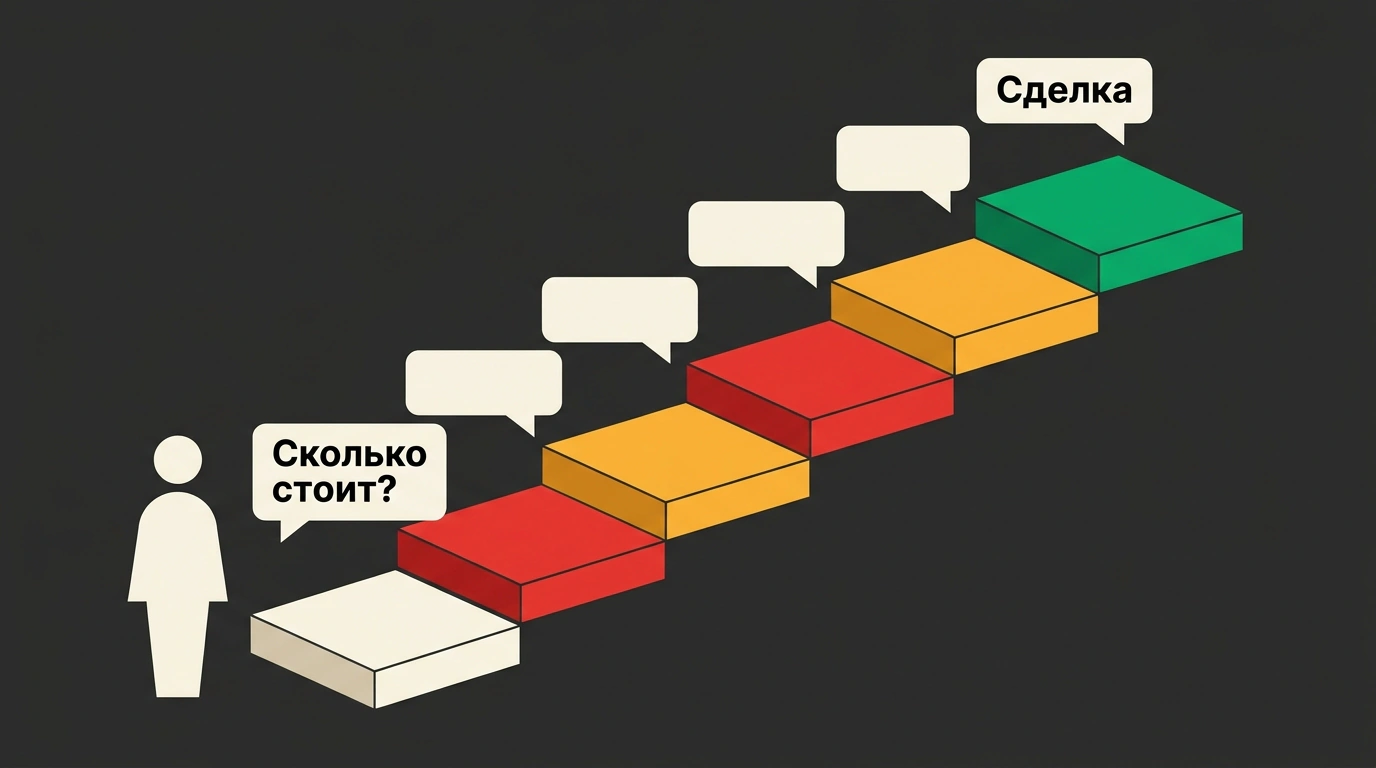
To stop burning ad budget and turn random conversations into closed deals, Avito specialists adapted a classic marketing model—Ben Hunt's awareness ladder. Let's break it down for Avito chats using a relatable everyday example: building a custom built-in wardrobe for a narrow hallway.
Six Buyer Levels: Why Clients Are "Just Looking"
The essence of the model is simple: every buyer goes through six consecutive stages of awareness before a deal. Your main job is to identify where the person is right now and gently move them one step forward, without trying to close the deal prematurely.
- Stage 1. Unaware of the problem. For years, a person trips over a pile of shoes in the corridor and hangs jackets on the back of a chair. To them, it's just the normal reality of a small apartment. There's no point trying to catch these people on Avito itself—they aren't looking for furniture yet. You hook them in external articles and videos with smart space-organization ideas.
- Stage 2. Problem aware, solution unknown. The family reaches a decision: "We need to do something about this mess." The person starts looking for options: wall shelves, plastic modules, or a wardrobe. At this stage, sending order links is useless: the buyer needs a clear map of alternatives for their dimensions and budget.
- Stage 3. Comparing solutions. This is where the main battle of formats unfolds. The family weighs whether to buy a ready-made standard wardrobe from a mass-market store or call a measurer for custom furniture. Pros of ready-made: delivered in two days and cheaper. Cons: gaps will remain in the niche and the ironing board won't fit. A custom wardrobe will fit millimeter for millimeter, but you'll have to wait for production and pay for an individual project.
- Stage 4. Choosing a specific provider. The person has decided: we're going custom. They open the Avito catalog and compare listings: "Why you specifically?" Here, real photos of completed orders (not 3D renders downloaded from the internet), a clear description of hardware, and a transparent work process make the difference.
- Stage 5. Doubts and checking terms. They like the option and the estimate is clear, but hidden fears kick in: "What if the measurer shows up and doubles the price?" "Will they scratch the wallpaper during installation?" The worst thing you can do here is frantically offer a discount. A discount doesn't cure distrust. What's needed here is a clear contract and a locked-in price.
- Stage 6. Ready to buy. All doubts are gone. The client writes: "Everything works for us, when can you come for measurements?" All that's left is to lock in the date and send the contract.
In our guide to a step-by-step sales funnel on Avito, we broke down end-to-end conversion from headline to phone call, and in chats, hitting the exact right rung of Hunt's ladder becomes the decisive factor.
The "How Much?" Trap: How to Reply Without Losing the Conversation
Let's go back to our main pain point. Why does answering with a blunt number kill the chat? Because the phrase "How much?" on Avito is written by people with completely different motivations.
If it's a client at Stage 3, they are simply pricing out the manufacturing approach itself. A quoted figure of 85,000 rubles without context seems huge to them compared to a ready-made 30,000-ruble wardrobe from a store, so they leave. Meanwhile, if the question comes from someone at Stage 6, they need exact estimate parameters.
Never reply with a bare number, and never send the buyer a five-question survey in a row. Your reply should follow the formula: "Approximate price range + one gentle qualifying question."
The right two-step reply script:
- Step 1. Give an honest price range: "Hello! A basic built-in wardrobe for these dimensions with mirrored doors and quality hardware comes out to roughly 45 to 65 thousand rubles, depending on the internal layout."
- Step 2. Ask one open-ended question to uncover criteria: "Could you tell me if you're planning the wardrobe for an existing niche or along a free wall?" or "What matters more to you right now: maximizing shelf space for boxes or keeping to a minimum budget?"
What a Live Chat Looks Like at Different Stages
Unsuccessful scenario (head-on pitch to a hesitant client): Buyer: "Hello, how much is the wardrobe in the photo?" Seller: "85,000 rubles. Shall we book a measurement?" Buyer: (seen and silence).
Constructive scenario (Hunt-based qualification): Buyer: "Hello, how much is the wardrobe in the photo?" Seller: "Good afternoon! This exact project with matte MDF fronts and soft-close hinges cost the client 78,000 rubles turnkey with installation. But the final estimate depends on the internal layout: a similar wardrobe can also be built for 50–55 thousand if you choose laminated chipboard. Do you already have approximate dimensions for the niche?" Buyer: "Yes, the width is about two meters, and we'd like a mirror and a compartment for a vacuum cleaner..."
Anatomy of a Listing: How to Hook Both the Hesitant and the Ready-to-Buy
Since people at Stages 3, 4, and 5 all land on the same listing, the card text should be built like a layer cake:
- Headline and first line (for Stages 3–4): a sharp focus on the task with no ad fluff. Not "Wardrobes super quality cheap," but "Custom Built-In Sliding Wardrobes to Individual Dimensions." In the first paragraph, immediately explain who it's for: "We design spacious wardrobes for narrow hallways while preserving usable walkway space."
- Specs and materials block (for Stage 4): a detailed breakdown of what's inside. Board thickness, whose hardware is used (with or without soft-close), and how long workshop production takes.
- Fear-removal block (for Stage 5): a guarantee that the estimate won't change. State it plainly: "Measurer visit with material samples. We lock the exact price in an official contract—no extra charges after installation."
- Clear call to action (for Stages 4–6): a simple and safe next step. "Send your approximate wall width and height in the chat—in 15 minutes I'll prepare a preliminary sketch and calculate two estimate options."
Auditing 20 Chats: Pinpointing Where Conversations Break Down
To stop guessing in the dark, run a simple audit of your chats once a month.
Verification method:
- Export a slice of the last 20 meaningful conversations (drop spam and empty clicks).
- Tag each chat: what question the client came in with and which stage of Hunt's ladder they were on.
- Mark the drop-off point: at which message the conversation died (scared off by price, manager was rude, sent a long questionnaire, didn't reply within 10 minutes).
- Change exactly one element in your reply script. For example, start giving a price range instead of a fixed sum.
- Measure the result on the next 20 chats using the formula: Measurement conversion = (Number of scheduled measurements ÷ Number of meaningful chats) × 100%
This deliberate approach turns a classifieds site from a generator of random leads into a manageable sales tool. You start hearing the buyer's real needs, save your nerves, and close deals with a high average ticket.