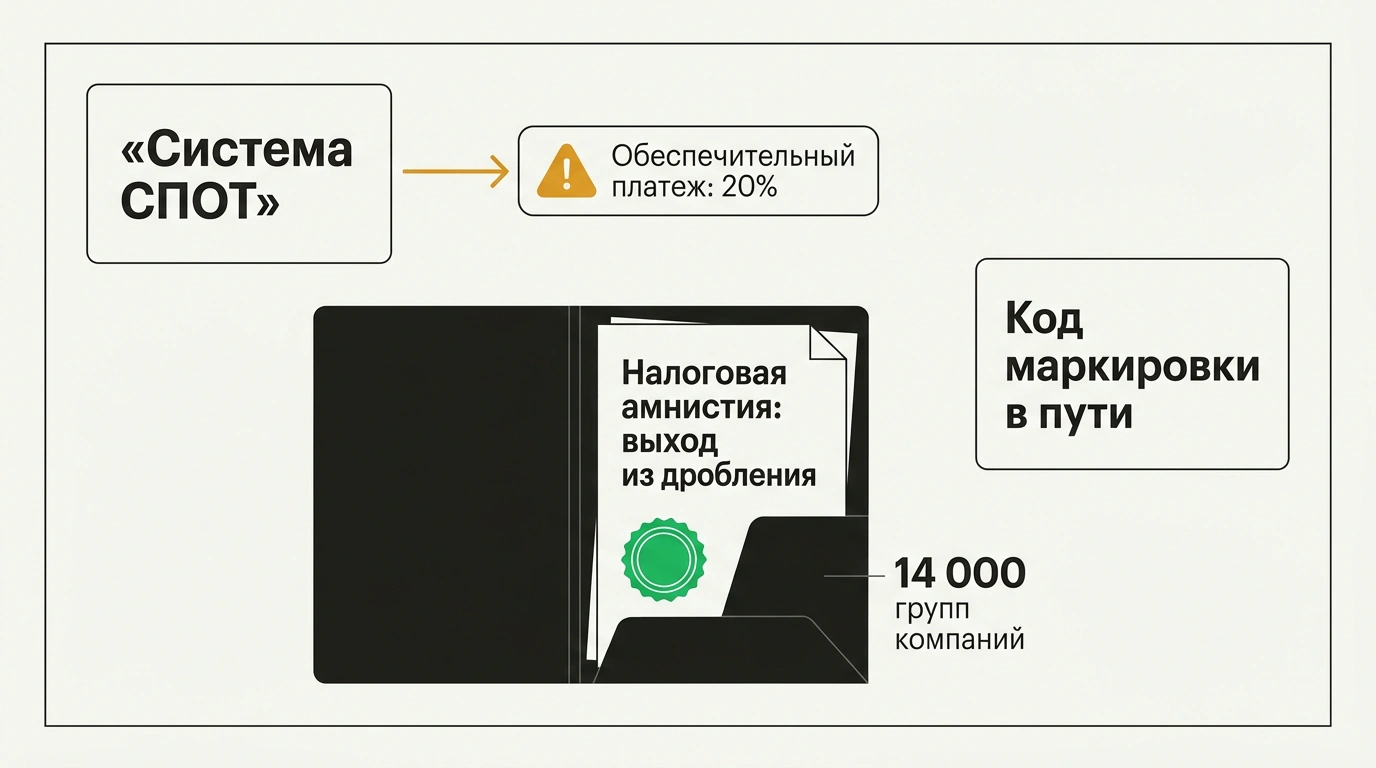
Digitalized state financial oversight at the end of 2026 is finally locking the Federal Tax Service (ФНС), customs, and the national digital marking system into a single seamless perimeter. While gray logistics schemes, under-invoiced EAEU border imports, or splitting a business across dozens of small sole proprietors on simplified taxation (УСН) could once fly under inspectors' radar for years, today cross-agency control algorithms flag anomalies automatically. Sellers and importers are having to rebuild document workflows on the fly: figuring out identification codes in waybills, hedging working capital against double customs deposits, and deciding how to exit tax-splitting schemes.
Marking in Transit
The Federal Tax Service detailed rules for recording marked goods in electronic shipping documents (ЭПД)—electronic bills of lading (ЭТрН) and waybills. Earlier, we analyzed the tightening of «Честный знак» rules, and now enforcement shifts directly to the physical transport of cargo between warehouses.
Key agency requirements:
- Shipping documents must now include the unique code of the state information system and the individual identification code of each transported product unit.
- If goods are subject to simultaneous tracking in multiple state registries (for instance, «Честный Знак» and the national import traceability system), system codes in the electronic file must be separated strictly by commas with no spaces.
- A line-multiplicity attribute applies to grouped pallets and boxes.
At the same time, tax authorities and security specialists are warning of a phishing wave ahead of the sales: scammers are sending fake emails posing as marketplaces, promising bonuses for filling out bills of lading in order to hijack dashboard sessions. On a brighter note for domestic manufacturers, an expanded list of complex radio-electronic equipment approved by Михаил Мишустин grants eligibility for preferential profit tax rates and reduced insurance contributions.
The СПОТ Customs System
To monitor road imports from Eurasian Economic Union countries (Kazakhstan, Kyrgyzstan, Armenia, Belarus), the Supply Expectation Confirmation System (СПОТ) has entered commercial operation. Here, importers face a serious financial trap.
How the system works:
- Before a truck physically crosses the border, the importer must generate an Upcoming Goods Delivery Document (ДОПП) in their dashboard.
- A security deposit covering estimated import VAT and excise duties—roughly 20–22% of the batch's total value—is paid into a dedicated personal account. Without a positive balance, the carrier will not receive the border clearance QR code.
- The trap springs on any technical correction. If a tractor breaks down en route, a driver changes, or a typo is found in the paperwork, regulations require canceling the old ДОПП and creating a new one.
- Upon creating the new ДОПП, the system automatically demands a second full security deposit!
Meanwhile, the first deposit is instantly frozen: getting it refunded to your bank account or offset via the unified tax account (ЕНС) is only possible after filing an indirect tax return and passing a 3-month desk audit. As a result, up to 40–44% of the cargo's value gets locked up, triggering a severe cash gap. ФНС is already drafting a corrective document form, but for now sellers must double-check every single letter in a ДОПП before the truck rolls out.
Exiting Business-Splitting Schemes
According to official ФНС России statistics, around 14,000 corporate groups—encompassing over 34,000 legal entities and individual entrepreneurs—have already used the voluntary tax amnesty for business splitting.
Industry breakdown confirms the scale:
- 38% of companies exiting the gray zone are in retail and wholesale trade (including marketplace sellers);
- 17% come from the construction sector;
- 12% are in warehouse and transport logistics.
Business consolidation has already brought over 23 billion rubles into the budget. Recall that the amnesty waives fines and penalties for 2022–2024 provided the business voluntarily transitions to the general tax system (ОСНО) or merges structures in 2025–2026.
To ease dialogue with auditors, a new pre-trial tax dispute resolution reform prepared by Минфин is set to help. Entrepreneurs will gain the legal right to participate in person or via video link during real-time inspector reviews of their objections, bring in independent mediators, and have complex cases heard by a three-officer panel under mandatory video recording. Meanwhile, the appeal filing window shrinks from 1 year to 3 months, though if a regional УФНС rejects the claim, businesses can go straight to commercial court.
The unified digital oversight perimeter no longer leaves loopholes for semi-legal operations. Today, safety and survival for marketplace businesses depend on an impeccable "white" paper trail: from the electronic code on a waybill to a transparent corporate structure free of artificial splitting.