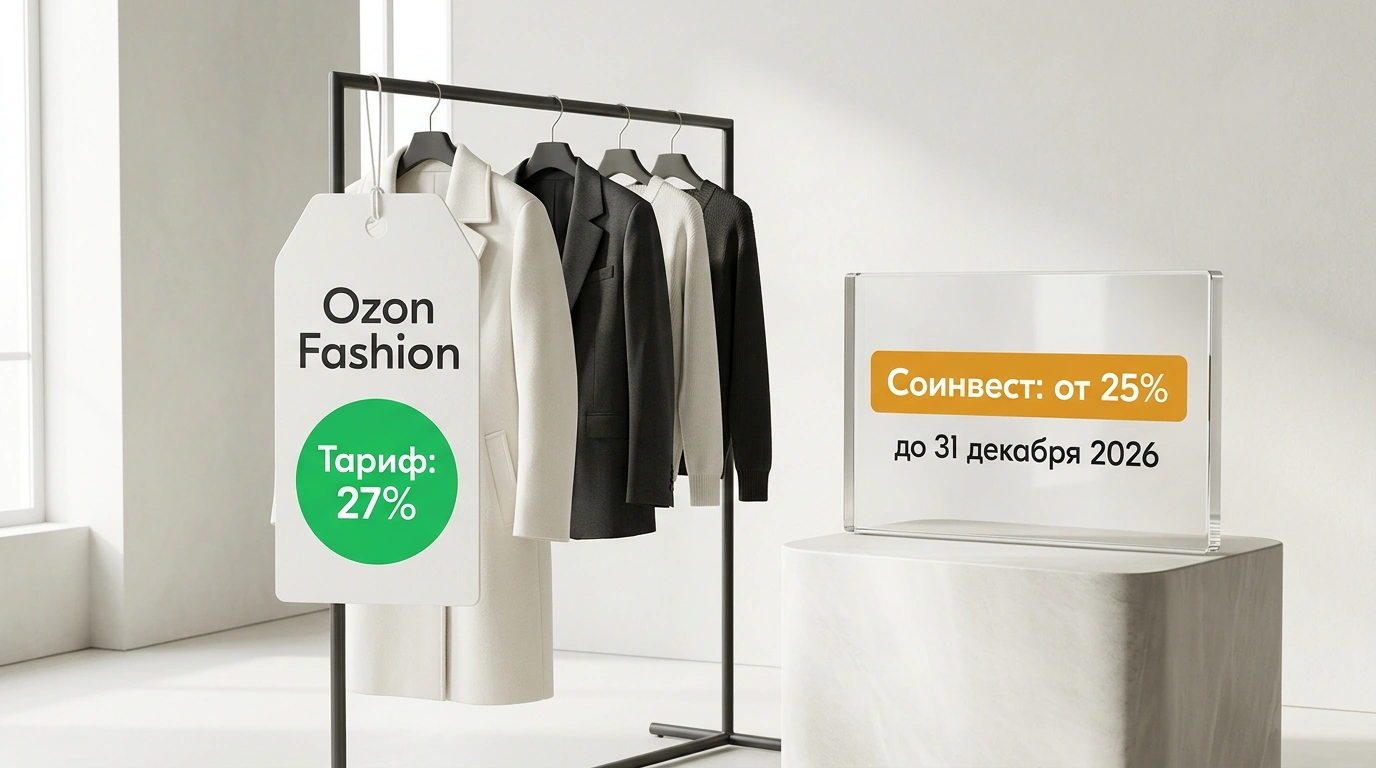
Whenever a marketplace promises to slash commissions while simultaneously paying a quarter of the item's price to shoppers out of its own pocket, any seasoned seller immediately looks for the fine print. Ozon has rolled out a major terms update for the Fashion category (clothing, footwear, accessories): the base sales commission is reduced to 27% locked until March 31, 2027, while the minimum guaranteed platform co-investment toward customer discounts is set at at least 25% through the end of 2026.
Earlier, we dissected Ozon's preferential 27% clothing commission and calculated step-by-step unit economics for clothing sales. The platform is fighting tooth and nail with Wildberries for fashion traffic and is ready to pour cash into the category. Let's break down the program mechanics piece by piece: who qualifies for the perks, how co-investment works, and why this generosity risks turning into a pricing hangover right after midnight on New Year's Eve.
Anatomy of the Mechanics: How Ozon Subsidizes Sales
The program targets two categories of sellers by tax ID (ИНН):
Newcomers: entrepreneurs who accepted the offer agreement after October 1, 2026 (onboarding runs on Thursdays).Returning sellers: those who had zero fashion sales across all brand accounts between September 1 and October 20, 2026.
Beyond the 27% commission, Ozon piled on a full package of logistics perks: free FBO warehouse storage for 365 days, free sorting of mixed boxes, zero cross-docking fees to Siberia and Kazakhstan, and the right to ship clothing directly through regular pickup points (ПВЗ).
The most interesting part, however, is co-investment. Co-investment is a shopper discount that Ozon subsidizes out of its own fee. Say you set a price of 2,000 rubles. Ozon gives the buyer a 25% discount at its own expense, the item sells for 1,500 rubles, and the marketplace compensates you for the difference in the form of "discount points," which offset commissions and services. Your revenue is calculated from your price minus 27%.
Analytics service MetricLab conducted a large-scale study of tens of thousands of fashion SKUs and uncovered clear patterns:
- The "Clothing" (89% of SKUs seeing higher discounts) and "Footwear" (79%) categories became the algorithm's clear favorites.
- Internal advertising helps: actively promoted products receive co-investment more consistently, though mechanically inflating ДРР does not increase the discount.
- If co-investment exceeds the 27% commission rate, Ozon effectively pays out of its own budget to sell your item, covering part of the logistics.
The January 1 Trap and Strict Restrictions
It sounds like a fairy tale, yet the devil—as always—is in the details and deadlines:
- Date mismatch. The reduced 27% commission is guaranteed through the end of March 2027, whereas the generous "at least 25%" co-investment is only promised through December 31, 2026. What happens on January 1? If the platform zeroes out co-investment, the storefront price for shoppers will instantly jump by a quarter, sending organic orders into a nosedive.
- Price index. If your price on Ozon turns out to be even a couple of rubles higher than on Wildberries or Яндекс Маркет, the algorithm automatically disables co-investment, leaving you alone with an overpriced listing.
- Exclusions. Sellers in the Ozon Селект pool are excluded from the program.
The preferential tariff and co-investment are an excellent springboard for capturing peak sales in November and December. Still, you need to calculate unit economics with a cool head—never baking a permanent 25% subsidy into your baseline 2027 financial model.