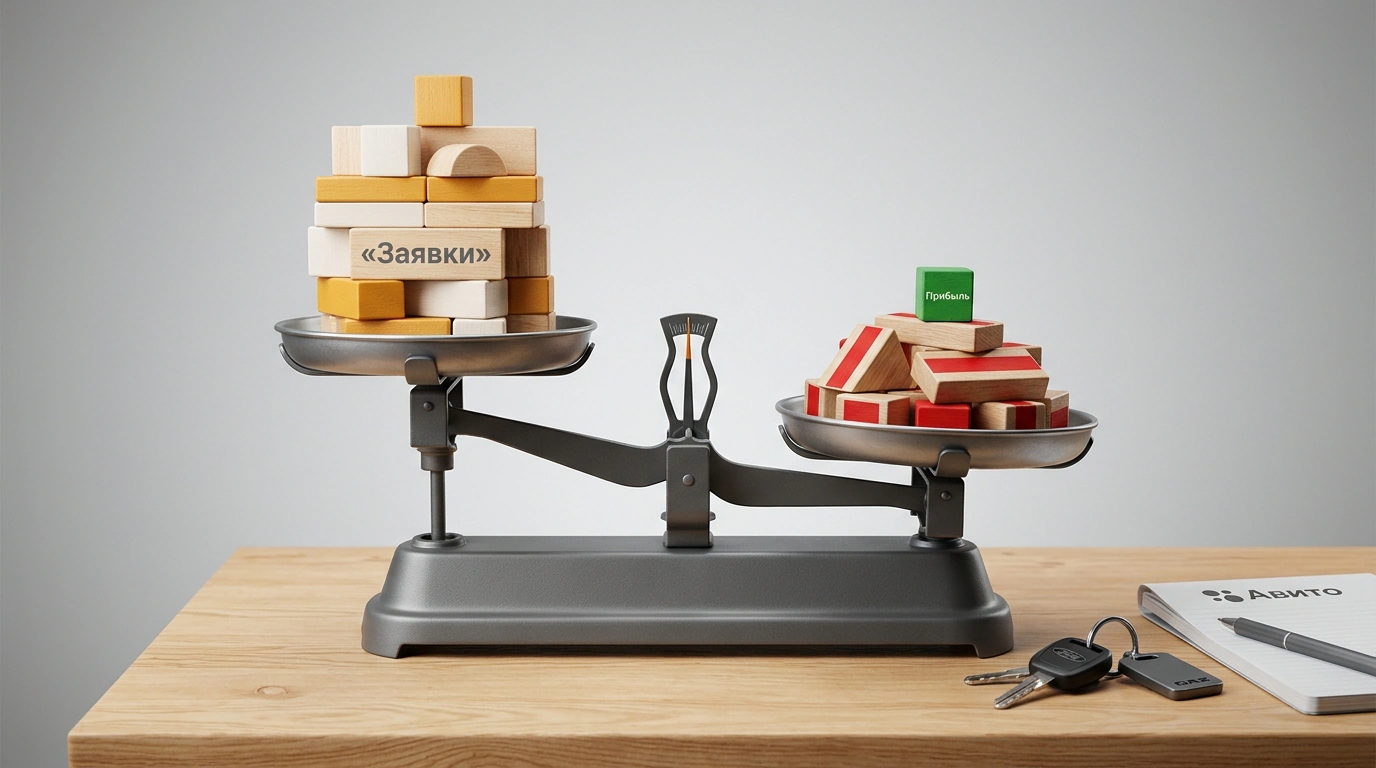
In local service businesses, a stubborn myth persists: the more calls ads generate, the richer the entrepreneur gets. The logic seems ironclad: "If a 12,000-ruble budget brought 40 leads and 23,000 rubles in net profit, let's pour 30,000 rubles into promotion, get 80 inquiries, and double our income!"
Inspired, the owner turns on paid Avito boosts with maximum multipliers, the phone rings off the hook, drivers race across town, revenue climbs... And at the end of the month, the owner opens their bank app and sees a measly 5,000 rubles in net profit. Meanwhile, vehicle wear is through the roof, staff are exhausted, and the business barely dodged a cash-flow gap.
This is a classic crisis of uncontrolled scaling. Let's break down a real case of a service company in Kazan (construction debris and old furniture removal) and calculate why blindly buying traffic without a strict filter kills profitability.
Month One: A Modest but Healthy Single-Truck Model
Initial setup of the Kazan business: one Gazelle truck (1.5 tons, 14 m³ cargo volume), a salaried driver-expediter, and hired loaders paid per job.
In the first month, Avito promotion was handled cautiously:
- Ad spend: 12,000 rubles.
- Incoming traffic: 40 inquiries (calls and Avito chats).
- Cost per lead (CPL): 300 rubles (12,000 / 40).
- Conversion to deal (CR): 50% (20 completed orders out of 40 leads).
- Customer acquisition cost (CAC): 600 rubles (12,000 / 20).
- Revenue: 130,000 rubles at an average ticket of 6,500 rubles.
Each trip consists of direct costs:
- Fuel: driving around Kazan plus a run to the Samosyrovo or Vostochny landfill—40–60 km per trip.
- Piece-rate pay for the driver and 1–2 loaders.
- Landfill waste disposal fee.
The average cost per trip was 3,800 rubles. 20 trips cost 76,000 rubles. Gross margin before fixed overhead: 130,000 − 76,000 = 54,000 rubles (2,700 rubles per trip).
Overhead (depreciation, minor repairs, phone/comms) ate up 19,000 rubles. Month-end bottom line: 54,000 − 12,000 (ads) − 19,000 (overhead) = 23,000 rubles in net profit.
The economics were healthy: ads took up 9.2% of revenue, and every ruble invested brought nearly two rubles in net profit. With a model like this, you understand how to allocate an ad budget across products on Avito: revenue calculation using shelving and retail fixtures based on actual operational capacity.
Month Two: The Illusion of Revenue Growth and Operating Profit Collapse
The owner decides to scale the flow. The Avito budget is increased 2.5x—to 30,000 rubles—by turning on X10 boosts and color highlighting.
On the surface, the plan worked: traffic doubled!
- Ad spend: 30,000 rubles (+150%).
- Number of leads: 80 inquiries (+100%).
- Cost per inquiry (CPL): rose to 375 rubles (+25%). The auction heated up, and impressions expanded to broad queries.
- Conversion to payment (CR): dropped from 50% to 37.5% (30 completed orders out of 80). A flood of calls came in from people wanting a single bag hauled away for 500 rubles or a cast-iron bathtub picked up for free.
- Customer acquisition cost (CAC): jumped from 600 to 1,000 rubles (+66.7%).
- Revenue: grew to 186,000 rubles (+43%).
However, the cost per trip climbed from 3,800 to 4,300 rubles (+13.1%). To close 30 orders, they took unprofitable calls, and the average ticket sagged from 6,500 to 6,200 rubles:
- Mileage stretched: the truck criss-crossed the entire city in traffic, racking up deadhead kilometers.
- Tough jobs rolled in: fifth-floor walk-ups (extra pay for loaders under heavy conditions) and loading delays.
- Direct costs for 30 orders totaled 129,000 rubles (30 × 4,300).
Gross margin before ads: 186,000 − 129,000 = 57,000 rubles (margin per trip fell from 2,700 to 1,900 rubles). Overhead rose to 22,000 rubles (tire wear, brake pad replacement).
Let's calculate net profit: 57,000 − 30,000 (ads) − 22,000 (overhead) = 5,000 rubles!
| Business Metric | Month 1 (Control) | Month 2 (Scale) | Change |
|---|---|---|---|
| Avito budget | 12,000 ₽ | 30,000 ₽ | +150% |
| Incoming leads | 40 | 80 | +100% |
| Completed orders | 20 | 30 | +50% |
| Conversion rate (CR) | 50.0% | 37.5% | -12.5 pp |
| Cost per lead (CPL) | 300 ₽ | 375 ₽ | +25% |
| Customer acquisition cost (CAC) | 600 ₽ | 1,000 ₽ | +66.7% |
| Average ticket | 6,500 ₽ | 6,200 ₽ | -4.6% |
| Cost per trip | 3,800 ₽ | 4,300 ₽ | +13.1% |
| Margin per trip | 2,700 ₽ | 1,900 ₽ | -29.6% |
| Revenue | 130,000 ₽ | 186,000 ₽ | +43.1% |
| Net profit | 23,000 ₽ | 5,000 ₽ | -78.3% |
The company worked harder and took home 4.6 times less cash. This is a textbook example of how revenue matched Telegram Ads spend: why the project is still in the red when the root issue lies in unit economics.
Two Major Traps: Cheap Leads vs. Expensive Trips
Two classic mistakes triggered in this case.
Trap #1: Evaluating by CPL Instead of CAC and Unit Margin The owner watched the lead price: it was 300 rubles, became 375. The difference looked modest. But if 50 out of 80 callers drop off when hearing the minimum order price, the real cost per closed deal (CAC) skyrockets. Such hidden budget leaks: where money goes in Avito promotion happen precisely because of chasing clicks.
Trap #2: Non-Linear Cost Growth Under Overload Revenue grew 43%, while direct costs jumped 70%. In physical services, costs do not scale linearly. While a truck makes 1–2 trips a day, routes are optimal. Trying to squeeze 3–4 trips out of a single Gazelle leads to traffic jams, idle time, and overtime pay. Every additional trip costs more than the last.
The Reboot Algorithm: Cutoff Threshold and High-Ticket Packages
To restore profitability, marketing was rebuilt:
- Cutoff threshold in the ad text: the first line stated: "Minimum dispatch — from 5,000 rubles (up to 1.5 tons / up to 10 m³). We do not dispatch for small bags." This immediately cut off junk traffic.
- Dispatcher qualification script: the first question to the caller—"What floor, is there an elevator, and what type of debris?". Carry-down surcharges were quoted strictly before dispatch, eliminating arguments on site.
- Packaged demolition upsell: the crew was positioned not just to load bags, but to tear down partitions, screed, and tile. The average ticket grew to 18,000–25,000 rubles on the same fuel spend.
- Focus on site foremen: repeat B2B clients in specific districts of Kazan shortened driving distances and kept the truck utilized on a schedule.
Avito ads generate profit when the listing filters out casual tire-kickers and attracts only those who bring high margin to your business.