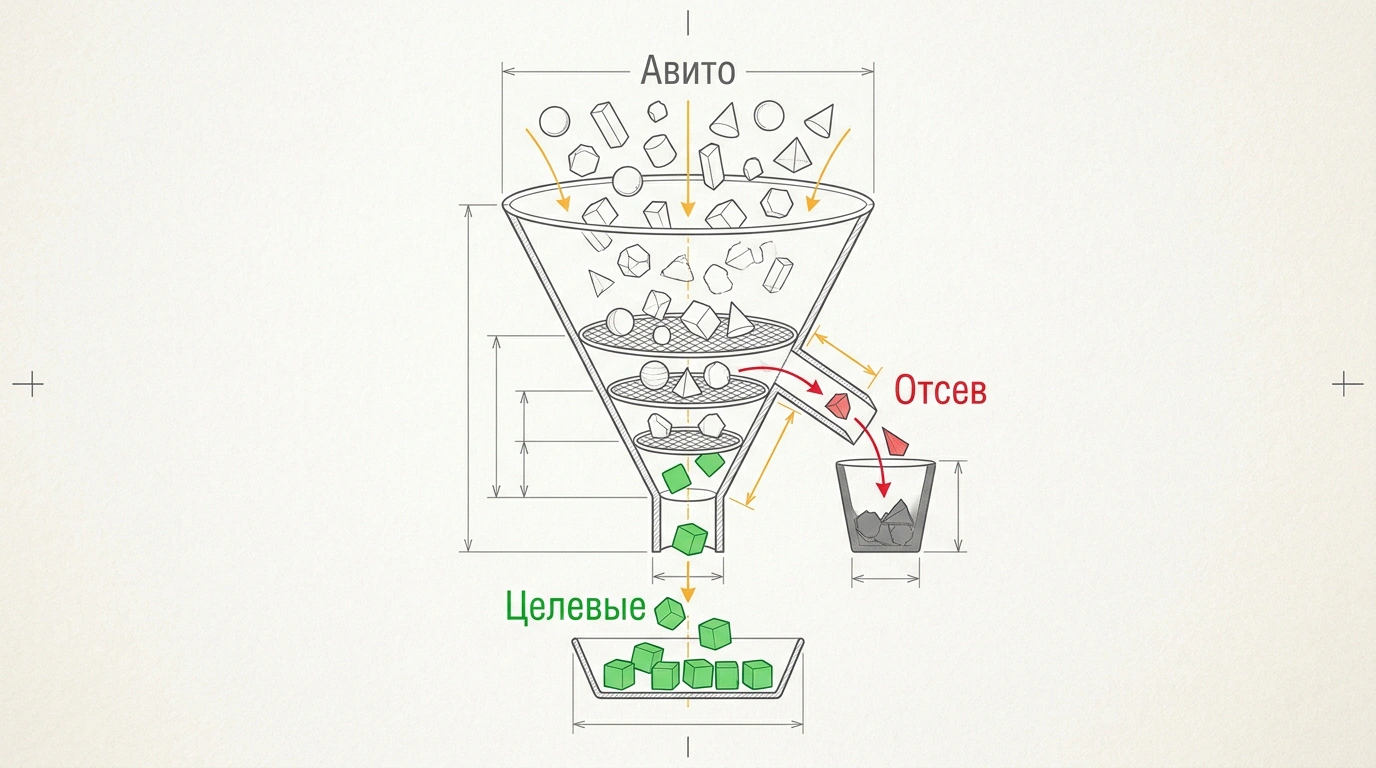
Among classifieds entrepreneurs, the phenomenon of "fake busyness" is common. The manager's phone rings non-stop, a hundred unread chats pile up on Avito, and the sales team works eight hours straight without a break. Yet when the owner reconciles the books at the end of the month, a paradox emerges: revenue is flat, and net profit is near zero.
The root of this problem is blind optimization of listings purely for click-through rate (CTR) and maximum volume of cheap contacts. A marketer boasts about a cheap 150-ruble lead without realizing that sales reps are burning work hours chatting with people who will never buy anything.
For ads to bring in money rather than empty hustle, a listing must act as a strict sieve, filtering out low-intent and casual visitors before they even hit the call button.
Four Barriers in the Listing: From Headline to Real Photos
Four structural barriers in a listing help build a proper Avito funnel:
- A specialized headline instead of generic labels Generic titles like "Apartment renovation," "Sofa," or "Freight transport" pull in all the junk search traffic, including people hunting for used items for pennies. A precise headline sets the segment right away: "Turnkey major apartment renovation by design project," "Orthopedic corner sofa in velour from factory," or "Construction debris removal to landfill / Gazelle 16 m³." The target client sees the solution to their problem, while a casual browser scrolls past.
- An honest price anchor instead of a dumping trick The most destructive mistake is putting a facade price of "5,000 rubles" on a service that actually costs 50,000. As a result, a rep spends twenty minutes clarifying details, quotes the real sum, and gets hit with fraud accusations and a negative review from an angry caller. State a real price anchor: the base rate per clear unit or minimum dispatch fee ("Crew dispatch — from 8,000 ₽"). And if your price is higher than competitors', spell out right in the description what it includes: formal contract, bank transfer with VAT, and a three-year factory warranty.
- Qualification terms in the description The listing text should work like an intake form. Clearly state your boundaries: "We work only with legal entities under contract from 50,000 ₽," "We service northern city districts and suburbs up to 30 km." Honestly stating who you do not work with weeds out non-target inquiries and earns respect from serious buyers.
- Real photos instead of stock images Idealized 3D renders and random internet pictures create false expectations. Real shots of an actual workshop, clean trucks, and neat technicians in branded uniforms convey reliability and scare off bargain hunters looking for "free service." Learn why companies lose clients from Avito: sales team sabotage, the "non-target leads" myth, and deal rules to eliminate friction between marketing and sales.
Automating the Filter: How a Chatbot Protects Sales Reps' Time
Even with a spotless description, some users refuse to read and immediately message: "How much?" To keep live reps from getting distracted, set up an auto-reply sequence:
- Qualifying auto-reply question: in the very first seconds of a chat, a bot sends a follow-up prompt: "Hello! To calculate an exact quote and check crew availability, please share: 1. What is your exact address and floor? 2. What is the scope and nature of the job?".
- Handoff to CRM: the conversation reaches a live operator only after the customer answers the qualifying questions and confirms they meet the minimum ticket.
According to the "Avito for Business" portal, introducing price anchors and qualifying auto-replies cuts empty chats by 40–60%. Managers stop acting as a free info desk and focus on paying orders. And to avoid losing qualified buyers, watch your response speed: check why Avito sellers lose deals: how chat response speed affects sales.