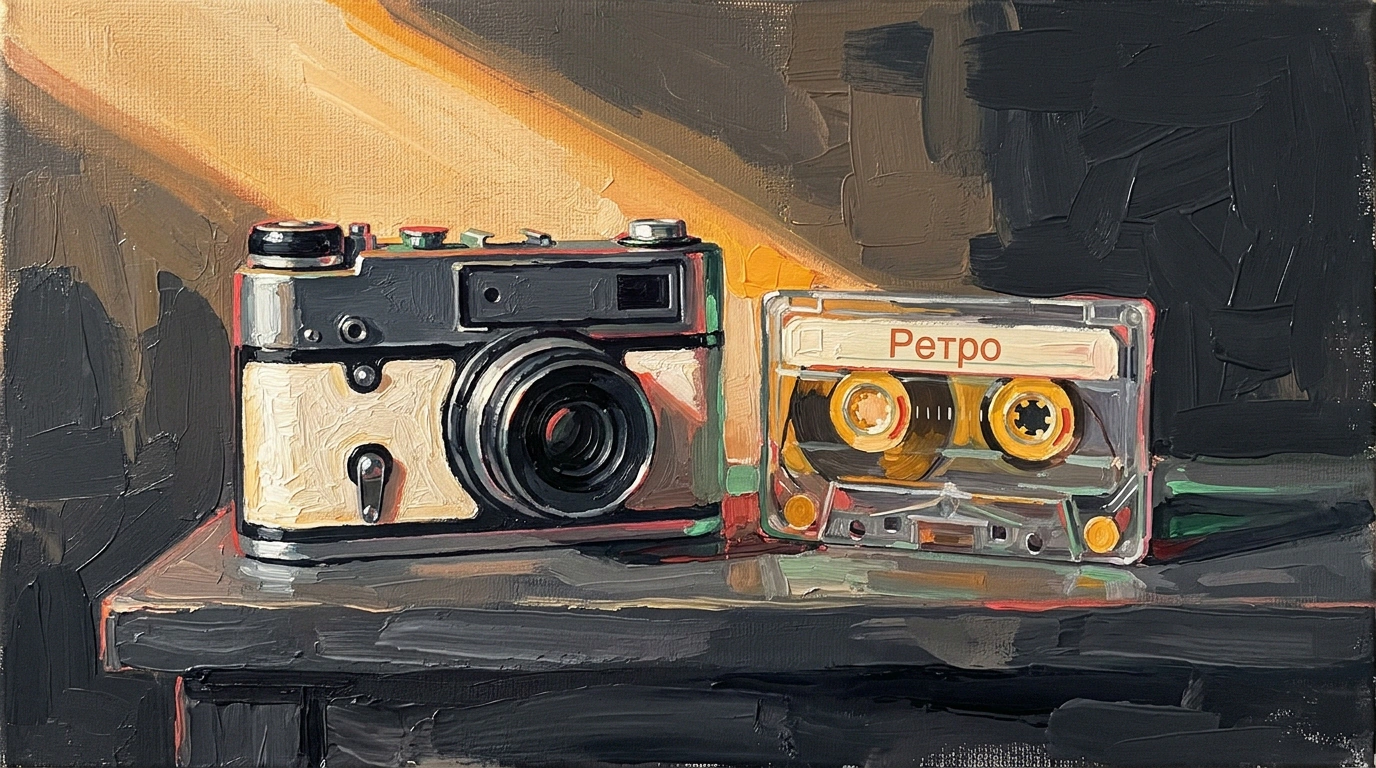
If you open popular social networks or step into youth clothing stores, you will notice a strange sight. Teenagers and twenty-somethings born deep into the era of high-speed internet and smartphones are buying up disposable film cameras, wearing baggy jeans from the year 2000, geeking out over pixel art, and playing music on vinyl turntables.
Marketers used to think nostalgia was the domain of older adults: supposedly, people only start longing for the past around forty, once the fatigue of adult life piles up. Yet today, the main sales driver in fashion, retail, and consumer goods has become so-called historical nostalgia, or anemoia—an acute emotional longing for eras a person physically never lived through.
This is not just an aesthetic fad among young people, but a powerhouse commercial tool. If a brand understands how the psychology of anemoia works, it can justify a premium price tag and build a loyal community practically out of thin air. Let's look at how this mechanism works from the inside.
The Anemoia Phenomenon: Why Gen Z Falls in Love with Someone Else's Childhood
A sociological survey by the analytical center Anketolog among 1,200 respondents over 18 reveals striking numbers:
- 29% of respondents regularly feel genuine nostalgia for times they never witnessed.
- 65% of consumers have at least once bought goods inspired by retro aesthetics or heritage brands.
- 56% of buyers explicitly stated they are willing to pay a price premium for a product that evokes a warm sense of nostalgia!
- 74% of respondents view the retro trend as a lasting long-term constant rather than a passing fad.
What pushes someone to spend money on memories of someone else's past? In the motivation breakdown, 64% cite warm images of family and childhood, 40% trust brands with a long history, 38% see exclusivity and authenticity in vintage, and 26% are drawn to the tactile design of the pre-digital era.
The psychological root of this phenomenon was detailed by researchers Neave, Freemantle, and Lappeman in a major 2026 study for the Journal of Consumer Marketing. A series of in-depth interviews with young consumers showed that behind the romanticization of the nineties and two-thousands lies exhaustion from digital noise. In a world of endless algorithmic feeds, screen time, and instant notifications, the younger generation subconsciously craves "slow time"—an era where things were physical, relationships were personal, and the future felt clear and safe. A similar search for tangibility shows up in clothing: see how Old Money style without the pretension: wardrobe basics, fit, and understated aesthetics draws young people away from loud disposable logos.
Academic Evidence: Why Nostalgia Sells
The impact of nostalgic triggers on sales moved beyond marketer intuition long ago. In a meta-analysis by researchers Cheng & Yan published in the International Journal of Advertising, scholars pooled results from 31 empirical experiments with a combined sample of 5,814 participants.
The study recorded a consistent statistical link between nostalgic context and ad persuasiveness (r = 0.19, p < 0.01). When an ad creative taps into warm historical imagery, the consumer's critical price barrier drops. People pay not for the utilitarian function of an item, but for the emotional experience of cultural belonging.
At the same time, the meta-analysis uncovered an important boundary: the effect peaks when a product targets hedonic consumption (food, drinks, apparel, entertainment, gifts) and connects to the buyer's self-identity. In utilitarian B2B procurement of rebar or accounting software, nostalgia is powerless, whereas in consumer marketing it works wonders.
Three Brand Strategies: From the New Coke Flop to Pokémon's 30th Anniversary
To put nostalgia to work in business, slapping on a pixelated logo isn't enough. Leading global and Russian brands use three fundamentally different memory strategies.
1. Reinventing a historical flop: the New Coke case In 1985, Coca-Cola made one of the biggest blunders in marketing history: it changed its classic formula and launched New Coke. Furious Americans protested and boycotted stores, and after 79 days the product was pulled amid scandal. 34 years later, in 2019, marketers turned that disgrace into a cult triumph. In a collaboration with Netflix ahead of Stranger Things Season 3 (set in the summer of 1985 at Starcourt Mall), Coca-Cola released a limited collector's batch of New Coke. Viewers—most of whom weren't even born in 1985—sold out the batch within hours at collector merch prices. A historic failure became an icon of an era.
2. Cross-generational platform: Pokémon's anniversary In 2026, the Pokémon media franchise turned 30. Its audience spans ages 7 to 45: some started on the handheld Game Boy in 1996, others watched the anime on TV, and Gen Z discovered pocket monsters via mobile Pokémon GO in 2016. The brand launched the "What's Your Favourite?" platform. Instead of forcing a single nostalgic image, the company aired a Super Bowl LX spot featuring global stars (Lady Gaga, Charles Leclerc, Trevor Noah, Jisoo, Lamine Yamal) reminiscing about their favorite characters. Sold-out Night Out electronic festivals followed at California's Intuit Dome and London's O2 Arena. The brand built a platform where every generation found its own slice of nostalgia.
3. Reviving a local FMCG brand: the Beseda tea case The Russian experience is instructive too. In 2023, the United Tea Company relaunched the legendary 1990s brand—Beseda tea with its Domovoy mascot. Marketers executed a deep upgrade: ditching cheap round stringless tea bags, switching to a quality blend in dual-chamber filter bags, and entering the mid-price segment. Starting on marketplaces backed by organic reviews ("that exact tea from childhood at the dacha"), the brand entered federal retail chains. The result: in the first half of 2025, brand sales grew 23% year-over-year without costly TV budgets—purely on trust equity in a familiar cultural code. Recall how the era of powdered drinks and margarine: scientific and marketing lessons from 90s brands was built to appreciate the power of consumer memory.
Practical Framework: Integrating Retro Triggers Without Fakery
If you want to weave nostalgia into your product, follow three core rules:
- Authenticity of the physical medium: Young people's nostalgia is deeply tactile. Gen Z is captivated by tangible qualities: the texture of kraft paper, vinyl gloss, the mechanical click of buttons, the rustle of an audio cassette. Use these textures in packaging and storefront design. If you are building independent sales, study the shift to your own website instead of a marketplace: how brands reclaim independence and rebuild sales.
- Modern service under a retro wrapper: Shoppers want the aesthetics of the past, but demand instant modern convenience: 30-minute delivery, one-tap smartphone checkout, and flawless service. The wrapper can be vintage, but the engine inside must be high-tech.
- Guard against cheap props: Mechanically slapping Soviet fonts or American slogans onto a random product only irritates buyers. Nostalgia must grow organically out of the brand's story or align with a real cultural tradition of your audience.
Anemoia proves that in an age of digital overload, people gravitate toward tangible emotions and predictability. Give customers a way to touch a warm myth of the past, back it up with impeccable modern quality, and they will gladly stay with your brand for years to come.