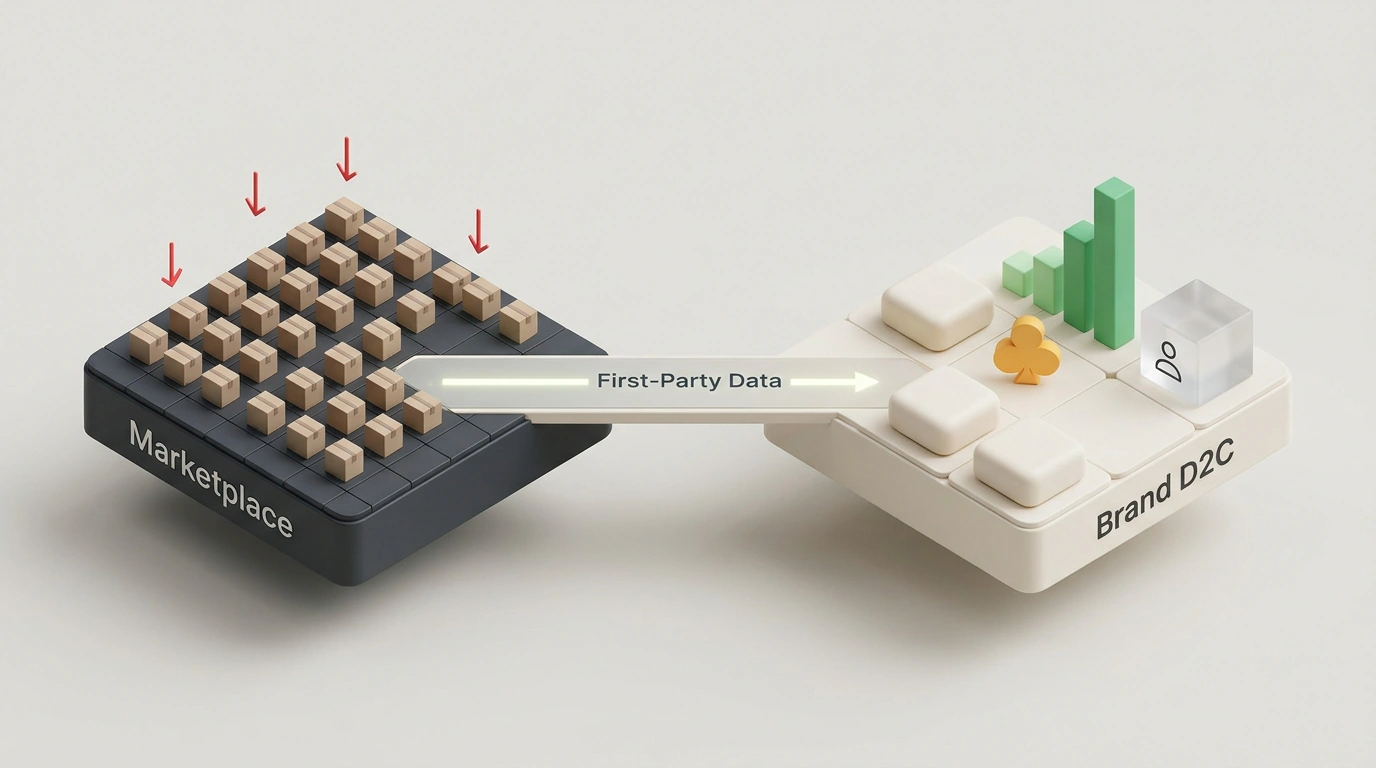
If you've been in Russian e-commerce for at least the last three or four years, you remember the golden boom years. Marketplaces were growing like weeds, fulfillment warehouses were opening by the hundreds, and the playbook looked embarrassingly simple: find a fast-moving product, ship boxes to FBO (Fulfillment by Operator), slap on a slim markup, seed your first twenty reviews—and let platform algorithms carry you on a wave of organic traffic straight to multi-million-ruble turnover. It felt like standalone online stores were dead for good. Why bother building a website, wiring up end-to-end analytics, fighting for form conversions, and bidding in overheated search auctions when a marketplace hands you a crowd of millions with bank cards already linked?
Then in 2025–2026, the music abruptly stopped—and left everyone with a brutal hangover. Industry data shows Russia's e-commerce market growth slowed to 24% in 2025, its lowest pace in eight years. Even the giants—Wildberries, Ozon, and Yandex Market—posted combined sales growth of 25–32.2%, down 24–28 percentage points from prior years. Shoppers stopped buying indiscriminately, inflation squeezed household budgets, and platforms trying to protect shareholder margins systematically tightened the screws on sellers.
The backlash was inevitable: a tectonic shift swept through the market. In 2025 alone, more than 46,000 new independent online stores launched in Russia, pushing the total number of active .ru sites with working shopping carts past 190,000. In the second half of 2026, business demand for launching autonomous D2C storefronts jumped another 1.5x. Founders suddenly realized that single-channel dependence on marketplaces no longer delivers net profit—and huge top-line GMV in reports often masks a rapid drain on working capital.
Let's skip the corporate fluff, dissect this crisis, run the honest unit economics of an independent store, and map out a hybrid system that gives your brand back control over both customers and cash.
The Gold-Mine Illusion: How Marketplaces Became a Margin Black Hole
To understand why sellers are rushing to spin up their own servers and build landing pages, look soberly at what a marketplace actually is. At launch, platforms acted like generous dealers: handing out free traffic, subsidizing discounts out of pocket, opening pickup points (PVZs) in every apartment block, and luring merchants with near-zero fees. Sellers got comfortable, forgot how to build their own sales funnels, and handed their entire operation over to someone else's ecosystem.
Once marketplaces captured critical retail market share, the rules flipped overnight. From welcoming storefronts, they turned into feudal monopolies with rigid terms where you own nothing:
- Someone else's customers: a shopper who buys from your listing doesn't know your brand. To them, it's "an Ozon order" or "a Wildberries buy." You don't get their phone number, can't message them, and can't send a personalized email. The marketplace walls off the buyer and monopolizes the data.
- Algorithmic terror: your SKU sat in the category top 3 for years? One overnight search update or a penalty for a two-hour shipment delay sends your listing to page 40, while warehouses keep billing you for paid storage.
- Dumping traps: platforms routinely auto-enroll listings in discounts and hit sellers with an ultimatum—join the forced promo and sell at zero or negative margin, or get buried in search and vanish from sight.
Before long, the business lands in a classic cash-flow crunch: revenue grows, warehouses sit packed with millions in inventory, staff scramble to pack boxes—and at month-end there isn't even enough cash in the bank to cover taxes. As we saw when examining the customer retention crisis in e-commerce, the market no longer forgives neglecting your customer base.
Anatomy of the Fee Squeeze: Where 45–55% of Your Retail Price Goes
Let's look at the hard numbers marketplace gurus conveniently leave off their webinar slides. How much does a universal marketplace actually take today?
Independent research from AdIndex and 2026 seller benchmarks paint a sobering picture: total platform deductions now eat 45% to 55% of the retail shelf price. Here is where half your ticket disappears:
- Base category commission: depending on the niche, it has climbed to 15–25% of item price.
- Linehaul and last-mile logistics: shipping from sorting centers to final pickup points (PVZs), plus inter-warehouse transfers.
- Paid receiving and storage: every day a box sits in a warehouse ticks up a fee that turns into a heavy anchor whenever turnover slows.
- Reverse logistics and returns: if a shopper orders five pairs of shoes or three dress sizes and keeps one, the seller pays two-way shipping on all five items. Denis Tsarev, CEO of Morizo (E-Promo Group), shares a telling client case in fashion: return rates on marketplaces consistently exceed 40%, while on the exact same brand's own website, returns sit below 10%. On marketplaces, shoppers click impulsively—and sellers foot the bill for the fitting room.
- Acquiring and payment processing fees: hidden percentage slices on every customer transaction.
- Mandatory internal ads: the biggest trap of the past two years. Organic search on marketplaces is effectively dead. The top 10–15 slots in search and category pages are reserved for paid placements (promoted cards, shelf auctions, boosts). If you don't feed the platform 10–15% of revenue for internal ads, your sales drop to zero.
The math is brutal: a seller moving a 3,000-ruble product hands 1,350 to 1,650 rubles to the marketplace just for shelf space and delivery. Subtract COGS, payroll, and taxes from what's left, and net profit shrinks to a laughable 3–5%—turning your business into a charity for the platform. In our look at strategies for launching your own online store, experts agree across the board: a single-channel marketplace model is doomed.
Global Playbooks: Why D2C Wins in the US and Stalls in Asia
It's worth seeing how this tension between storefront and manufacturer played out globally. Two opposite digital retail paradigms emerged.
The US Model (D2C-Centric): In the US, brands never handed the entire market to Amazon. Shopify became the flagship of merchant independence, evolving into a massive distributed infrastructure for standalone brands. In 2025, total GMV across Shopify merchants hit an astonishing $378 billion—capturing over 14% of all US e-commerce. American shoppers are used to buying straight from brands they love, valuing authenticity, extended warranties, and VIP perks.
Better yet, US D2C brands led the circular economy wave: by 2025, 153 fashion brands had launched built-in Resale sections on their own sites—up 325% from 2021—drawing conscious buyers and keeping them inside their own domains for years.
The Asian Model (Platform-Centric): In China, the opposite happened: four giants—Alibaba, JD.com, Douyin, and Pinduoduo—concentrated nearly 90% of all online retail value by 2024. There, e-commerce fused seamlessly with entertainment, 24/7 influencer livestreams, and viral social mechanics inside super-apps. Running an independent standalone site makes little sense for a Chinese brand when all traffic circulates inside social and livestream ecosystems.
Europe's Middle Ground and Russia's Reality: Europe historically leaned on direct sales through local brand websites, though marketplaces have steadily gained ground, now accounting for 60.8% of retail turnover and up to 70% of cross-border trade.
Where does Russia stand in 2026? Our market started on the Asian path of hyper-concentration around Wildberries and Ozon. No independent brand has the resources to build tens of thousands of its own fitting-room pickup points on every corner. Yet as monopoly fees crossed every reasonable threshold, Russian brands began carving out their own model: hybrid omnichannel.
Hybrid Funnel Architecture: Marketplace as Showcase, Website as Private Club
The biggest strategic mistake founders make out of frustration with rising fees is slamming the door, deleting marketplace listings, and burning bridges. That's pure suicide.
Vera Miroshnichenko, former Head of E-commerce for Kalinov Rodnik and Nadoba, puts it crisply: "A marketplace is a display window in a giant, noisy supermarket where people go to compare prices and grab everyday essentials. A brand's own website is a private club for people who have already chosen you."
Mature marketing isn't about waging a pointless war between channels—it's about assigning each channel the job it does best:
- Marketplace — Top of Funnel (Lead Generation & Trial): The platform excels at first touch and low-friction product trial. Shoppers hesitate to type a card number into an unfamiliar site, but they'll happily order your item on Ozon knowing they can pick it up downstairs tomorrow. Sell your entry-level SKUs, travel sizes, and consumables here. Accept the platform fee on that first touch as a customer acquisition cost.
- Your Own Online Store — Profit and Retention Core (LTV & Expansion):
Never drag cheap low-margin trinkets onto your own site where shipping will eat you alive. Your website is home to:
- Flagship and high-ticket product lines;
- Exclusive limited drops and collaborations unavailable anywhere else;
- Custom bundles, multi-packs, and gift sets;
- Expert sizing/selection tools, extended service warranties, white-glove assembly, or personalized consultations;
- A loyalty program with members-only sales and cashback.
Look at international fashion retailer Marc O'Polo in Russia. CEO Marianna Rumyantseva stresses that sustainable growth rests on three balanced pillars: roughly 30% of their sales come from marketplaces, just over 30% from their own website and online store, and the final third from traditional brick-and-mortar retail. Crucially, their customer database is unified across all three: a shopper can browse a coat online, book a boutique fitting, and earn loyalty points redeemable in any channel.
When your marketplace team fights your e-commerce team over the same buyer, the company pays twice for one customer. A unified end-to-end strategy wins every time.
The Unit Economics of Independence: 35% Repeat Rate and 4,000-Ruble AOV
Let's pull out a calculator and check honestly when launching your own site makes financial sense—and when it guarantees bankruptcy. Building a website doesn't magically generate cheap sales. On a marketplace, traffic is already buzzing inside the app; on your own site, you have to bring every single visitor by hand, paying for clicks in Yandex Direct, VK Ads, or creator seeding.
If you try selling a 500-ruble phone case or a 300-ruble pack of tea on your own site, your unit economics will shatter on order #1. Courier or locker delivery runs 250–350 rubles, paid acquisition eats another 400 rubles, and you book a 500-ruble net loss per order.
AdIndex research and real-world D2C rollouts establish clear viability benchmarks for an independent store:
- Minimum Average Order Value (AOV): first-order AOV needs to be at least 4,000–5,000 rubles so gross margin can absorb paid clicks and last-mile shipping.
- Repeat Purchase Rate Threshold: a standalone D2C store hits break-even only when repeat orders reach 35% or more of your customer base.
- Net Margin Lift: with a working CRM funnel and 35%+ repeat orders, net margins on your own site run 12–18 percentage points higher than on marketplaces. That ~15% spread is your independence dividend.
- Payback Timeline: launching a modern online store on a ready stack (fast headless frontend, CRM sync, payment acquiring, courier APIs) typically pays back in 8–14 months of disciplined execution.
Evaluating your website on First-Click ROI or first-order profit is the fastest way to shut down a promising project in two months. D2C must be measured by cohorts: LTV-to-CAC ratio, time to second order, and growth in branded search demand.
Monopoly on Attention: How First-Party Data and Micro-Conversions Train Ad Pixels
Many marketers treat their website like a glorified cash register. In 2026, a website is first and foremost a First-Party Data engine and a competitor-free media space.
Daniil Bobrovskikh, Head of PR at Starlink Group, highlights the core advantage of an owned platform: a monopoly on user attention and total transparency in behavioral analytics.
Picture what a marketplace product page looks like:
- Competitor ad banners sitting right above your title;
- A "Similar items at a lower price" carousel directly beneath your "Buy" button;
- Pop-up alerts pushing someone else's flash sale;
- Rigid templates where you can't tell your brand story, embed factory tour videos, or offer an interactive configurator.
Shoppers are trapped in constant distraction. On your own website, you own 100% of their attention. You control the storytelling, pacing, and visual identity, guiding visitors down a deliberate journey with zero risk of a rival hijacking the click.
Even better is what happens under the hood. On your own site, you control Yandex Direct pixels, VK Ads pixels, and web analytics. You capture not just final checkouts, but granular behavioral micro-conversions:
- Scroll depth on a longform manufacturing breakdown;
- Engagement with an interactive calculator or sizing quiz;
- Time spent reading reviews and watching video demos;
- Add-to-cart events and exact checkout drop-off steps.
Those signals are pure gold for ad-platform machine learning. Instead of training Yandex's algorithm on random clicks or junk leads, you feed it high-value audience segments with strong AOV. The pixel learns to hunt for solvent buyers who value your product—not bargain hunters. And every opted-in contact stays permanently in your CRM, giving you a free owned audience for retargeting and automated email flows.
The "Box-to-Brand" Bridge: Step-by-Step Migration Into Your Own CRM
Now for the central engineering question: how do you migrate a marketplace buyer to your own store without triggering harsh penalties or account bans? Marketplaces strictly forbid slipping flyers into boxes that say "Buy on our website for 20% off!"—pull that stunt and your listing gets permanently banned.
Macro product shot of unboxing a kraft branded box with an enclosed warranty card and private buyers' club invite.
You have to move smarter by offering genuine added value a marketplace simply can't deliver. Starlink Group's Daniil Bobrovskikh and Morizo CEO Denis Tsarev recommend a playbook known as the "Box-to-Brand Bridge":
- Digital warranty registration and authenticity check: Print a clean QR code on the box or hangtag: "Activate your extended 2-year manufacturer warranty and verify authenticity." The buyer scans it and lands on a branded page or a Telegram/MAX mini-app. To register, they enter their name, phone number, and upload a photo of their marketplace receipt. Just like that, you legally capture a verified real buyer's contact info.
- Receipt-verified promo and private loyalty club access: When the buyer uploads their marketplace receipt in your mini-app, they instantly unlock 500 welcome points redeemable on your official website. They immediately get the message: they bought a standard item on the marketplace, but VIP status and member pricing live on your home turf.
- Gamification and expert content: Selling complex appliances? Link the QR code to setup video guides and chef recipes. Selling premium skincare? Offer an AI skin-type diagnostic on your site that builds a custom routine. People show up for a solution, not just a coupon.
- End-to-end triggered follow-ups: Once the contact enters your CRM, automation takes over. Fourteen days post-purchase (once the unboxing high settles), your system sends a warm check-in: "How are you liking it so far? Here's a personal code for replacement heads or our latest flagship releases on our website."
- Click-Out ads: On platforms supporting Click-Out formats (marketplace ad banners that link to external URLs), send warmed-up shoppers straight to branded landing pages and interactive calculators.
Marketplaces remain a fantastic pump for capturing initial market demand. But if your business ends at a marketplace warehouse, you don't own a business—you're just a contract supplier for someone else's platform. Build your own online store, claim your customer data, earn direct trust, and remember: real e-commerce profit lives in repeat orders from loyal buyers.