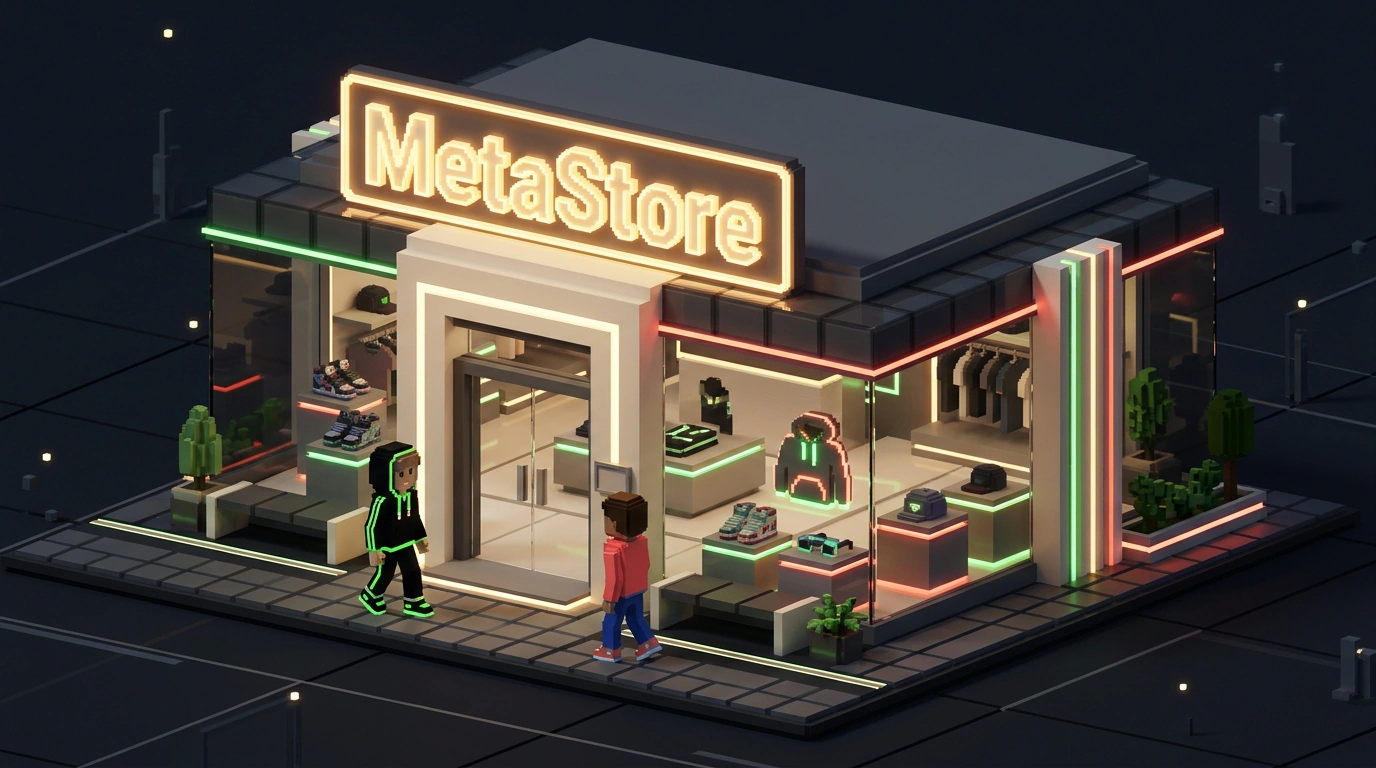
If you still picture Roblox as a digital sandbox for elementary schoolers where blocky avatars build cube houses, it's time to ditch the stereotype and look at the hard numbers. The platform's daily active users (DAU) have topped 70 million—and more than 40% of that massive base is Gen Z users over 17: young adults with their own bank cards, forming buying habits, and huge reserves of free attention.
Traditional e-commerce is gasping for air under brutal competition, squeezed by the margin crisis on marketplaces. The classic "click banner -> product card -> cart" funnel misfires with younger shoppers, who tune out pop-ups and display ads. Inside the metaverse, old-school retail marketing fails completely. Why would anyone walk into a virtual supermarket for bread when a real store sits on the corner 24/7? People log into Roblox to hang out, play, and craft a digital identity—forcing brands to rewrite the rules from scratch.
The Direct-to-Avatar Economy: Why a Digital Bag Outpriced the Real Thing
A brand-new commerce sector has taken shape inside the metaverse: D2A (Direct-to-Avatar)—selling goods straight to virtual characters. For a Gen Z player, an avatar isn't a throwaway sprite; it's their primary badge of self-expression in a digital social circle. In 2023, researchers Yulia Lee and Jeong Yoon Kim studied Russian teens' motivations in Roblox and proved a core point: an avatar's clothes and accessories signal group status just as powerfully as real sneakers or a flagship phone in a school hallway.
That's why luxury house Gucci blew up the market in May 2021 with its two-week immersive space, Gucci Garden. Visitors explored themed galleries and bought digital replicas of real collections using Roblox's in-game currency, Robux.
What happened next set an economic precedent: a digital Gucci Dionysus bag with a bee motif originally sold for 475 Robux (around $6 at the time). Limited supply sparked speculative frenzy. On Roblox's secondary marketplace, one unit resold for an astonishing 350,000 Robux—roughly $4,115! For comparison, the physical leather Dionysus bag in real-world boutiques retailed for around $3,400.
Buyers paid $700 more for a cluster of polygons than for a tangible piece crafted in a Milanese atelier. The digital item nailed the status job: setting its owner apart from millions of players. According to Roblox Business Insights, net margins on virtual collections exceed 70% because the marginal cost of copying a 3D asset is essentially zero.
Retail Gamification: How Auchan Turned Checkout Into a Sport
High luxury is one thing, but what about mass-market FMCG grocery retail with shopping carts and discount tags? In December 2023, Russian hypermarket chain Auchan teamed up with DVOR Studio to launch Auchan City, modeled on its flagship hypermarket in Pushkino outside Moscow and surrounded by a sprawling game city with parks, mazes, and transit.
The genius of the project was turning mundane store chores into competitive action. In real life, shoppers rush to get past the register while staff stock boxes on autopilot. In Auchan City, everyday supermarket tasks became fast-paced quests:
- Cashier simulator: players race to scan barcodes on a moving conveyor belt.
- Merchandiser challenge: speed-sorting boxes onto the right shelves and brand displays.
- Virtual bakery: interactive timed baking of signature baguettes.
Completing tasks earns in-game currency called "Ashbacks," which players spend on branded bucket hats or hoodies for their avatars—while the weekly top 10 players win real Robux prizes.
Auchan didn't stop inside the game; it built a seamless bridge back to physical grocery stores. In a seasonal zone by a virtual pool, a booth showcased private-label ONE TWO FUN toys. Players could walk up to a virtual promoter, enter their real Auchan loyalty card number, and instantly claim a 30% cashback coupon for their neighborhood store. The experience racked up over 28.5 million visits, proving a kids' game can pull parents back to real-world checkouts.
Sports and World Curation: The Adidas and Walmart Playbooks
Metaverse retail fits squarely into a wider shift toward digital autonomy, where marketing converges with agentic commerce and buying without websites. Brands aren't hanging billboards—they're weaving themselves into virtual daily life.
For its Football Festival campaign, Adidas plugged straight into the hit game FIFA Super Soccer (built by Gamefam). Instead of launching an empty standalone world, Adidas went where players were already spending hours, adding a branded stadium, locker rooms, and kits for 14 global football clubs. In four weeks, the integration generated over 51 million play sessions and 480 million minutes of active brand engagement. According to Roblox for Brands, average dwell time in a branded immersive space runs 11 to 18 minutes—a figure traditional social feeds and video ads can't touch.
Retail giant Walmart went even further with Walmart Discovered. Recognizing that players easily get lost among millions of user-built worlds, Walmart positioned itself as the platform's chief curator—showcasing over 300 independent developers, organizing themed collections, and helping indie creators earn Robux from their digital items. The retailer stepped into the role of senior partner and tastemaker.
The Pre-Launch Litmus Test: Why Would Anyone Visit Your Virtual Store?
Global case studies show that completing a branded quest lifts brand awareness among younger audiences by 28–35%. Yet if you blindly copy the format and build a sterile virtual showroom lined with dull banners, your project will become a graveyard of abandoned polygons.
Before investing millions of rubles in 3D modeling and dev teams, ask yourself one blunt question: "What will a user do in my space if they have zero intention of buying anything?"
If your answer is "admire our wonderful vacuum cleaners on pedestals," the project is dead on arrival. Give players an exciting challenge, a status-worthy digital item, a reason to compete with friends, and a clean mechanic to trade game points for real-world retail perks—and you'll earn one of the most loyal, engaged audiences your brand can build.