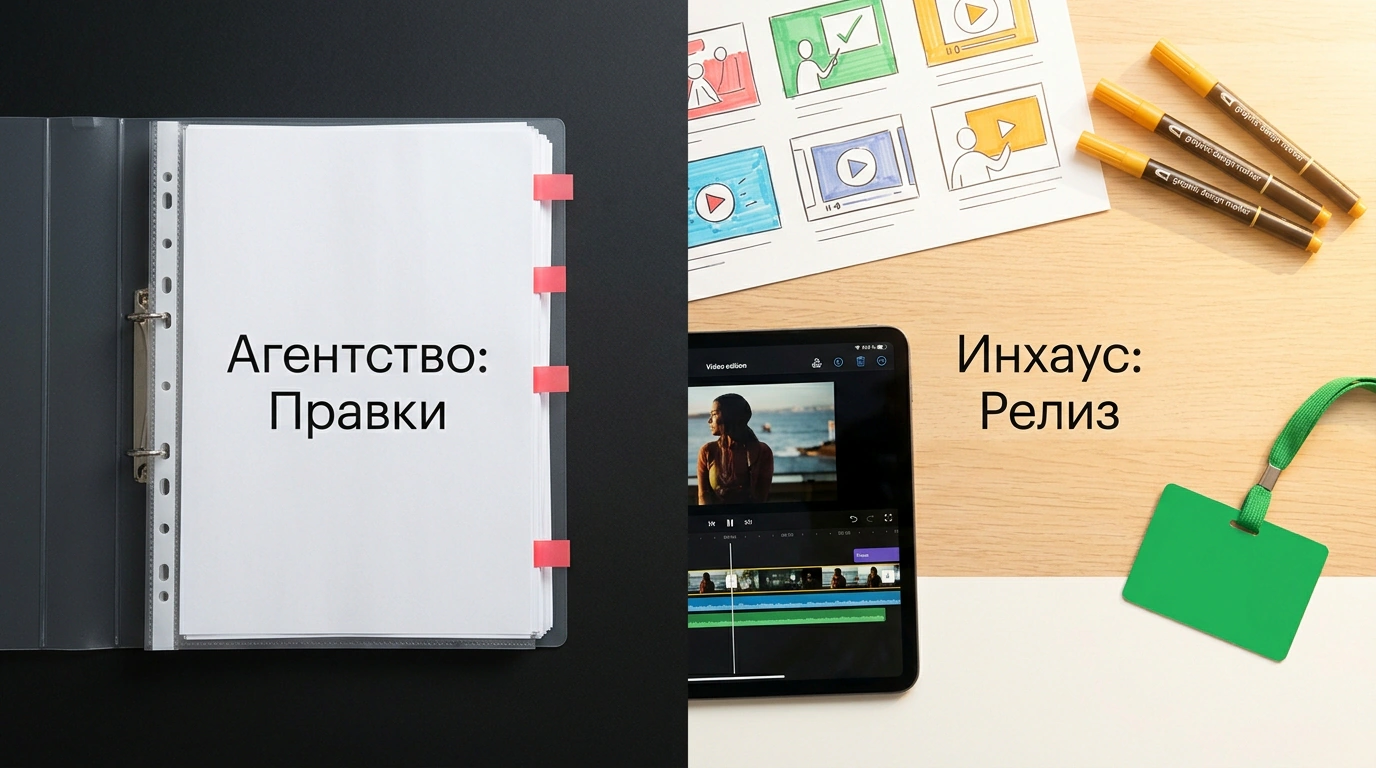
If you run marketing or own lead generation, you know this pain all too well: you brief an agency on a batch of banners to test a new audience, and the final layouts land in your inbox two and a half weeks later. By then, the auction has shifted, the offer has gone stale, and the budget has been sitting idle. In modern performance advertising—where creatives burn out in a matter of days—that kind of sluggishness costs a company far too much.
That is exactly why the ad market has undergone a massive tectonic shift. According to the fourth wave of the authoritative Creative Health Tracking 2026 study by AKAR (Russian Association of Communication Agencies) and the RIR Analytical Center, 71% of Russian advertisers have moved ad creative design to internal in-house teams—a massive 13-percentage-point jump in a single year. The share of brands building tactical campaign creative concepts themselves rose to 48%, 45% now write communications strategy internally, and 43% have brought video production in-house.
Speed and Economics: Why an Internal Team Beats an Agency
The primary driver behind the exodus from agencies is a sharp compression of business planning horizons. Companies need fast sales and instant audience contact. Whereas two years ago 51% of marketers considered a three-week creative turnaround normal, today 47% name two weeks as the absolute ceiling—and in reality demand deliverables in days.
A global report by the Association of National Advertisers (ANA) confirms the gap: an in-house team assembles and ships new creative combinations in 24–48 hours, compared to 2–3 weeks with an external vendor. In-house designers and copywriters are deeply immersed in product margins, know every weak spot in the offer, and watch end-to-end analytics in real time.
The upside of the in-house model is backed by hard numbers:
- Annual budget savings on regular graphic production run 20% to 35%;
- The number of creative combinations tested in performance campaigns grows by an average of 3x;
- Multi-layer agency bureaucracy and endless email threads with account managers disappear.
For more on how the balance of power between clients and external vendors is shifting, check out our piece on the transformation of the ad market and new agency roles, which breaks down the changing business models in detail.
What Remains for External Agencies and How Tenders Are Changing
Does this spell the complete death of advertising agencies? Not at all. A healthy division of labor has emerged. Businesses have pulled routine tactics and adaptations under their own roof, while continuing to tap agencies for complex strategic challenges:
- 72% of companies still hand high-level tactical campaign concepts to agencies;
- 64% entrust external partners with Big Ideas and long-term brand campaign platforms;
- 50% delegate brand positioning and communication frameworks.
The vendor selection process itself has transformed just as dramatically. The share of companies hiring agencies directly without a tender jumped from 16% to 28%. Long annual retainers and drawn-out RFPs are giving way to targeted pitches for specific projects (up to 36%). At the same time, the market is shedding free spec work: the share of clients demanding unpaid concepts fell to 42%, while standard compensation for participating in a paid pitch has settled at 200,000 to 700,000 rubles.
The biggest trap of going in-house is creative burnout among staff specialists. When a designer spends months making banners for the exact same product, tunnel vision sets in. The optimal model for a mature business is hybrid: a nimble internal design factory handles daily performance, while external creative boutiques plug in for bold strategic leaps.