Over the past two years, digital marketing has been gripped by a full-blown gold rush. Agency heads and marketers laid off copywriters en masse, strung together prompt chains, and flooded corporate blogs with hundreds of AI-generated articles churned out in a couple of clicks. The logic seemed bulletproof: why pay a writer for deep research and subject-matter mastery when a language model spits out polished copy in ten seconds and hits every keyword?
That euphoria didn't survive contact with reality. Search engines overhauled the search landscape. Smart AI overviews arrived, answering user intent right on the results page without a single click through to a website. Take a telling case from digital agency AINET: in 2025, one client's search impressions tripled—jumping from 600,000 to 1.8 million. Yet actual traffic didn't budge by a single percent because click-through rate (CTR) collapsed from 6% to 2%. Users read the summary in the snippet and closed the tab.
Trying to offset falling traffic with sheer publishing volume, companies mashed the generate button even harder. But how much do search engines actually trust synthetic content over the long haul? Until recently, confounding variables—domain age, backlink profiles, brand traffic, hosting—made it hard to measure cleanly. The AINET team, led by founder Ruslan Minyazhetdinov, decided to settle the debate once and for all with a textbook eight-month controlled experiment.
AINET's Clean Experiment: One Invented Word and 10 Sterile Domains
To strip out all external noise and distortion, the researchers approached the test with engineering rigor. They invented a completely new word that didn't exist anywhere in nature: "lipihydrodation" (липигидродация). In their backstory, the term described a cosmetic technology for simultaneous deep hydration and skin nourishment. Before the test began, the word didn't appear in a single database, dictionary, or search index.
For the experiment, they registered exactly ten brand-new, completely clean domains. Zero history, zero backlinks, and zero footprints in the Web Archive. All ten sites were built on an identical minimalist HTML and CSS template with no heavy frameworks and launched simultaneously on the exact same physical server.
Next, they split the ten sites right down the middle:
- The first five articles were written by live professional writers—beauty experts working from a single strict brief. They wove in practical nuances, industry slang, ingredient breakdowns, and procedure logic.
- The other five articles were generated by leading AI models: Manus, ChatGPT, Perplexity, Gemini, and DeepSeek. Every model received the same detailed prompt with identical structural requirements.
All ten articles were identically optimized for the target query with matching keyword density and schema markup. Only two agency employees even knew the domains existed. To avoid skewing behavioral signals, nobody searched the query manually; rankings in Yandex and Google were tracked monthly via Rush Analytics.
Four Months of Illusion: Why AI Initially Captured the Top of Yandex and Google
The early results gave champions of human-written content plenty of reason to sweat, even though the two major search engines behaved very differently.
In Yandex, professional writers took a commanding lead in the first weeks after indexing, sweeping all top five spots. Human-written content held an impressive 72.7% share of visibility versus a modest 27.3% for AI texts. It looked as if Yandex had sniffed out synthetic copy immediately. By month four, however, the tables turned sharply: Manus and Gemini surged from 10th and 8th place straight to 1st and 2nd. AI visibility jumped to 45.5%, virtually erasing the gap between human and machine.
On Google, the swing was even more dramatic. At launch, Google ranked both groups almost dead even: 50.9% visibility for AI versus 49.1% for human experts. By month four, Google went all-in on artificial intelligence: AI article visibility soared to 63.6%. Only a single human expert managed to hang on inside the top five. Gemini's text flat-out claimed the #1 spot, boasting textbook definition density and slick grammar.
At that point, automation evangelists could easily have declared total algorithmic victory. But in SEO, the winner isn't whoever spikes to the top first—it's whoever holds those positions over the long run.
Month Eight and the Synthetic Crash: How Algorithms Purge Soulless Rewrites
By month eight, search algorithms had accumulated a critical mass of behavioral and textual signals, and the pendulum swung back with crushing force.
In Yandex, human writers reclaimed total control of the results page. They locked down positions 2 through 6, capturing 71.4% of total visibility with an average ranking of 4.0—compared to a dismal 8.2 for AI. Articles generated by Gemini, Perplexity, and ChatGPT fell out of the top 10 altogether, banished to the backwaters of the search index.
Google saw a similar tectonic shift. Expert content climbed to 67.3% visibility, improving its average rank to 3.6 versus 7.4 for generated texts. Only one synthetic piece survived in the top six. The most vivid illustration was Gemini's trajectory: the model opened at #1 overall, held the crown for four months, and by month eight cratered to rock bottom at 10th place. The only AI model to show steady retention in the cohort was DeepSeek, thanks to the specific internal structure of how it lays out facts.
The final bottom line of the experiment: over the long term, expert-written articles beat AI-generated content in Yandex visibility by exactly 2.5x.
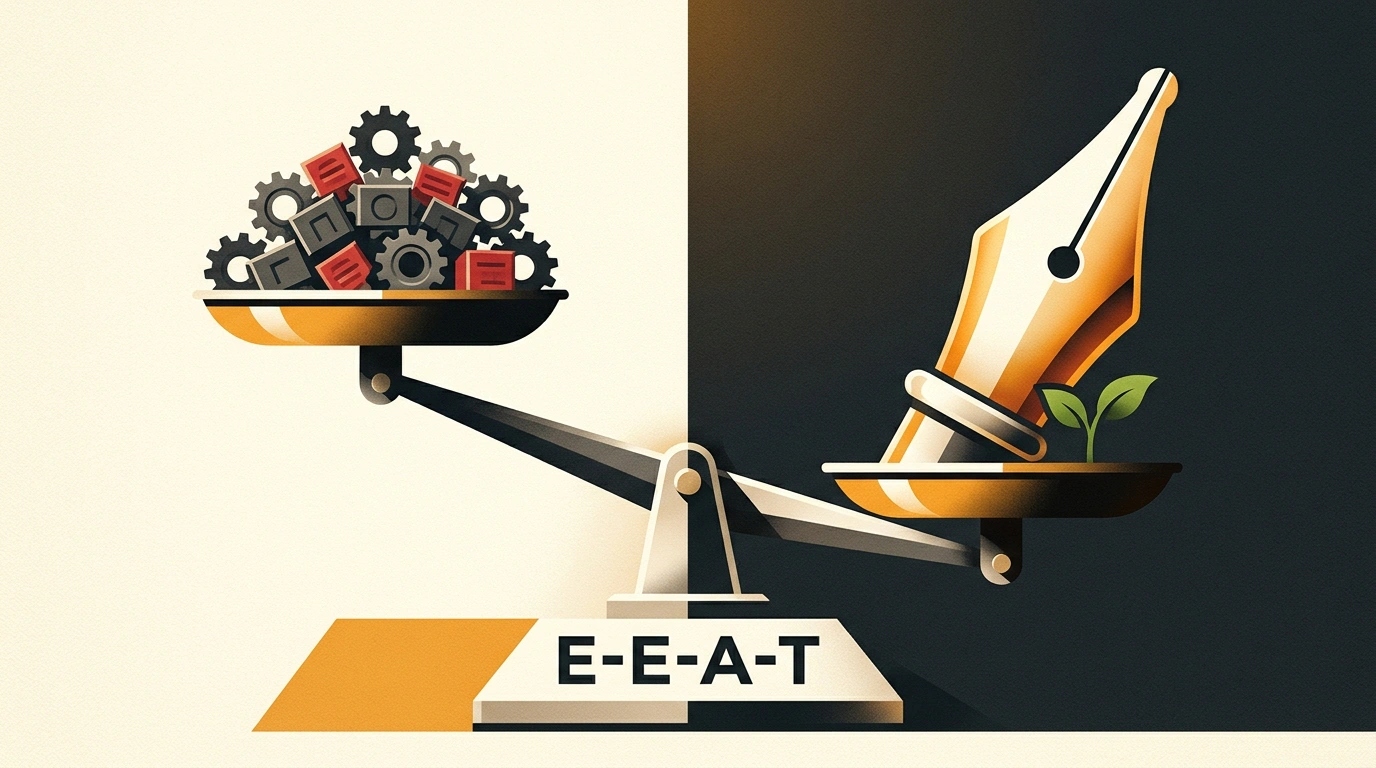
Why did that happen? Search crawlers evaluate far more than surface keyword matching. Content helpfulness algorithms kick in—what Google codifies under E-E-A-T (Experience, Expertise, Authoritativeness, Trustworthiness). Language models operate on token probability distributions: they average out information, sand down sharp edges, and churn out predictable stylistic clichés. A real expert writes from lived practice—using uncommon synonyms, unexpected factual connections, real-world trade-offs, and specifics a language model still can't fake. Over time, search crawlers spot the uniform entropy of synthetic text and demote it in favor of primary sources.
How Businesses Should Build Content in the Era of Zero-Click Search and AI Answers
The takeaway from this benchmark test isn't that businesses should ban language models and go back to manual 2010-era workflows. AI is a phenomenal assistant, but a disastrous final author.
If you're building content marketing for long-term organic traffic and real ROI, stick to a hybrid model:
- Delegate initial research and outlining to models. AI excels at drafting an initial article outline, compiling a baseline list of industry definitions, or translating technical documentation. That saves a writer up to 40% of prep time.
- Bake your team's firsthand experience into every piece. Without original interface screenshots, real CRM numbers, candid post-mortems of failures, and quotes from your in-house engineers, an article stands no chance in search rankings. Search engines hunt for Information Gain—value that doesn't exist on any other site.
- Fact-check relentlessly for hidden hallucinations. Language models confidently invent regulations, nonexistent formulas, and fabricated quotes. One slip like that wrecks reader trust and triggers algorithmic penalties for inaccuracy.
- Optimize for AI search and snippets. Because a chunk of traffic inevitably stays inside AI overviews, format each section's core takeaways as crisp bullet lists and tight definitions in the opening two paragraphs.
The era of cheap content spam is over. Companies investing today in strong industry writers and genuine expertise lock in steady organic traffic—while fans of 100% AI generation watch their traffic evaporate into thin air.