If you've managed Yandex Direct campaigns over the past couple of years, you've watched the landscape shift at breakneck speed. Manual bidding, surgical exact-match keyword sculpting, and meticulous negative-keyword pruning are fading into the past. Yandex is steadily—and forcefully—pushing advertisers into auto-strategies and mandatory auto-targeting. The platform's official pitch sounds inspiring: neural networks have gotten smarter, algorithms read billions of behavioral signals, and AI can find ready-to-buy customers better than any human media buyer.
Yet the moment a founder or marketer loads hundreds of thousands of rubles into an ad account, that fairy tale collides with reality. Reports show dozens of cheap leads, cost per conversion looks right on target, click graphs climb briskly—and the sales team is tearing its hair out. Reps pick up the phone only to hear: "Oh, I just had a quick question," "Can you fix my old Soviet fridge for 500 rubles?", or "Your consultation is definitely free, right?"
You end up in a dangerous paradox: the ad account celebrates a smashing success while the cash register sits empty. To avoid burning your budget when launching a Unified Performance Campaign in Yandex Direct, you have to pop the hood on Yandex's neural models. Let's strip away the hype, examine how auto-targeting actually thinks, expose the architectural flaws in how auto-strategies learn, and put engineering-grade control back over your ad spend.
The Machine-Learning Black Box: Why the Algorithm Doesn't Care About Your Profit
The #1 mistake specialists make is projecting human common sense and commercial logic onto machine learning. Burn this into memory: Yandex Direct's algorithm has zero concept of your company's profit. It knows nothing about your product margins, warehouse carrying costs, or how many hours your reps waste on dead-end calls.
Direct's mathematical model solves one narrow optimization problem: predicting the probability of a specific event (a click or a form submission) that you designated as the conversion goal.
At the micro level, the algorithm's decision loop runs like this:
- It scores incoming user signals: recent search queries, visited sites, device type, geolocation, and time of day.
- It calculates a probability weight: how likely is this specific user to submit a form right now?
- If that user belongs to the cohort of "serial lead-fillers"—people who love clicking ads and submitting forms everywhere for free quotes—the algorithm assigns them a sky-high propensity score.
To the robot, a form fill from a college student hunting free thesis material and a form fill from a factory CEO requesting a 10-million-ruble equipment quote are 100% identical. Both fire goal_achieved = 1. And because attracting that student is ten times cheaper and easier, the auto-strategy happily floods your site with junk traffic while proudly reporting a falling CPL. As we saw in how auto-strategies burn budgets, any optimization disconnected from real money turns into a mirage factory.
Search vs. RSYA: Intent vs. Probability
A second critical mistake is treating Yandex Search and the Yandex Advertising Network (RSYA) as the same environment. They run on completely opposite targeting mechanics.
Search ads target explicit commercial intent: On Search, the user spells out their need. When someone types "buy industrial milk chiller with delivery Moscow," they're already at the bottom of the funnel. The system's job is simply to serve the most relevant answer.
With mandatory auto-targeting, however, even Search no longer relies strictly on your chosen keywords. Neural embeddings parse your ad headline and landing page copy to guess what other queries might fit. If you sell industrial refrigeration, the system is perfectly capable of matching you to "why isn't my home Atlant fridge freezing." Conceptually close—cold, trouble, repair—yet commercially worthless.
RSYA targets interest and behavioral probability: Across display partner sites, users aren't actively shopping for your product at that second. They're checking the weather, reading a pie recipe, or browsing industry news. The algorithm serves your banner based on behavioral trails—what they searched three days ago or sites they visited.
Interest in a topic doesn't equal willingness to pay:
- A visitor reading a roofing guide might be DIY-ing a weekend cabin;
- They might be a trade-school student writing a term paper;
- They might be your direct competitor researching the market.
To RSYA's algorithm, all three look equally promising. That's why optimizing RSYA campaigns for shallow micro-conversions like "spent 60 seconds on site" or "scrolled 50%" is lethal. You'll simply train the machine to buy idle readers and funnel your budget straight to clickbait publishers.
Five Auto-Targeting Categories: What to Switch Off at Launch
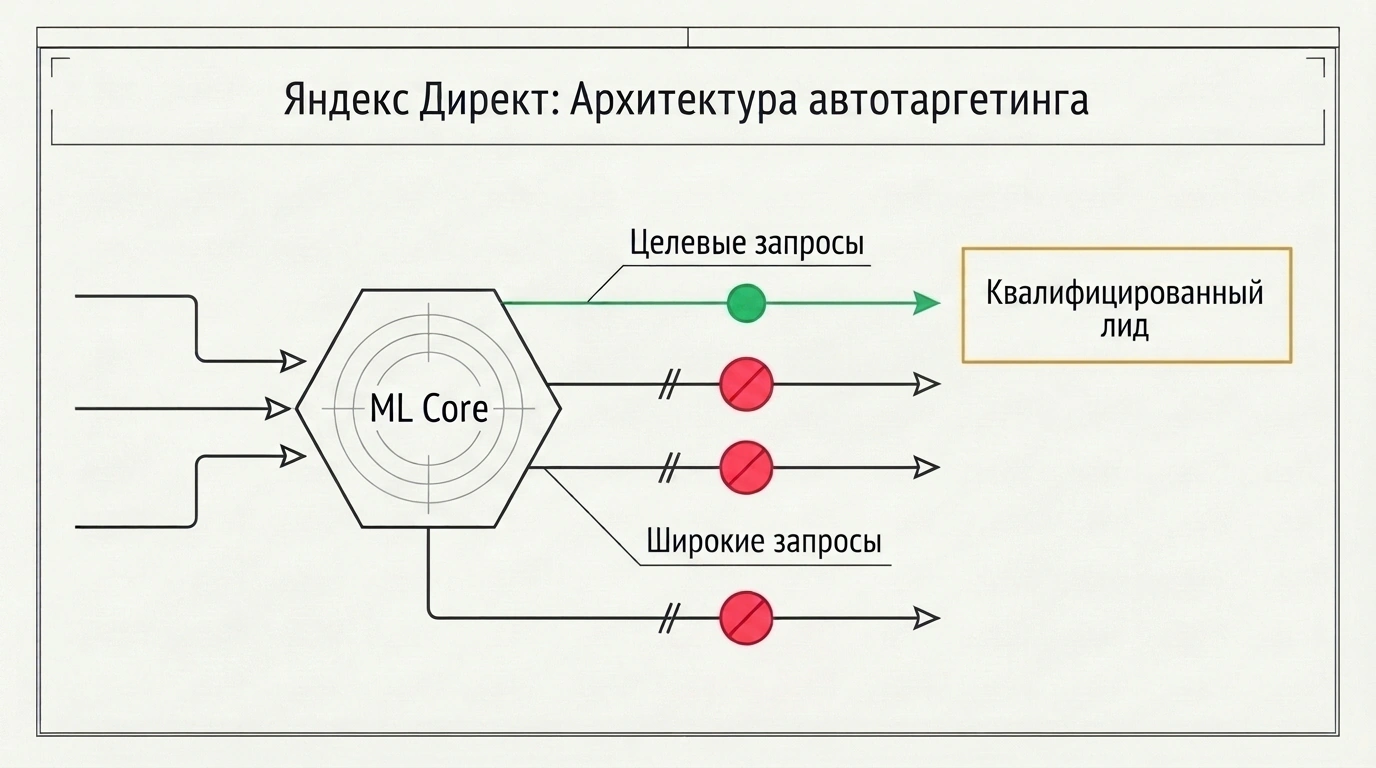
Let's look under the hood at Yandex Direct's five official auto-targeting buckets for text-and-image ads:
Conceptual diagram of search query selection in Yandex Direct auto-targeting: filtering out irrelevant traffic through a multi-stage filter system.
- Target queries: searches that clearly and unambiguously express intent to buy your exact product or service (e.g., "order workshop ventilation design").
- Alternative queries: the user searches for a different product that could solve the same problem (e.g., searching "server room AC" when you sell precision split systems).
- Complementary queries: products or services bought alongside yours (e.g., "buy galvanized air ducts" when you advertise ventilation installation).
- Competitor queries: direct searches for your rivals' brand names.
- Broad queries: high-volume generic terms broader than your offer (e.g., just "ventilation" or "climate control").
Yandex Direct's own official documentation gives an unambiguous rule: during launch and the learning phase of a new campaign, you must turn off Broad queries and Complementary queries!
Leave broad auto-targeting turned on in a cold account, and the neural network will immediately drag the campaign toward cheap adjacent junk. It will burn your entire first week's budget on near-zero-intent informational queries before gathering enough conversions on your core target terms.
Also, take full advantage of Direct's fine-tuning field: Search Query Description (a prompt up to 500 characters). Never leave it blank. Spell out in plain language who your offer is for and who must be excluded: "B2B supply of commercial kitchen equipment for restaurants and cafeterias. No home appliances, no household repair, no retail, minimum order 300,000 rubles." That text context directly steers the neural embeddings matching your pages.
The Vicious Optimization Loop: How a "Free Consultation" Form Breaks Machine Learning
Let's trace a classic trap that catches 80% of companies selling complex products—what I call the "self-reinforcing traffic degradation loop."
Imagine a corporate law firm specializing in commercial arbitration and asset protection, with deal sizes starting at 500,000 rubles. The marketer puts a slick lead magnet on the landing page: "Get a free 15-minute legal consultation." Yandex Metrica tracks "Form Submitted," and Direct launches a "Maximize Conversions" auto-strategy paying per click or per goal.
Here is what happens next:
- A retiree or student with a neighbor dispute over a leaking pipe or a barking dog lands on the page, spots the magic word "Free," happily types in their phone number, and hits submit.
- Metrica fires immediately: goal achieved! The signal shoots back to Direct.
- The robot studies this user's profile—age, interests, visited communities, browsing history. To the machine, this retiree is the gold standard of conversion efficiency, delivering a 300-ruble lead against a 2,000-ruble target.
- What does the algorithm do next? It scours the internet for everyone sharing similar digital footprints—people looking for free legal help on personal disputes.
- Two weeks later, the campaign is "perfectly" optimized: dozens of leads a day, record-low CPL. Yet when the lawyers call them back, nobody has a dime to spend, and the firm only handles B2B corporate litigation.
The algorithm didn't malfunction—it executed your exact instruction flawlessly. You fed it the wrong signal for success, and the machine scaled that junk with ruthless efficiency. To escape this trap in an overheated Yandex Direct auction, you have to rebuild your feedback signal architecture from the ground up.
Nizhny Novgorod Case Study: How a Higher CPL Lowered Real Deal Cost
Let's walk through a real-world case from a Nizhny Novgorod company supplying commercial car-wash equipment and turnkey detailing-center builds. They sell industrial high-pressure washers, foam generators, stationary compressors, and water-treatment systems, with average deals starting at 400,000 rubles.
Month 1 (January) — The Classic "Cheap Lead" Drain:
- Setup: Search + RSYA, auto-strategy optimizing for "Any site form submission."
- Budget: 110,000 rubles.
- Inquiries generated: 44 leads.
- Reported CPL in Direct: 2,500 rubles.
On paper, a stellar result for heavy industrial gear. Then the sales audit exposed a disaster: out of 44 leads, only 16 were genuine commercial buyers. The other 28 calls were weekend homeowners hunting an 8,000-ruble Karcher washer for their garage rugs, or shoppers looking for cheap hoses and gaskets the company doesn't even carry.
True cost per Sales Qualified Lead (SQL):
110,000 RUB / 16 leads = 6,875 rubles!
Month 2 (February) — Rewiring Signals and Filtering Demand: The team pulled the plug on autopilot and performed sharp surgery:
- Landing page overhaul: they killed vague headlines and put a hard filter right above the fold: "Commercial wash equipment for car-wash complexes, fleets, and industrial plants. Minimum order 150,000 rubles. No retail sales for home garages or cottages."
- Ad copy cleanup: they stripped out generic "pressure washer" phrasing and replaced it with "industrial 380V high-pressure units" and "turnkey commercial wash bay outfitting."
- Goal separation in Metrica: they wired CRM qualification back into analytics. Lead events only fired to Direct once a sales rep tagged the inquiry as "Qualified (B2B)."
- Budget: 105,000 rubles.
- Inquiries generated: 35 leads (down 20%).
- Reported CPL in Direct: climbed to 3,000 rubles. At first glance, an inexperienced marketer would panic—fewer leads and a higher CPL! Inside the CRM, though, 21 of those 35 inquiries passed qualification. True SQL cost dropped from 6,875 to 5,000 rubles—nearly a 30% jump in efficiency.
Month 3 (April) — Syncing With Margin and Warehouse Stock: In April, the team went a step further and tied campaigns to live warehouse inventory. They noticed qualified buyers were dropping off over long lead times on custom-order items, so they refocused spend strictly on high-margin kits in stock.
- Budget: 115,000 rubles.
- Inquiries generated: 37 leads.
- Qualified leads (SQLs): 24.
- SQL cost: fell to 4,790 rubles while closed-deal conversion climbed.
The lesson is crystal clear: in B2B and high-ticket sales, chasing cheap CPL is a straight road to ruin. Judge campaigns strictly along the chain: "Click → Qualified Lead → Signed Contract → Gross Margin."
Critical Mass of Conversions: Micro-Goals, Conversion Values, and 15 Events per Week
That raises an obvious technical question: "If we optimize strictly for qualified B2B deals and only get 2–3 a week, how can the auto-strategy learn? It won't have enough data!"
Fair point. Yandex Direct's machine-learning math requires a hard statistical floor: for a conversion auto-strategy to run stably, a single campaign needs at least 10–15 target events per week. Drop below that threshold and the algorithm enters stochastic drift—bids swing wildly, impressions stall at zero, or the daily budget burns out in two hours.
How do you solve that dilemma? Use a tiered composite-goal architecture with assigned Goal Values:
- Macro-conversion (Final goal):
- "Qualified CRM lead" or "Paid invoice."
- Assign maximum value—for example, 10,000 rubles.
- High-intent micro-conversion:
- "Completed quote-estimator quiz" or "Downloaded technical equipment catalog with corporate email."
- Assign mid-tier value—for example, 1,500 rubles.
- Behavioral micro-conversion (Initial filtering):
- "Visited pricing & leasing terms page + 3+ pages viewed + 90+ seconds on site."
- Assign base value—for example, 200 rubles.
Next, set your Direct strategy to Maximize Conversions optimizing across those key goals, capped by target Cost Revenue Ratio (CRR / DRR) or weekly budget.
What does that give the algorithm? The system gets the statistical volume it needs (30–50 total events per week) while mathematically understanding your priorities. It won't chase penny-ante pageviews when a completed quote form carries 10x to 50x more virtual weight than a casual visit. You feed the machine dense training data without letting it degrade into clickbait.
Engineering Control SOP: Weekly Audit Checklist and Negative-Keyword Hygiene
To keep your campaigns from developing a secret life of their own, enforce regular hardware-style oversight. Run this audit checklist every week:
- Inspect the Search Queries report regularly: Every 3–4 days, open the Search Queries report grouped by targeting condition and filter for "Auto-targeting." Read the exact phrases real users typed. Add every informational, consumer, junk, or out-of-region query straight to campaign-level negative keywords.
- Police placement exclusions in RSYA: In RSYA, up to 40% of impressions can leak into mobile apps, kids' gaming sites (accidental thumb taps), and auto-refreshing ad-farm domains. Regularly pull placement reports and ruthlessly block domains showing zero time on site, abnormally high CTR (>5–7% on display is a dead giveaway for misclicks or click fraud), and zero conversions.
- Stop tinkering too often: Machine-learning algorithms need 7 to 14 days to recalibrate weights after major edits. A rookie's worst habit is tweaking settings daily—cutting budget 10% at breakfast, rewriting ads at lunch, changing target CPC at dinner. Every edit resets learning progress and forces the cycle to restart. Batch your changes and let campaigns run at least a full week on stable inputs.
- Segment by economics, not demographics: Don't slice out audiences by age or gender—in B2B, the buyer might be a 25-year-old specialist or a 60-year-old director. Split campaigns by product margin, shipping geography, and order size instead.
Yandex Direct today is a sophisticated engineering system. Stop treating it like a magic slot machine, and stop fighting automation with outdated manual habits. Put hard guardrails around the algorithm, feed it honest financial signals from your CRM, watch your analytics closely—and Yandex's smart machines will work for your profit instead of your burn rate.