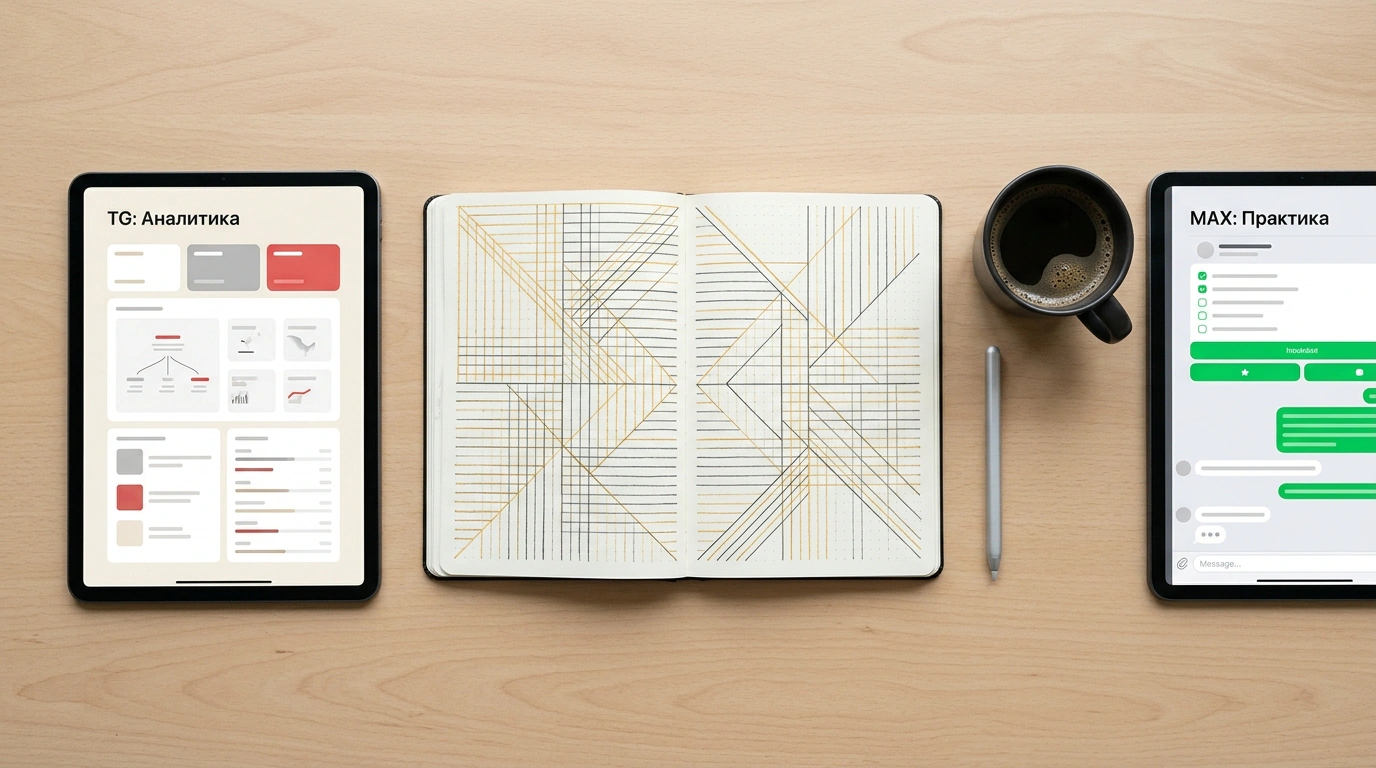
Whenever a company decides to scale its communications and expand into a second messenger, someone at the marketing standup almost always pitches a tempting shortcut: "Let's just turn on auto-posting and clone our chatbot one-to-one!" At first glance, it looks like peak operational efficiency. Why spend hours building a separate content plan and hiring developers when you can flip a couple of switches in a cross-posting tool?
In practice, that illusion of savings delivers a double blow to the business. First, your most loyal customers—the ones subscribed to your brand on both platforms—get hit with synchronized spam: the exact same announcement lands in Telegram and MAX five seconds apart. Annoyance spikes fast, and people unsubscribe from both channels. Second, under the hood, sales teams walk into a nightmare: two out-of-sync versions of the same workflow appear, leads get duplicated, reps lose track of statuses, and end-to-end analytics spits out distorted numbers.
Lead developer and technical architect at AppsMax.ru Egor Ainyukov broke this problem down in detail, showing how to separate channels cleanly at both the content-strategy level and the backend architecture level. I dug into his engineering blueprint—let's unpack it piece by piece.
The Cloning Trap: Why Copying Posts and Bots Wrecks Conversion
Messengers aren't just different screens on the same phone; they represent fundamentally different user behaviors. People open Telegram for fast-breaking news, opinion columns, quick insights, and informal professional chats. On MAX messenger, users are far more oriented toward getting specific jobs done: accessing public services, finding vetted businesses, reading structured guides, and buying products through native storefronts.
If you blindly copy a long technical breakdown into Telegram, it gets scrolled past in the relentless pace of the news feed. If you drop a quick joke or an emotional meme without context into MAX, it gets lost among utility-driven messages.
Things get even worse when you clone chatbots button for button. Different messengers enforce different UI constraints: form widths, inline button support, Mini App behavior, and phone number validation rules. Trying to make both bots "identical" just guarantees a clunkier experience on both platforms.
Splitting Channel Roles: Real-Time Telegram vs. Service-First MAX
To make a multi-messenger strategy generate profit instead of irritation, split the positioning of the two channels from the ground up:
- Telegram—your real-time megaphone and discussion hub. Use it for instant reactions to industry news, sharp founder takes, voice notes from company thought leaders, and open comment threads. Content moves fast here: news has a shelf life of a few hours, and engagement runs on immediacy and emotional connection.
- MAX—your service hub, storefront, and structured knowledge base. Turn your channel on the national messenger into a reliable client reference center: step-by-step guides, worked-out case studies with real math, training cheat sheets, and a native service showcase. Here, users can study your product at their own pace, browse the built-in MaxMarket catalog, and complete a purchase without leaving the app.
With that separation, a subscriber following you on both platforms never sees repeats: on Telegram they keep a finger on the industry's pulse, while on MAX they come for tools, catalogs, and frictionless service.
Two-Adapter Architecture: Sharing Business Logic Without Duplicating Entities
Egor Ainyukov's core technical insight is splitting your architecture into a shared business state (Domain Model) and two isolated Channel Adapters.
Instead of maintaining two separate, independent bots with their own databases, all business logic lives in a single unified backend. That shared core handles customer status, order creation, payment verification, and lead routing to CRM reps. The messengers themselves act strictly as thin UI clients.
A minimal technical contract for a channel adapter includes five core methods:
normalizeIncomingEvent(payload) -> DomainEvent— translates a messenger-specific webhook into an internal system event.renderStep(step, context) -> ChannelResponse— renders a flow step tailored to the platform's native UI capabilities (buttons, lists, cards).validateOutgoing(message, recipient) -> ValidationResult— verifies whether a message may be sent: user consent, rate limits, and ad-labeling rules.send(response, idempotencyKey) -> DeliveryResult— guarantees message delivery while using an idempotency key to prevent duplicate sends during network hiccups.mapError(platformError) -> NormalizedError— maps platform-specific errors into unified monitoring codes.
Thanks to that isolation, the core business process knows nothing about Telegram's or MAX's internal field names. If either messenger updates its API or changes button structures, you only update one adapter without ever touching billing logic or your CRM.
For end-to-end tracing, tie your internal correlation_id to the platform's incoming event ID. At the same time, enforce strict data hygiene: don't dump full customer chat transcripts into system logs. The less personal data ends up in technical logs, the easier it is to stay compliant with Russia's personal data law (152-FZ) and manage access permissions.
Honest Funnel Metrics: Why /start and a Submitted Form Aren't a Sale
Many rookie marketers fall into self-deception: the bot logs a hundred /start taps, and the monthly report proudly cites "100 potential leads." Yet a button tap—or even a filled-out screen form—has nothing to do with actual revenue.
To track a multi-messenger funnel honestly, stick to a grounded set of metrics:
- Share of users who initiated an interactive flow.
- Completion rate across all mandatory steps (without drop-offs on intermediate fields).
- Number of unique, deduplicated working records created in the CRM across channels.
- Median time from form submission to first response from a live rep.
- Share of confirmed deals verified by cash receipts or billing records.
- Technical failure and delivery error rates broken down by channel.
Keep communication rules front and center: having a unified workspace to draft campaigns is great, but a blanket "send the exact same blast to everyone" rule is strictly off-limits. Every channel must pass independent checks for recipient opt-in and regulatory compliance (including registering an erid ad identifier where required).
Growing a presence on two messengers isn't about doubling your workload—it's about process discipline. Separate content roles for your readers, build a clean adapter architecture for your developers, and you'll unlock a steady omnichannel stream of paying customers.