You open Telegram to read a couple of trusted channels you carefully sorted into folders, only to see dozens of unread counters and scroll past half the posts without looking. The messenger's entire architecture was built on a strict rule: however many people you brought into a channel through seeding or ads, that's how many pairs of eyes would see your text. And suddenly, right in the middle of this closed club system, a unified algorithmic feed appears in a test build—capable of putting a little-known author's post onto the screens of thousands of people who never subscribed to them.
I studied the analytical breakdown by Sostav correspondent Miron Malafay and cross-checked media agency executives' assessments against clarifications from FAS Russia. Right before our eyes, the fundamental mechanics of how reach is generated in Telegram are shifting, explaining why judging a channel by subscriber count is losing commercial sense and how to rebuild content and budgets for the new rules.
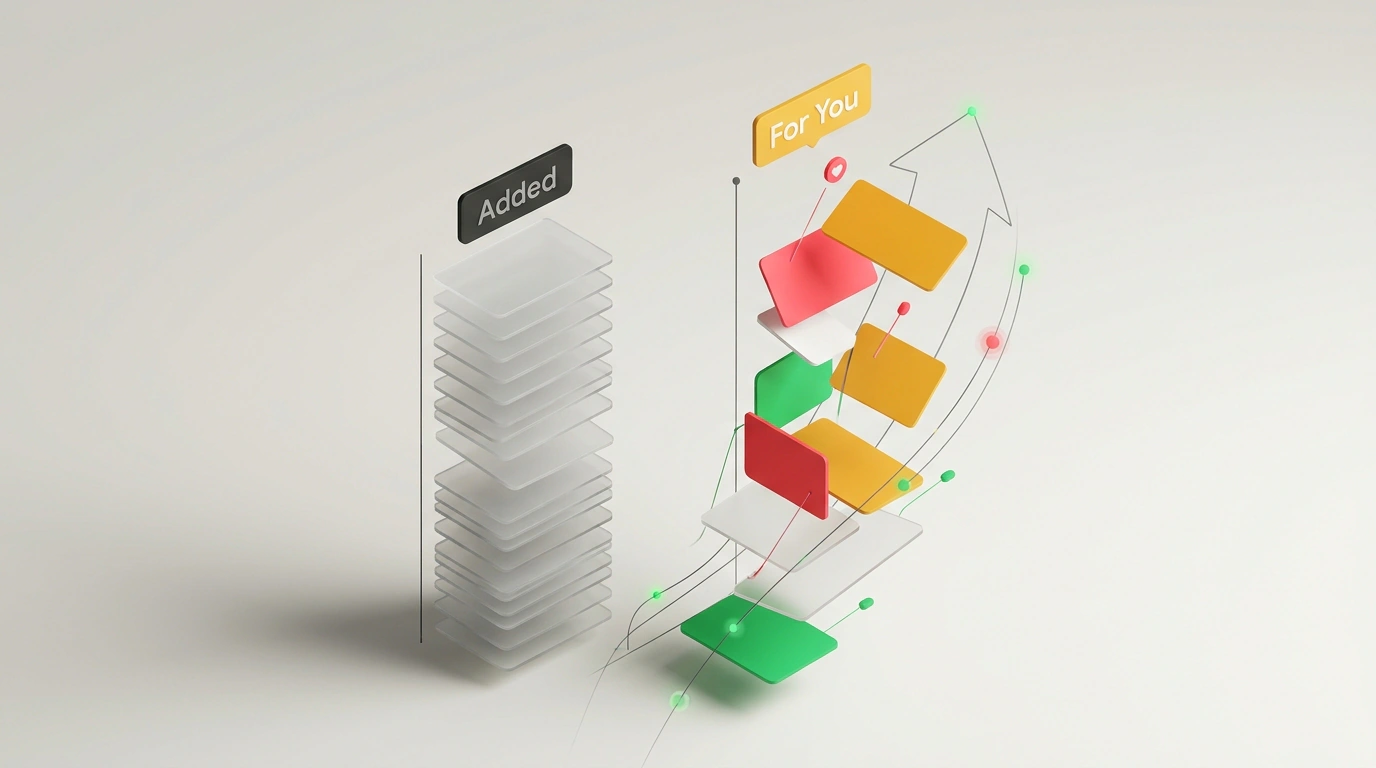
How the News Tab Works: Splitting the Feed into Added and For You
A News tab was spotted in the beta version of the Telegram macOS client—a unified feed of channel posts gathered into a vertical stream. Instead of a chat list where you have to manually open each channel and back out again, the interface offers single-window reading.
Under the hood, the feed splits into two tracks:
- The Added section compiles posts in chronological order only from channels you chose yourself. It is your personal agenda without switching between folders.
- The For You section acts as a recommendation engine: the algorithm selects posts matching your interests from channels you didn't even know existed.
The rollout timeline for the main app is still unknown. Ilya Levinson, Head of Integrated Communications Practice at Mikhailov & Partners, notes that the scale of change depends on technical execution and audience reaction. Users are accustomed to manual channel curation, so an aggressive algorithmic feed could cause irritation. In a softer scenario, recommendations will become an additional discovery tool without displacing the existing model.
Still, the very arrival of a unified stream triggers a shift that Sergey Golovanov, Managing Director at Content+ (Group4Media), compares to turning the messenger into a full-fledged social network. Now the reader doesn't go to your channel—your individual post goes out to find a reader in the shared stream.
The End of the Subscriber Monopoly: Why Reading Channels Turns into Short-Session Surfing
Let's look at what happens to attention on the other side of the screen. Daniil Bobrovskikh, Head of PR at Starlink Group, identifies a turning point: previously, Telegram was the only major subscription-based platform where a channel served as an asset of trust. A unified feed turns it into surfing—the frequency and number of short sessions rise, reading depth within a single channel drops, and the first two lines of a post plus its visual become critical. For the market, the main consequence is that reach stops being a function of subscriber count.
This is precisely where the opportunity lies for smaller projects amid a broader decline in attention—we examined the global trend in the Telemetr study of 1.7 million channels. Over winter and spring, the gap widened: from mid-December 2025 to the end of March 2026, small Telegram channels lost up to 17% of views versus 9% for large ones.
According to Maryana Pilipenko, PR Director at Media Instinct Group, recommendations will let small creators compete with major channels not on budget or base size, but on the quality of an individual piece. As seen in algorithmic feeds on Threads* (owned by Meta, designated an extremist organization and banned in Russia) or after the Explore tab launched on Instagram* (owned by Meta, designated an extremist organization and banned in Russia), an unheated account with a strong, catchy post can organically rack up tens of thousands of views. For small and mid-sized creators, the For You tab becomes a "lucky lottery ticket" and an incentive to grow user-generated content (UGC), while brands gain a reason to run their own channels more actively for free reach.
However, the algorithmic race has three downsides:
- A drift toward clickbait. Fighting for a cold reader encourages sensational headlines and increases the share of irrelevant traffic.
- The rise of content factories. When reach depends on interest in a single post, mass-producing and testing posts becomes profitable. Just like with short-form video, networks of thematic channels sharing a single editorial team and infrastructure will emerge for different audience segments.
- The resource advantage of big media. Major players still hold strong newsrooms and brand recognition, so over the long haul, those who understand reader interests most accurately will win.
The New Ad Economy: Viral Creative, Regulatory Swings, and the Move Toward a Super-App
If a noticeable share of views starts coming from recommendations, ad placement evaluation itself will change. Ekaterina Mosyaga, CEO of Go Influence, notes that alongside a conservative forecast of steady views from subscribers who value an author's expertise, less predictable traffic from the feed will enter the mix.
In Maryana Pilipenko's (Media Instinct Group) view, the market will shift from judging a channel by averaged metrics to analyzing the dynamics of each post. Advertisers will need data on view sources, the share of non-subscribed readers, reach velocity, retention, and audience fit against the target profile. At the same time, free reach from For You will not replace paid promotion: an algorithm cannot guarantee a specific volume of contacts by a target date, contact frequency, or geography, so paid placements will continue to backstop business KPIs.
Russian regulatory context is layering on top of these technical shifts. In March 2026, FAS Russia saw signs of a legal violation (Part 10.7, Article 5 of the Law "On Advertising") in placing integrations on restricted-access resources, pointing to liability for both advertisers and distributors. Later, the agency outlined a transition period until December 31, 2026, with no fines for the placement itself as long as mandatory labeling via ORD and ERIR is maintained.
Andrey Turchin, Digital Director at Group4Media, identified three brand response models: complete exit, reduced presence, and maintained activity. As a result, from January to June 2026, ad volume in Telegram fell by 22%, while the messenger's audience grew by 26% from September 2025 to September 2026. According to Ekaterina Mosyaga, after a slump from late March through May, demand rebounded in June, rates held at 2025 levels adjusted for media inflation, and in stable periods Telegram accounted for around 40% of Go Influence clients' influencer budgets.
To enter early 2027 fully prepared, Tatiana Bolsheva, Head of Targeted Advertising and Mobile Marketing at EMP (E-Promo Group), and market experts recommend restructuring strategy in three areas:
- A flexible 70/20/10 media split. Reacta agency uses a ratio where 70% of the budget goes to proven tools, 20% to growing platforms like VK Ads and the MAX messenger (we covered launch details in the guide to running a B2B campaign in MAX), and 10% to experiments.
- Parallel channels and native formats. Creators are already building mirror channels in MAX so they can move ad monetization there if full restrictions take effect. Inside Telegram itself, tighter rules will push focus toward branded channel content and native mentions without direct calls to buy.
- Packing the core message into the first two lines. Rebuild post formatting for fast vertical scrolling: put the main benefit and a strong visual right at the very start of the post.
In the long run, testing the News tab brings Telegram closer to the Chinese WeChat super-app model—a "one-stop shop" combining a messenger, recommendation feed, mini-apps, and a built-in payment system. In this reality, an old subscriber base is no longer guaranteed rent: those who win free reach and pay back their spend will be the ones who turn every post into a standalone, hook-driven product.