It's 20:14. A shopper opens a porcelain tile product page on your online store from their smartphone. By every standard, the page is exemplary: the collection name, manufacturer SKU, dimensions, price, and photos are all filled in. Any SEO audit would give the page a green checkmark without hesitation. Then a chat widget pops up in the corner of the screen, and the customer writes: "Do you have the same one, just bigger?"
There is no brand, no SKU, and no numbers in that message. The person looks at their screen and assumes the store sees the exact same picture. Yet the site search and system hit a dead end: the buyer gets an empty results page or a request to send the product code, closes the tab, and leaves for a competitor. Why is a catalog that looks flawless in reports blind to real people's queries, and how can you close the semantic gaps between natural speech and your product database without developers?
The Green Checkmark Illusion: Why an Exemplary Catalog Is Blind to Natural Speech
Whenever I audit an online store's sales funnel, I am always wary of spotless technical reports paired with flat conversion rates. The owner knows their product nomenclature inside out, and developers check that database fields are populated and no links are broken. The trouble is that failing to understand a buyer leaves no errors in server logs—the customer simply walks away with their money.
To quantify this blind spot, Oleg Shevtsov, founder of the AI agent service for online retail Clora, and his team analyzed 11,400 customer conversations across 37 online stores (tiles and building materials, home goods, electronics, groceries, and apparel). Comparing chat questions against product database records revealed a systemic issue.
Standard site search and catalog filters look for an exact text-string match, whereas people think in terms of everyday tasks and the context of the open page. Where the database expects an exact character string from a price list, the buyer types phonetically and calculates room area instead of boxes. At the intersection of these two worlds, four hidden gaps emerge that burn through ad traffic every day.
Four Semantic Gaps Between Customer Language and the Store Database
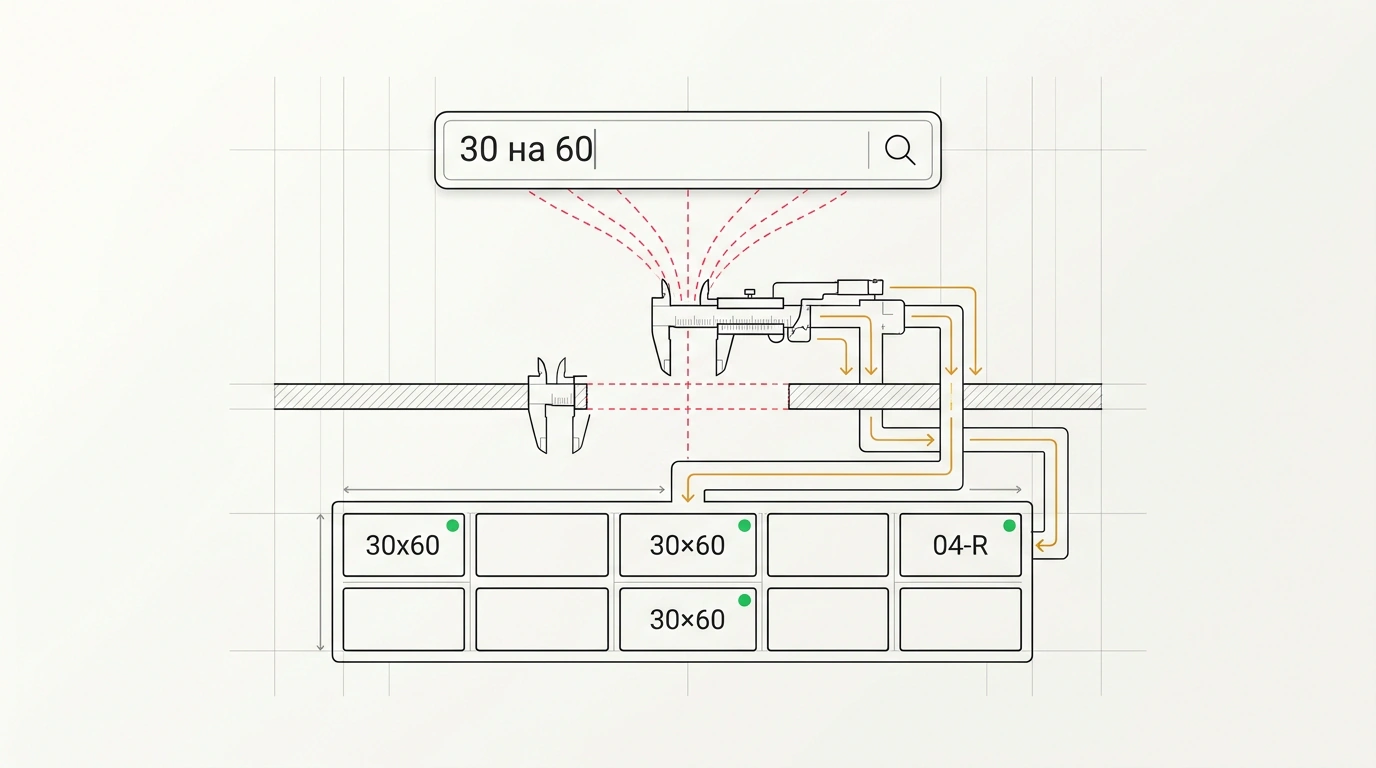
First gap — language: the customer writes in their own words, while the database expects an exact substring. In the product card, a tile size is written as "30x60" with a Latin letter x. Buyers, however, enter five variations: "30х60" with a Cyrillic "х", "30×60" with a multiplication sign, "30 на 60", or "300 на 600". In 6 out of 10 size queries at tile stores, substring search returns "nothing found," and the shopper assumes the item isn't carried.
The catalog trips over the letter "ё" and Latin script in the same way. A supplier invoice loads "Мёд липовый," while the customer searches for "мед," "елка," or "свекла"—for half of all search engines, those are different words. And after hearing the collection name Pastel White from a designer, a buyer types "пастель вайт есть в 60?". Without transliteration enabled, Latin-script brands vanish for them.
In technically complex niches (tiles, plumbing fixtures, spare parts), three structural traps make this worse:
- SKU buried in the title: roughly half of all chats start with an SKU ("need 04R, do you have it?"). That's a hot buyer ready to purchase. But if the code is embedded inside the product name ("Trendy Белый 04R 120x60") and the query includes a hyphen ("04-R"), search fails and managers have to guess the item.
- Mismatched calculation units: a customer asks "for an 18-square-meter room," the price is listed per square meter, and the warehouse ships in 1.44 m² boxes. Without a box-step rule on the product page, the buyer orders individual pieces instead of meters.
- A dumping ground of duplicates: the Pastel White collection across different sizes, colors, and surface finishes splits into 20 separate rows in the database. In one 12,000-item feed, 800 variants were detached from their parent product, making search results look broken.
Second gap — lost context: the buyer assumes the store sees their screen. In 20% of conversations, people write directly from a product page without naming the item: "Is this in stock?", "Do you have a cheaper alternative?", "Will it fit Bosch Serie 4?". Here it is crucial to distinguish three technical mechanisms:
- Chat widget: passes the open product URL to the operator only if the integration script is configured properly.
schema.org Productmicrodata: helps search crawlers read product attributes from the page, but is not connected to the chat session.- Open Graph protocol: generates link previews when shared in messengers.
Having one of these tools does not give you the other two. If specifications and compatibility are buried as plain prose in the description, finding a cheaper substitute or checking compatibility with Bosch Serie 4 requires reading through the catalog manually. Context also breaks across time: when someone asks "Is it available today? I need to lay it this weekend," yesterday's export answers "3 left," even though the last units sold on a marketplace that morning. An exact count sounds like a promise, so it is safer to display statuses ("in stock," "out of stock," "made to order"). And if a customer builds a cart over a week ("I was looking at that gray one earlier, is it still there?"), but the chat wipes history once the tab closes, the conversation starts from scratch.
Third gap — deceptive feed: the file is technically valid, yet unusable for sales. Most stores pass their catalog to external systems via a feed in Yandex Market YML format (or CSV/API) that nobody opens for years. In Clora's practice, they encountered an active 53,000-SKU home goods store running a feed from November 2022: in 1C-Bitrix, the export pulls only checked profile sections, new categories were never added, and scheduled updates kept re-reading a four-year-old price list.
Even in a fresh file, small details break sales: some systems read available="false" as "out of stock" while others read it as "made to order"; a price of 0 turns an item into a free product; and "from 1,290" without the from flag is parsed as a fixed price. Meanwhile, if a manager copies a link with r1=yandext and r2 parameters straight from the feed and sends it to a customer in chat, Metrica attributes the sale to Yandex Market, distorting ad reports.
Fourth gap — drop-off at the finish line, after the product is already found. According to a Harvard Business Review audit of 2,241 companies, the average first response time to an online inquiry is 42 hours, and 23% of businesses never reply at all: a question asked at 23:40 is no longer relevant by morning. At checkout, another barrier awaits: per Baymard Institute data, average cart abandonment reaches 70%, and the top reason (cited by 48% of respondents) is unexpected shipping and fee surcharges at the final step before forced registration. Meanwhile, a cart reminder sent after 2 hours brought buyers back to pay 1.5 times more often than a 24-hour reminder—provided it listed the items and total, wasn't sent at night, and was sent only once.
A 15-Minute DIY Audit of Your Catalog and Chat
An owner can check their store across all these points in 15 minutes without a developer.
The first 5 minutes — inspect your export feed in a browser using Ctrl+F across seven parameters:
dateon the first line: check that the file generation date and year are current.<offer>: compare the number of offers in the file against the number of products on the site.<vendorCode>: is the SKU placed in its own field instead of inside the title text?group_id: are sizes and colors of the same model linked by a shared identifier?<picture>: are photo URLs present (if missing, it's better to pass the product page link)?<price>: are there any zero prices, and is thefromflag set for "from" pricing?available: how is stock status transmitted to external platforms?
The next 10 minutes — test the logic on 5 control products (one with variants, one out of stock, one with a "from" price, an accessory, and a bestseller). Cross-check the product page against the feed, then open the chat from a product page and send 6 test phrases without naming the model: "Do you have a bigger one?" (passing the page URL), "Cheaper alternative" (attribute filtering), "I need enough for X area" (box-step calculation), "Will it fit model X?" (compatibility markup), "In stock today?" (status instead of raw count), and "I was looking at the gray one earlier" (cross-visit chat memory).
SKUs, variant grouping, box-step rules, feed freshness, clean links, and pre-checkout shipping calculation can all be fixed in the admin panel in a single evening. We covered how clearing out duplicates lifts storefront conversion in our article on the psychology of digital shelves in an online store. The second half—understanding natural speech, converting area into boxes, nighttime replies, and cart reminders—requires automation. We discussed losses from slow replies in our piece on seller response speed in chats, and the shift toward shopping in messengers in our review of agentic search in e-commerce. For a 30-item store where the owner replies in a minute, admin fixes are enough. At thousands of SKUs, pairing a clean feed with an AI agent works: in the very first tile store that connected Clora to its YML feed, completed orders grew by 44% and average order value rose by 31%.
Open your site's search on your smartphone right now and type any foreign brand from your catalog in Cyrillic letters, or a size using "на" instead of "x". If you see "nothing found," you just uncovered in thirty seconds a leak through which your paid buyers walk out every single day.