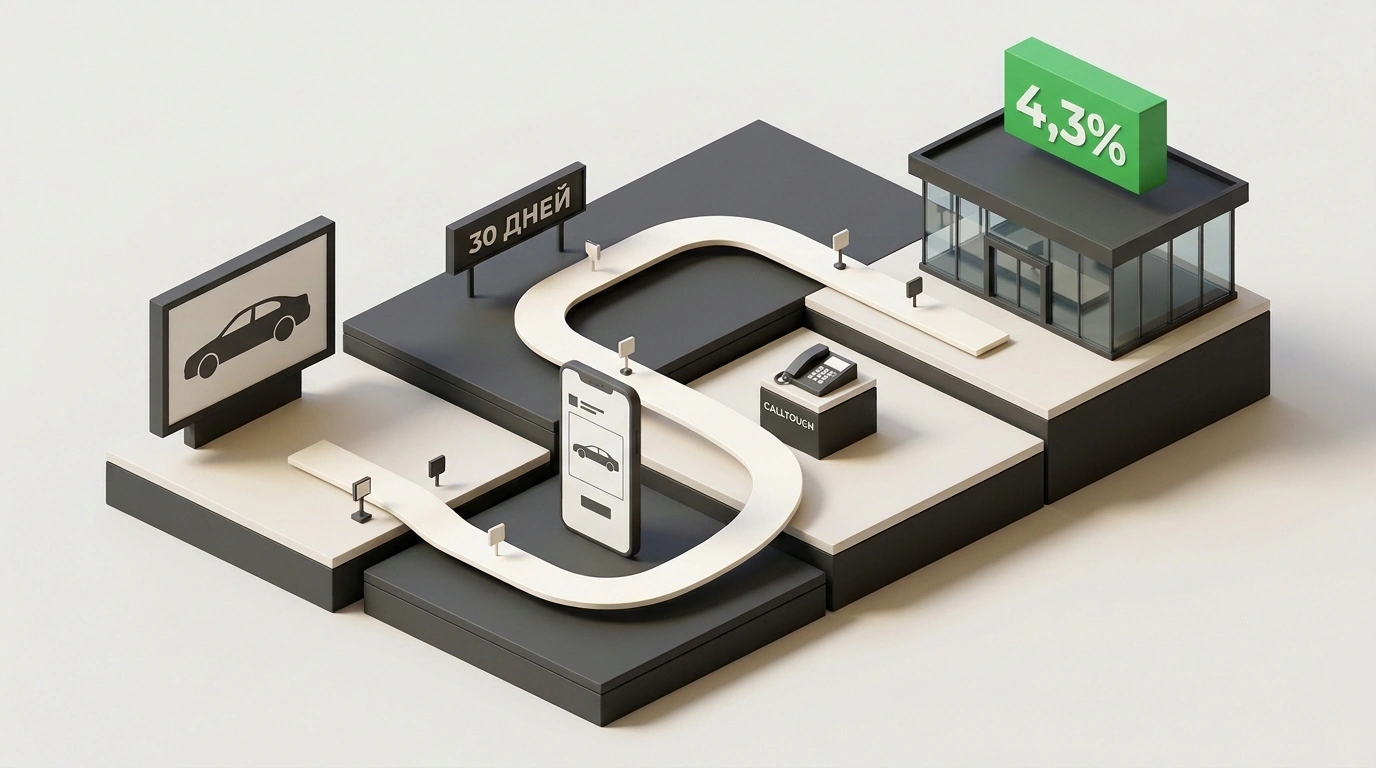
4.3% of all signed car purchase contracts and 4.2% of calls to the sales department over four months — that's how many real deals auto dealer Major's end-to-end analytics tied directly to display advertising. Almost every one of those contracts happened without a single click on a banner or video. If the team had relied only on standard click reports, that slice of revenue would have vanished from their spreadsheets, and display ads would have been cut after a month as wasted budget.
Seeing that revenue required one shift: the team stopped judging reach banners by search-ad rules and merged all websites, ad accounts, and phone calls into one system. The case study shared on Sostav.ru by Major, agency ProContext, and platform TargetADS clearly shows both the mechanics of that setup and its honest limits.
Why Click Reports Make Display Ads Look 'Blind'
With a 1,000 ₽ phone case, the funnel is simple: someone clicks an ad, goes to the cart, and pays. Cars don't work like that. Nobody scrolls the morning news over coffee, spots a crossover on a banner, and hits "Buy in one click."
In real life, the journey stretches over weeks. A buyer catches a video ad, remembers the dealer's name, and closes the tab. Two weeks later, they type the brand into search, click a search ad for that model's site, and call the showroom.
That's where standard post-click tracking (crediting a deal only after a direct ad click) breaks down. It sees only the final search visit and hands all the credit to search ads. Meanwhile, the display banner that sparked the interest sits in the report with zero sales.
To remove that blind spot, marketers use post-view conversions. The system credits a call or contract even if nobody clicked the banner: the person simply saw the ad and later visited the site on their own. As ProContext project manager Ilya Zhivorov explained, a user might see an ad today and call several days later after interacting with another channel or a specific dealership's website.
How They Connected 80+ Websites, 20+ Ad Accounts, and Phone Calls Into One Funnel
Major's setup was far more complex than average. Instead of one landing page, they run a whole network: a main portal plus more than 80 websites for individual car brands and dealerships. Each site has its own Calltouch call-tracking project, and ads run across more than 20 accounts. The dealer hadn't run display at this scale before, so from day one they needed a clear link to calls and contracts, not abstract reach. TargetADS account manager Polina Vitkovich called it a high-complexity task: tying a banner impression to an offline call days later across multiple channels is genuinely hard.
They solved it with unified technical plumbing. They placed the TargetADS pixel on all 80+ sites and connected every Calltouch project to the platform via a webhook — an automated notification that pushes call data from one service to another in real time without manual exports. At the same time, Yandex Metrica ran on every domain to optimize search ads and build audience segments.
To avoid losing someone who saw a video on their phone and visited the site a week later from a work laptop, TargetADS stitched user profiles using browser cookie files, mobile IDs (mobile ID), and ycid (Yandex's anonymous ecosystem user ID). They extended the funnel to real money in three steps: qualified call → conversation with sales → signed contract. A zoo of dozens of domains and ad accounts came together in a single dashboard.
Why They Chose Last Impression and a 30-Day Window
Collecting data isn't enough. You also need rules for how long an impression stays "in play" and who gets credit for the deal.
The time limit within which a system links a call to a past impression is called the attribution window. Historical auto-industry data shows an average of 18 days between the first ad impression and a target action. TargetADS supports windows of 1, 7, 15, 30, 60, and 90 days (a 1-day window only works for Last Impression). A 15-day window would have cut off buyers who take a little longer than average, so they chose 30 days.
To split credit across channels, they picked the Last Impression model over multi-touch schemes:
| Attribution model | Who gets credit for the deal | Why teams use it in practice |
|---|---|---|
| Last Impression | 100% goes to the last impression before the call | Simple reporting; shows which platform closed the chain |
| Linear | Split equally across all touchpoints on the path | Shows the entire customer journey |
| Position-based | Most credit goes to the first and last touchpoints | Balances awareness and closing channels |
For a first large-scale launch, Last Impression was the most practical choice. Rather than spreading one contract thinly across ten impressions, it immediately shows which platform stood right before the customer reached out, making it easier to compare sources and shift budgets.
Media Mix, Frequency, and an Honest Look at the Results
The campaign ran from April to July 2026 across three platforms: Yandex Direct, VK Ads, and AstraLab, using banners, video, and video banners. Creatives avoided cluttering the screen with complex promos, sticking to clean brand visuals of cars and clear special offers. Display warmed up interest, while performance campaigns closed the call. Ad frequency was capped at around four impressions per user — enough to be remembered without annoying people or wasting budget on over-saturated reach.
Over those four months, total calls and contracts across Major's ecosystem grew noticeably year-over-year and compared to the previous quarter:
Overall growth in Major leads and deals (April–July 2026)
Don't fall for big headline numbers without context. The chart shows the overall dynamics of Major's entire ecosystem, which includes seasonality, market shifts, search ads, and the sales team. Total ad spend, cost-to-revenue ratio (DRR), and exact vehicle unit counts aren't disclosed in the case.
What is verified for display specifically is that 4.2% of calls and 4.3% of contracts came from it, with almost all contracts captured via post-view. Major's head of organic traffic, Olesya Abrosimova, noted that end-to-end analytics allowed them to move from judging individual clicks to analyzing how ads affect real business metrics.
A 30-day post-view window has a downside: accidental overlap. If someone already planned to buy a car from a well-known dealer and simply scrolled past a reach banner two weeks before calling, the system still logs a post-view conversion. Plus, the same deal gets credited to an impression in the display report and to a branded search click in the performance report.
That's why in long-cycle industries — autos, real estate, high-ticket healthcare, or B2B — post-view works best for two jobs: connecting impressions to real contracts and comparing platforms inside your media mix. To prove pure incremental sales that wouldn't have happened without banners, you need incrementality tests on top of this analytics, such as geo-lift tests or unexposed control groups.