When you need to figure out why customers churn or what they'll actually pay for, you usually face two costly choices. You either pay an agency 100,000–250,000 ₽ for full customer discovery (in-depth buyer interviews to test ideas before burning budget), or hire a freelancer at around 5,000 ₽ per call while still writing hypotheses, crafting questions, and sorting transcripts yourself.
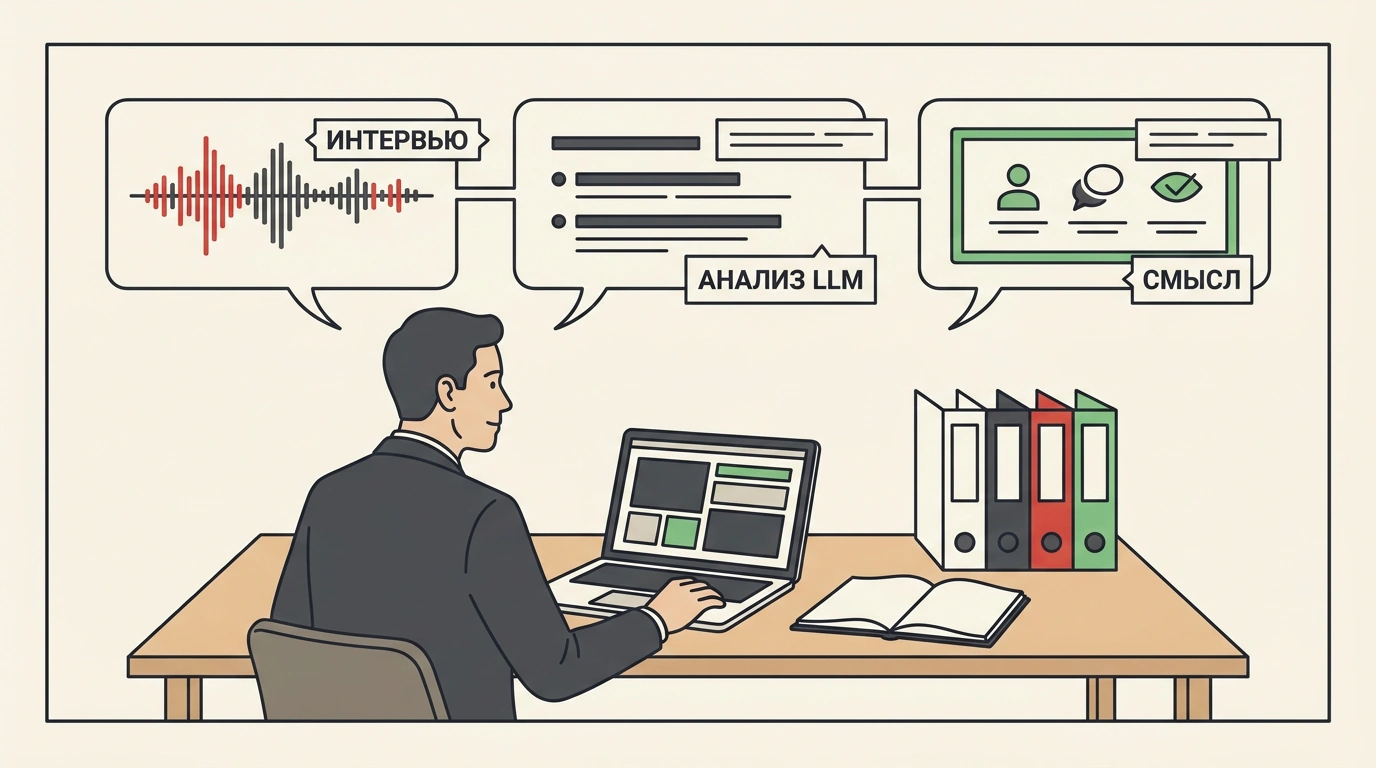
Freelance marketer Maxim Litvinov shared a third option on vc.ru, refined over a year of client projects: he hands prep work, script rehearsal, and transcript analysis to AI, keeping only the live human conversation for himself.
It sounds great, though speed has a price. AI finishes two hours of a freelancer's grunt work in minutes and never charges for revisions. You pay instead with the time needed to feed rich context (a two-line prompt only gets generic fluff) and paid subscriptions to top AI tools. Even so, it costs a fraction of an agency.
Prep and Rehearsal: From Raw Facts to Stress-Testing the Guide
You start with data, not questions. For a new product, feed the AI fast-growing competitors — their sites, social channels, product lines, and market research — plus their most active audience (the people commenting and clicking). For an existing business, pull CRM exports, geography, buying habits, and past surveys.
From that input, the model builds 5–6 segments with pain points, objections, and expectations, plus three customer avatars per segment — detailed composite profiles so you picture real people rather than a dry spreadsheet. For a chain of kids' gymnastics centers, for example, Litvinov asked the AI to list three parent pains, three objections, and three reasons to buy a membership for each segment.
Next comes the interview guide — a conversation plan tied to a specific goal (a launch, low conversion, or churn). Two tricks keep the script from feeling flat:
- Put the AI in the role of a niche marketer and ask for up to 10 hypotheses with matching questions to preserve a clear "assumption → test" link.
- Have it predict likely answers and write follow-up branches so you can chase interesting remarks without losing the thread.
Before your first real call, test the guide on AI avatars: feed the model one profile at a time and ask it to answer honestly. Repeat for every segment, and clunky phrasing shows up before you waste a real person's hour.
The Red Line: Why Bots Can't Run Live Calls
It's tempting to stop at AI avatars, yet that's where the line sits. Litvinov's favorite follow-up question — "all else being equal, how would you choose?" — once revealed that a client picked a lawyer based on whether the lawyer had kids, because that triggered trust. No AI would ever guess that.
A Nielsen Norman Group study backs this up: AI personas work well for rehearsing guides and sketching hypotheses, but they can't replace real humans. Models politely agree, average answers toward clichés, miss unexpected details you didn't ask about, and can't convey pauses or irritation in a voice. So run the interviews live — in person or on Zoom with recording on — aiming for at least 10 calls per scenario, and ideally 30.
After the Calls: Transcripts, Model Stack, and Early Bumps
Once calls are done, AI takes back the grunt work: transcribing recordings, merging text into a master table, spotting recurring themes, refining segments, and even drafting a content plan with lead magnets. Then switch hats to analyst and run hypothesis verification, checking assumptions against strict criteria in real answers. In an online-school project, that review uncovered an unexpected segment of established experts needing to stand out from rivals — and tailored programs for them proved the most profitable.
Litvinov splits roles across three models:
| Model | Role in the workflow |
|---|---|
| ChatGPT | Custom agents with saved prompts for recurring tasks |
| Claude | Analyzing long transcripts and forming hypotheses |
| Gemini | Working with data tables and summaries |
Your first 2–3 live interviews using an AI-drafted guide will almost always feel clunky — that's normal when tuning questions to real people. Tweak the wording by hand after that pilot batch, and the rest of the calls will flow smoothly.