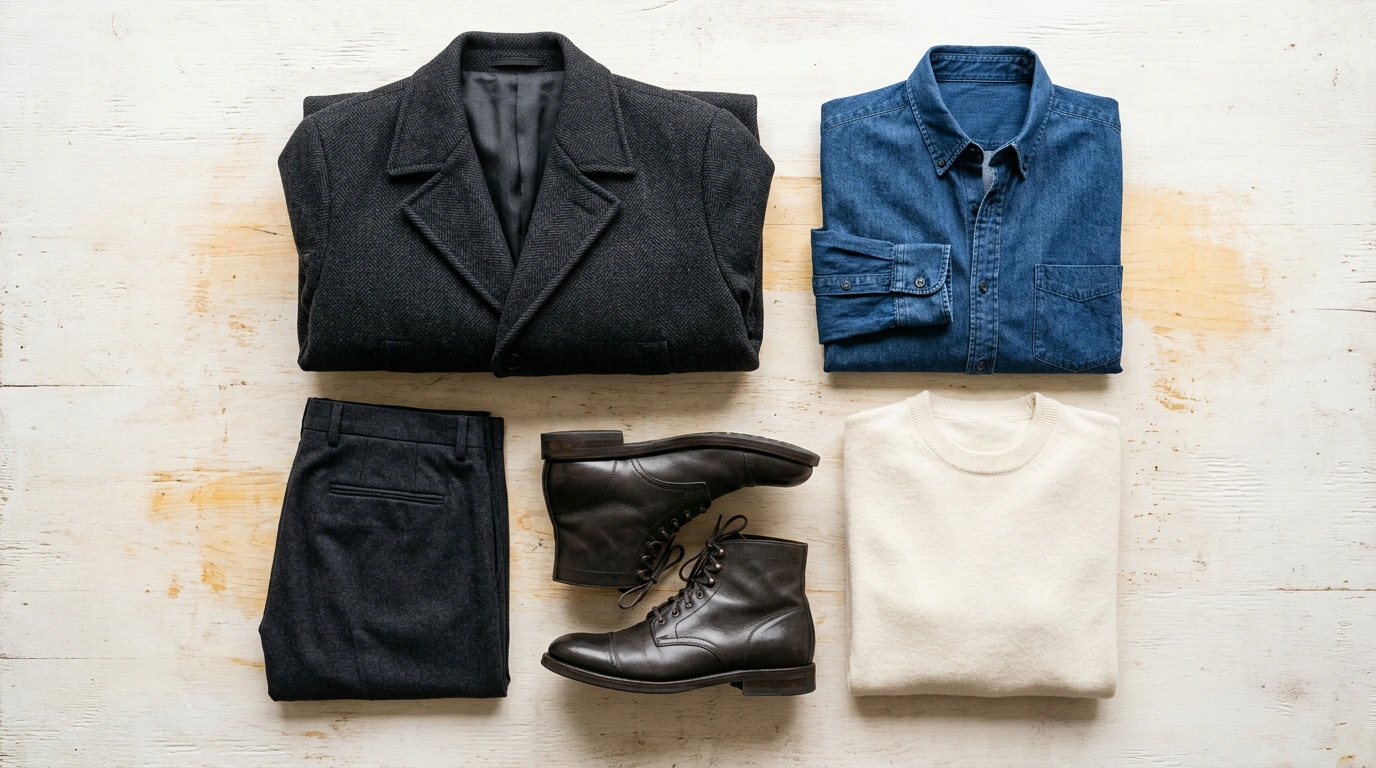
Every October, the moment the first real chill hits, the exact same depressing scene plays out on the streets: a young guy throws on a thin cotton T-shirt, pulls a massive, puffy synthetic parka over it, zips it all the way up to his chin, and turns into a clumsy, waddling Michelin Man. Outside at minus five, that spacesuit feels tolerable enough. The second he steps into the subway, walks into a lecture hall, or sits down at a coffee shop, the nightmare begins.
You instantly start overheating, your back breaks out in a sweat, and taking the jacket off feels embarrassing: underneath is a wrinkled T-shirt that looks sloppy and lounge-ready, with zero shoulder structure left to speak of. So you either roast alive or sit there with your giant puffer awkwardly unzipped.
Men's stylist Denis Gavrilov suggests escaping that trap through smart layering. It isn't some pretentious runway trick—it's pure applied physics and everyday comfort. A well-thought-out setup of two or three lightweight layers lets you adapt to any temperature shift while looking put-together and masculine.
The Physics of Dead Air: Why Two Thin Layers Beat One Giant Puffer
Plenty of guys genuinely believe the thicker and heavier a jacket is, the warmer it keeps you. Look at the basic physics of thermoregulation, though, and that myth falls apart fast. Fabric itself doesn't generate heat—your own body is the only heat source in the equation. Clothing's job isn't to warm you up; it's to trap the heat your skin radiates and block cold convection currents from the outside.
Swedish textile researchers at Woolpower proved a fundamental principle: insulation comes not from the weight of the fabric, but from the volume of trapped, still air ("dead air space"). Still, dry air conducts heat roughly 25 times slower than dense textile fibers.
When you wear one thick garment, the volume of still air is limited to the internal structure of that single piece. When you combine a thin turtleneck, a light vest, and an overcoat, extra microscopic air pockets form between each layer. Two thin layers always keep you noticeably warmer than a single layer of the same combined weight because those boundaries between materials cut down heat loss.
Your choice of base material matters hugely here. Cotton next to your skin in cold weather is the worst call you can make: it's hydrophilic, soaks up sweat like a sponge, stays damp, stops trapping air, and chills fast—leaving you with that clammy shiver. The gold standard is Merino wool. Its fibers have a natural spiral crimp that creates millions of tiny air pockets that don't flatten out under outerwear. Merino can absorb up to 30–35% of its own weight in invisible moisture vapor while still feeling completely dry to the touch, and even releases a tiny bit of warmth during sorption.
We've already broken down a basic fall capsule wardrobe for everyday wear, but once temperatures drop, the actual architecture of your layers decides everything.
Three-Layer Architecture: From Merino Base to Wool Overcoat
To keep your wardrobe simple and avoid looking stuffed like a cabbage, Denis Gavrilov recommends sticking to the classic "1+1+1" formula:
Layer 1: Base Layer Its job is direct skin contact, comfortable moisture wicking, and creating a clean silhouette. Ideal picks:
- A thin mock-neck or turtleneck in 100% Merino wool at 150–200 g/m².
- A heavyweight mercerized cotton crewneck T-shirt with a snug, structured collar.
- Colors: deep charcoal, taupe heather, ecru, or crisp white.
Layer 2: Insulating Mid Layer This layer locks in warmth, adds visual depth, and creates a sharp textural contrast when your coat is unbuttoned:
- An ultra-thin quilted sleeveless vest with synthetic fill. It insulates your vital core (chest and back) while leaving your shoulders and arms completely unrestricted.
- A dense wool zip-up cardigan with a stand collar.
- A structured twill or wool flannel overshirt.
- Colors: indigo, dark espresso, olive, or slate gray.
Layer 3: Protective Outer Shell Your final barrier against wind and rain, and the piece that defines your overall frame and shoulder width:
- A straight-cut wool overcoat hitting mid-thigh or just above the knee.
- A clean, insulated straight-cut bomber jacket with zero loud sporty patches.
- A classic dense cotton-twill trench coat.
Breaking Down Two Outfits by Denis Gavrilov: Overcoat + Vest vs. Bomber + Cardigan
Let's see how this theory translates into real, wearable outfits the stylist put together using accessible everyday brands (like Ostin, LIMÉ, and Zarina).
Look #1: Urban Sharpness with a Wool Overcoat
- Base layer: taupe-gray 100% Merino wool turtleneck. The high collar shields your neck from wind, saving you from wrapping a bulky infinity scarf around your throat.
- Mid layer: a razor-thin quilted charcoal vest. Buttoned under the coat, it's practically invisible while creating a windproof barrier across your chest. Once you step into a café, the coat comes off and the vest stays on—clean, intentional, and sharp.
- Outer shell: a straight-cut dark gray wool overcoat.
- Bottom: straight-leg micro-corduroy trousers in a deep dark shade and leather Chelsea boots.
The corduroy on the bottom balances the smooth weave of the overcoat, creating that exact noble visual depth we talked about when covering texture and proportion contrast.
Look #2: Smart Casual with a Cardigan and Bomber
- Base layer: a white heavyweight mercerized cotton T-shirt with a tight crew collar.
- Mid layer: a smooth-knit indigo wool cardigan with a two-way zipper. A double-zip is a genius detail: unzipping the bottom slider by 10 cm eliminates that ugly fabric bulge across your stomach whenever you sit down in a car or at a desk.
- Outer shell: a minimalist matte-finish straight-cut bomber jacket.
- Bottom: charcoal pleated wool trousers and tall lace-up boots with a rubber lug sole.
Three Styling Mistakes That Wreck Male Proportions
Layering demands attention to three basic geometric rules. Break them, and instead of looking sharp, you end up with a comical mess:
- Length Hierarchy Clash: Memorize this ironclad rule: an inner layer should never hang sloppily out from under a cropped outer jacket. If you're wearing a short bomber, the shirt or cardigan underneath needs to end right at your belt line or be tucked neatly into your trousers. Ten centimeters of white T-shirt tail dangling below your jacket instantly makes you look like a sloppy teenager.
- Collar Traffic Jam: Never try to stack a hoodie hood, a wide overcoat lapel, and a chunky knit scarf in the exact same spot. Your neck vanishes, your head looks sunk into your shoulders, and your silhouette turns boxy. Wearing a turtleneck? Skip the scarf altogether. Wearing an open-neck coat? Go with a smooth wool scarf tied in a flat, clean drape.
- Zero Texture Contrast: Three layers made of the exact same flat, smooth fabric look dull and lifeless. Play with contrast: matte structured wool on the coat, silky-fine Merino knit underneath, and rich corduroy or flannel on the trousers.
Pre-Door Layering Checklist
- Inner knit or shirt doesn't peek out awkwardly below a short bomber or jacket
- Stand or fold-over collar isn't fighting with a hoodie hood
- Texture contrast is dialed in: smooth wool paired with ribbed knit or corduroy
- Outerwear sleeves aren't stretched tight across the biceps and allow easy movement
Mastering two or three thin layers gives you the one thing that actually matters: freedom to move. You stop being at the mercy of unpredictable fall weather, you don't sweat through your shirt on the train, and you walk into any room looking like a grown, put-together man with real taste.