Walk into any gym on a Monday evening and the first thing you see is a line for the flat bench. For most guys under 25, the barbell bench press is still the ultimate yardstick of strength. The first question buddies ask you isn't about your squat—it's "How much do you bench?"
So you grind away month after month. You finally hit the milestone 100 kg, press it for 6 to 8 reps—and then hit a brick wall. The weight refuses to budge by a single kilo, every set turns into an ugly brawl with your own ego, and a dull, nagging ache settles into your front delts and elbow tendons. You try eating more, buying pre-workout, having a spotter scream in your ear—and the bar still pins you down.
Veteran bodybuilder Stanislav Lindover and the biomechanics crew at FitnessFAQs point to the exact same harsh truth: a bench plateau is almost never about weak pecs. Nine times out of ten, it comes down to sloppy technique, poor scapular stability, and ignoring basic joint anatomy.
The Ego-Lifting Trap: How Flaring Your Elbows to 90 Degrees Wrecks Your Shoulders
An athlete's worst enemy in the weight room is his own ego. Chasing heavier plates tempts guys into copying the single most dangerous bench variation out there: the flat-backed, wide-flare "guillotine press."
Here's what happens: a guy lies totally flat on the bench, grabs the bar as wide as possible, and flares his elbows straight out perpendicular to his torso—at a full 90-degree angle. To your ego, it looks efficient: shorter range of motion, less distance for the bar to travel.
Orthopedically, it's a disaster. Bench kinematics research indexed in PubMed Central shows that abducting the upper arm past 75 degrees forces the humeral head into extreme internal rotation under massive compressive load.
In that position, the acromion process of your shoulder blade drops down and literally grinds the supraspinatus tendon and long head of the biceps against the bone. That triggers subacromial impingement syndrome—chronic inflammation that eventually leads to rotator cuff tears and distal clavicle osteolysis.
The safe anatomical standard recommended by FitnessFAQs and sports physicians is moderate shoulder tucking: your elbows should track at a 45–60 degree angle to your torso (an arrow shape, not a "T"). Your bar path shouldn't be a rigid vertical line either, but a slight arc: lower the bar to the lower chest (around the nipple line), then press up and slightly back toward your eyes and throat.
A Solid Foundation: Scapular Retraction and Leg Drive Mechanics
The bench press isn't just a chest exercise. If your body lies on the pad like a soggy mattress, big weights will never move. Your whole frame needs to lock together like a rigid steel bridge.
The cornerstone of that bridge is your shoulder blades (scapulae). Biomechanical measurements prove that proper scapular retraction (pinching your shoulder blades together) and depression (pulling them down toward your hips) slashes peak torque stress in the shoulder joint by 28–32%. When you squeeze your shoulder blades back and screw your lats and traps hard into the bench pad, you build a rock-solid bony shelf. Your ribcage naturally lifts proud, and the glenoid socket locks the shoulder head safely in place with zero wobble.
The second pillar is Leg Drive. Watch beginners bench: their feet are dangling, heels off the floor, toes barely tapping the rubber mat. Like that, you leave 15–20% of your strength potential on the table. Plant both feet flat and firm on the floor, driving forward through the balls of your feet as if trying to push the floor away from you. That kinetic pulse fires up through your quads, tight glutes, and braced core straight into your upper back the instant the bar leaves your chest.
We've already broken down core anatomy and stabilizing muscles and how deep stabilizers connect your lower and upper body into one unit.
Breaking Plateaus the Lindover Way: Why Dumbbells Beat the Barbell
When you press the exact same barbell year after year, your central nervous system locks into a rigid motor pattern. Your brain gets too comfortable with the fixed path of a straight bar.
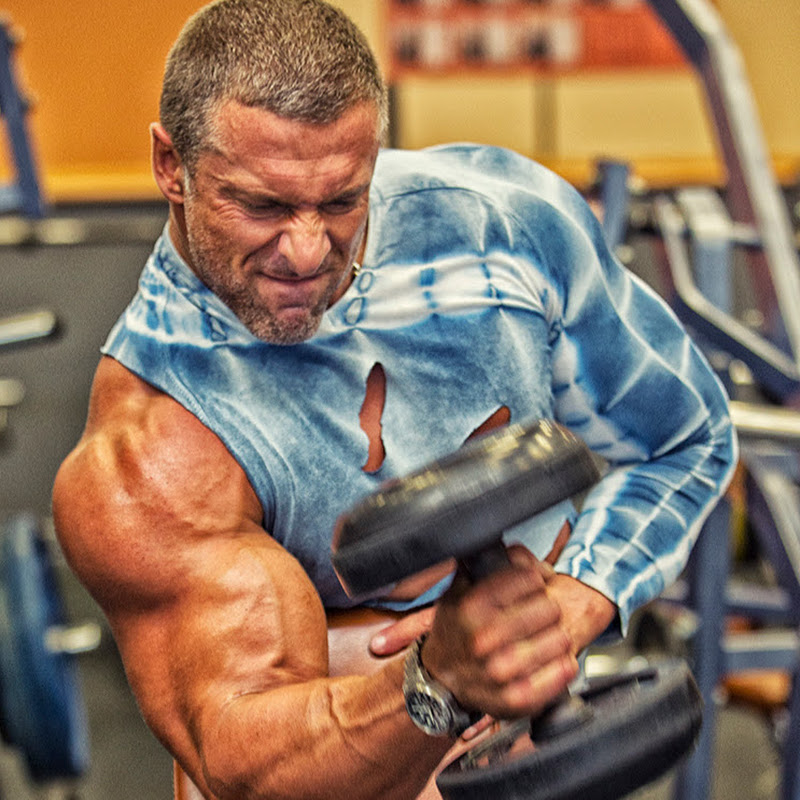
Stanislav Lindover shares a telling story from his own training: at age 25, his working flat bench stalled dead at 100 kg for 7–8 reps. No progression scheme moved the needle. So he made a radical call: he dropped the barbell completely for 2 to 3 months and switched exclusively to heavy flat dumbbell presses.
Why did that work so well physiologically?
- A barbell locks both hands onto one rigid axis. If your left arm lags behind your right, your dominant side quietly picks up the slack and masks the imbalance.
- Dumbbells move independently in space. They immediately expose weak stabilizers—rotator cuff, serratus anterior, and rhomboids. To stop two heavy dumbbells from drifting apart, your brain has to fire dormant muscle fibers at full capacity.
- Dumbbells let you use natural convergence (bringing your hands slightly closer together at lockout) and get a deeper pec stretch at the bottom without jamming your shoulder joint.
After driving his dumbbell press from 30 kg up to 38–40 kg per hand over three months, Lindover got back under the barbell—and with zero peaking prep, hit 110 kg for the same 8 reps on his very first session. That's pure cross-transfer of strength.
In our piece on honest strength-training mechanics, we showed how balancing foundational movements keeps your joints healthy for the long haul.
Heavy-Set Setup Protocol: Making Every Rep Count Safely
To make sure every working set builds muscle instead of booking you a trip to physical therapy, lock in a step-by-step setup ritual before every single unrack:
Pre-Unrack Bench Press Setup Checklist
- Shoulder blades pinched together toward the spine and pulled down toward the hips
- Traps and lats pressed firmly into the bench pad
- Feet planted flat on the floor with active tension through quads and glutes
- Closed grip with the bar sitting low over the heel of the palm—no bent-back wrists
- Eyes lined up directly beneath the barbell
Take a solid breath before unracking and lock the bar over your upper chest. Lower it under control for a two-count, lightly kiss your T-shirt without bouncing off your sternum, then drive explosively with your legs and chest. Keep your shoulder blades pinned back even at the top lockout—don't let your shoulders roll forward.
Leave your ego at the door, dial in your biomechanics, give heavy dumbbells a real block of work, and your numbers will climb again—pain-free.