Look at yourself from the side in a mirror when standing relaxed. If you spend 8–10 hours a day at a laptop monitor and holding a smartphone, there is a 95% chance your shoulders are rolled forward, your chest is caved in, and your chin juts out. In sports medicine, this is called shoulder protraction and upper crossed syndrome.
To a woman, your slouch is an instant nonverbal marker of insecurity, tension, and weakness. You can put on an expensive blazer or a coat with an impeccable cut, yet a rounded back turns your silhouette into a question mark. Worse, classic gym iron often makes it worse: barbell bench presses and pull-ups overload already-tight front delts and lats, pulling the shoulder joint even deeper forward.
Why Resistance Bands Specifically
The real rescue for your shoulder girdle is long elastic latex loops (resistance bands). Unlike dumbbells, where gravity pulls weight straight down, a resistance band creates dynamic tension in any plane. Load builds smoothly as the rubber stretches, lining up perfectly with the biomechanics of your rhomboids and deep shoulder rotators.
Top 3 baseline moves for every day:
- Band Pull-Aparts. Hold a thin band with straight arms at shoulder width in front of your chest. Exhale and pull your arms out to the sides, squeezing your shoulder blades hard together until the band touches your sternum. Do 3 sets of 15–20 clean reps with no jerking.
- Face Pulls with external rotation. Anchor the band at eye level on a pull-up bar or door anchor. Pull the ends toward your ears while rotating your forearms vertically upward. This wakes up the subscapularis and teres minor, seating the humeral head back into its anatomical socket.
- Band Dislocates. Take a wide grip on a taut band and smoothly sweep straight arms up over your head behind your back and back to the front. This opens up the pec minor and restores clavicle mobility.
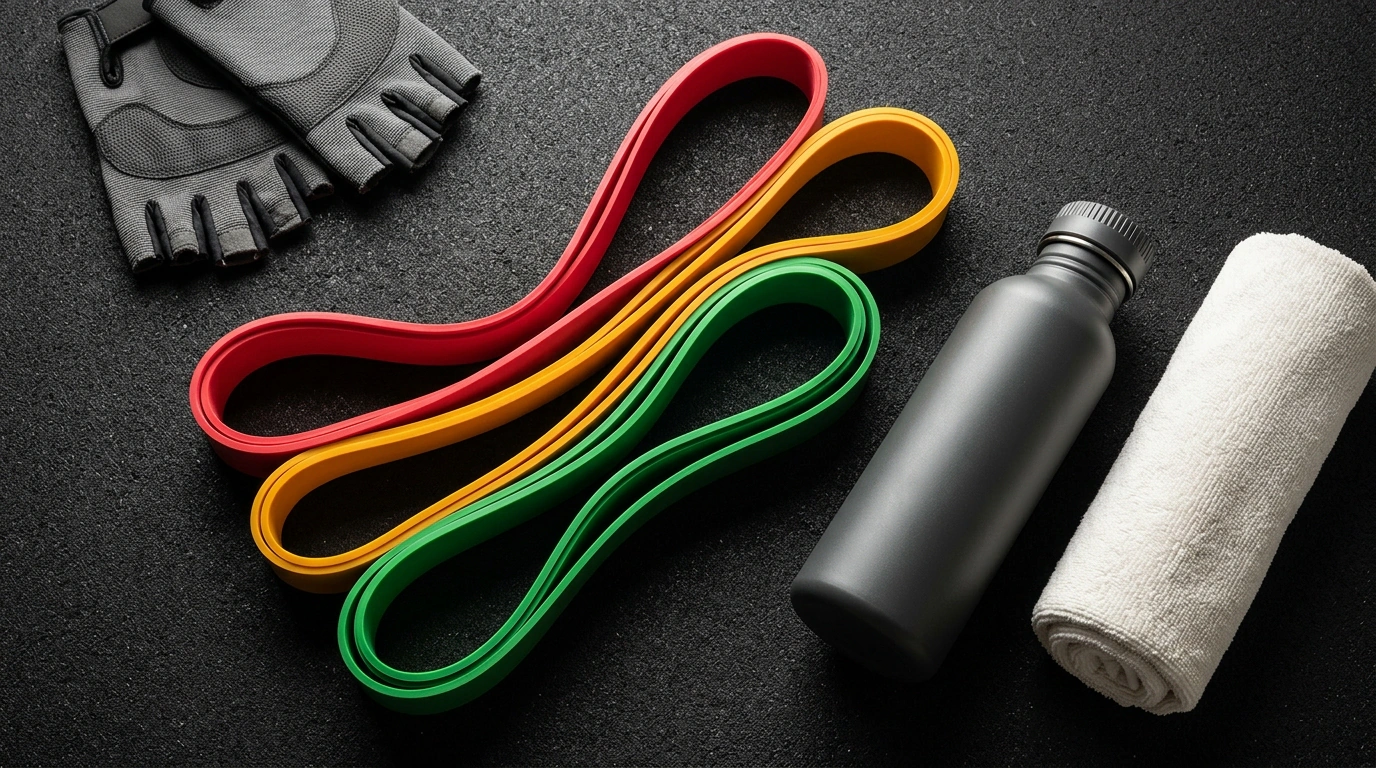
Use the thinnest band (yellow or red, 2–7 kg resistance). The point of these moves is neuromuscular activation of small stabilizers, not strength PRs. A thick heavy band recruits big muscles and ruins the whole effect.
Just 5–7 minutes with bands daily completely offsets a desk-bound day at the computer. Your shoulders will open back, your chest will lift, and your posture will gain that predatory, confident carriage that draws eyes.