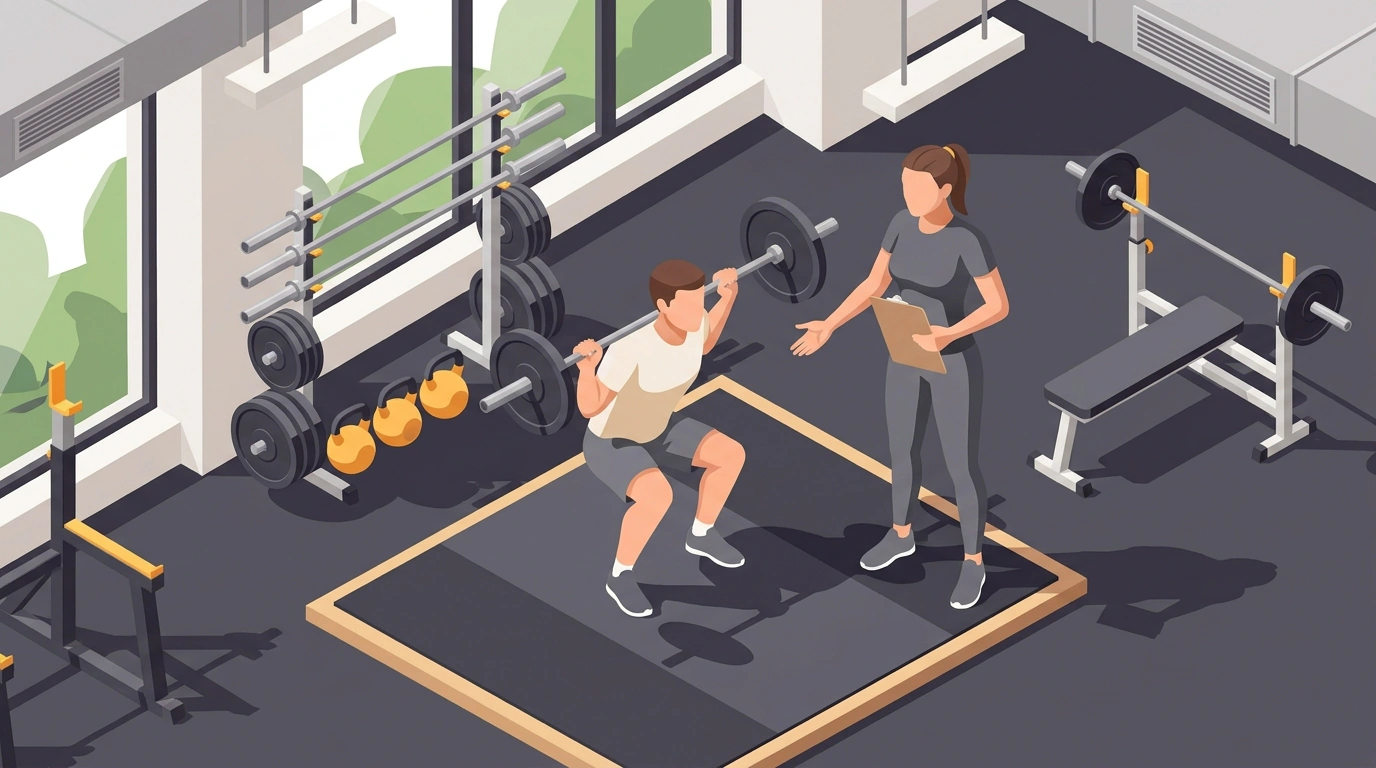
When a young guy decides to transform his physique and steps into a gym for the first time, he is often met with pushy pitches for personal training. Trainer rates at modern clubs aren't cheap, and the promises sound like fairy tales: "We'll turn you into Apollo in two months!"
The bitter reality of the fitness industry is that up to 80% of gym trainers are self-taught amateurs who took a two-week crash course or bought a questionable online certificate. They don't know anatomy or biomechanics, can't read bloodwork, and train clients using the same 1990s magazine templates they use on themselves.
An incompetent trainer won't just flush your budget down the drain—he'll virtually guarantee you lumbar disc bulges, patellar tendonitis, and wrecked shoulder joints. Let's break down the objective markers of a real pro and the major red flags that mean you should demand your money back immediately.
1. Initial Consultation: Musculoskeletal Screening
A professional never puts a beginner straight under a heavy barbell for squats or bench presses. Proper coaching always starts with a comprehensive functional movement assessment.
What a qualified specialist must do in the first session:
- Detailed health-history intake: spine injuries, fractures, dislocations, surgeries, chronic cardiovascular or joint conditions.
- Key joint mobility checks: ankle mobility (dorsiflexion), hip mobility, thoracic spine rotation, and shoulder girdle mobility.
- Visual static posture assessment: scoliotic curves, hyperlordosis, kyphosis, pelvic tilt, or flat feet.
If on session one a trainer simply asks, "So, wanna bulk up or lose weight?" and immediately tells you to hit the barbell bench press—you are looking at an amateur. Walk away without looking back.
2. Top Red Flags in a Trainer's Behavior
Watching a trainer work from the side—or training with him during your first two weeks—pay close attention to how he behaves mid-set.
Top 5 unforgivable gym sins:
- Staring at a smartphone screen. The client is grinding through a heavy working set of deadlifts with a rounded back, risking a spinal injury, while the trainer is texting on Telegram or scrolling social feeds. A pro never takes his eyes off the bar path, tracking knee angle and neck alignment on every single rep.
- One-size-fits-all programming. A 50 kg woman and a 90 kg guy get the exact same exercise template, only changing the pin on the machine. A program must account for limb leverage, mobility level, and individual goals.
- Impossible promises and fairy-tale timelines. Lines like "We'll drop 15 kg of pure fat in a month" or "We'll pack on 8 kg of lean muscle by summer" scream outright fraud. Natural male physiology allows at most 1–1.5 kg of quality lean muscle gain per month at the beginner stage.
- Pushing sketchy supplement tubs. If from day one a trainer aggressively hawks fat burners, BCAAs, or test boosters from a specific brand at the club bar to pocket his commission, he cares about your wallet, not your physique.
- Worshipping crippling soreness and puking. A trainer brags that clients can't walk for three days after his workouts or sprint to the bathroom nauseous. That is pure amateurism. The goal of training is an adaptive stimulus, not pointless destruction of your body.
An absolute red flag is a trainer casually suggesting in your first months that you "speed up progress" with anabolic steroid pills or injections. That's a criminal offense and a direct threat to your endocrine system.
3. Markers of a Genuine Expert
What a coach worth trusting with your body and money actually looks like:
- Keeping a training log. A pro tracks working weights, sets, reps, and RIR every single session. Progressive overload is built on numbers, not guesswork.
- Teaching principles, not blind obedience. A great coach explains the biomechanics: why your elbow should track at 45 degrees, how to brace intra-abdominal pressure, and why you engage your lats on a deadlift. His goal is to teach you to train smartly and safely on your own.
- Respecting form and calling a timely stop. If your bar path breaks down on rep 8, the trainer stops the set instead of yelling, "Give me three more, push through!" Joint health always outranks short-term PRs.
- Integrating sleep and nutrition. He regularly asks how many hours you slept, whether your calorie deficit is working, and whether you're hitting your daily protein target (1.6–2.0 g per kg of bodyweight).
Personal Trainer Vetting Checklist
- Conducted a thorough injury-history intake and mobility screen in the intro session
- Stays off his phone and monitors set technique continuously
- Keeps a digital or paper log of training loads
- Explains exercise biomechanics and puts safety ahead of ego weight
- Evaluates nutrition, sleep quality, and recovery status
Choose your mentor with a cool head. Your body deserves a science-backed, respectful, and professional approach.