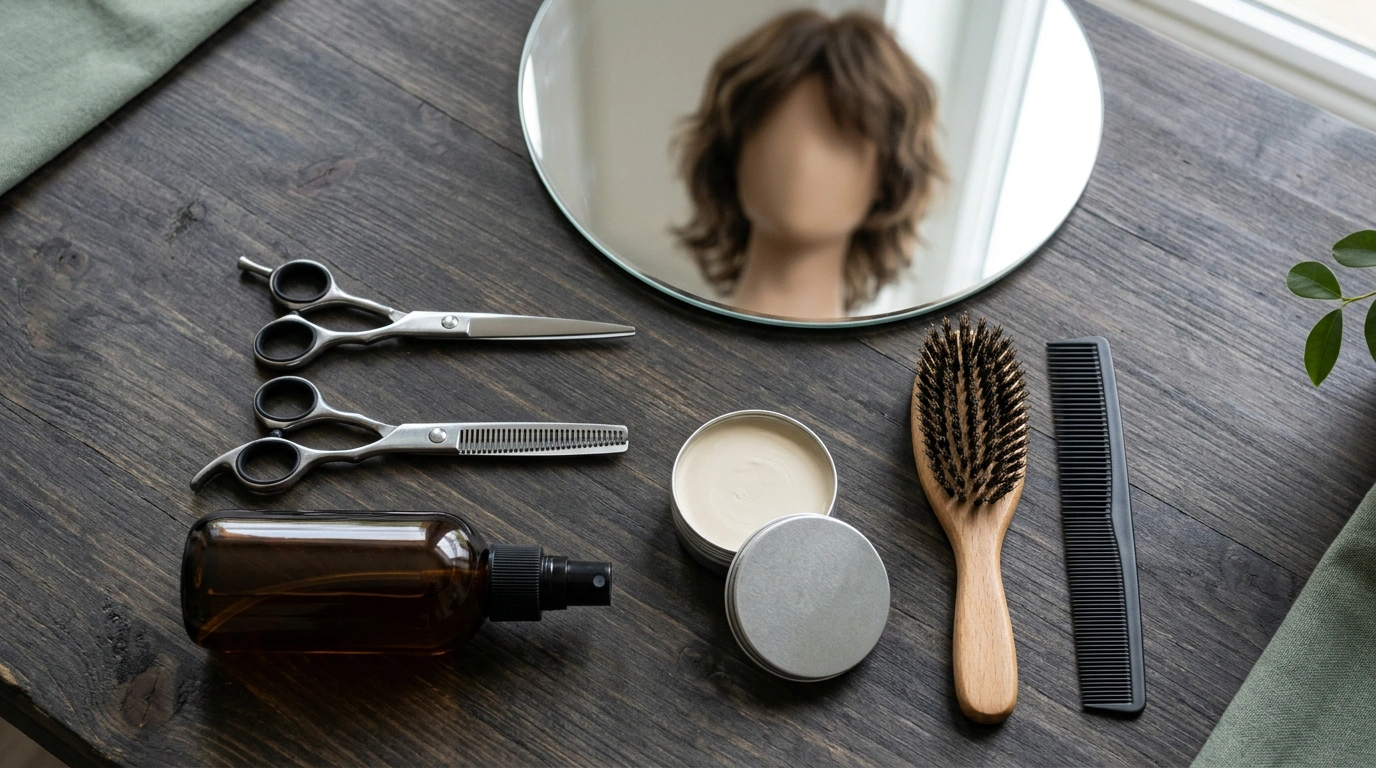
When I opened a recent grooming trend breakdown in MEN TODAY featuring commentary from Gleb Morozov, creator of the Strigonometry system, one detail jumped right out at me: in 2026, the lower edge of the go-to men's haircut has dropped down to the seventh cervical vertebra. After years of high skin fades forcing guys back into the barbershop every 10–14 days, the Soft Wolf Cut has taken over—a shape that holds its structure for a solid six to eight weeks.
Seeing all that textured volume in photos, it's easy to assume it'll turn into a shaggy mess in real life—or that your barber will reflexively buzz the sides down into a punk-rock silhouette. Let's break down whether this cut actually fits your face and hair type, what exact instructions to give in the chair, and how to style the layers without gluing them down with hairspray.
Anatomy of the Soft Wolf and What to Tell Your Barber
The secret lies in the architecture: from the 1980s mullet, the cut borrows length at the nape near the collar; from the 1970s shag, it takes graduated layers at the crown and piecey bangs. What makes the Soft version work is ditching the harsh contrast between a long tail and shaved sides.
That's right where most guys get burned. I cross-checked the guidelines in Forte Series' styling guide: the biggest mistake is simply sitting down and asking for a "wolf cut," because plenty of barbers will automatically reach for clippers and buzz the temples down to zero. Give clear specs instead: the sides must be cut strictly with scissors (scissor crop) or blended into a low taper. Keep at least 2–3 cm of length at the temples so the hair covers the top of the ear and flows smoothly into the back and curtain bangs.
Face Geometry and Hair Types: How the Sides Reshape Proportions
Watch how that single detail plays out in real life. Take a 21-year-old guy with thick wavy hair and a heavy square jaw. With a tight military crew cut, bare sides made his cheekbones and broad chin look even blockier, and within a week the sides stuck straight out like bristles. Once he grew the back out to 8–10 cm and switched to a Soft Wolf Cut, his proportions shifted: the side layers draped along his cheekbones, the fringe parted naturally, and the sharp angles of his jaw softened right out.
In my book, that's the clearest example of hair working as an optical frame for your face:
- Square and rectangular faces: temple layers and curtain bangs soften a heavy jawline, tall forehead, or slight asymmetry—just how Jacob Elordi wears it.
- Round faces: volume at the crown combined with length at the nape stretches the silhouette vertically, balancing out fuller cheeks.
- Wavy, curly, and thick straight hair: graduation removes excess bulk. Natural waves—like Timothée Chalamet's—fall into springy texture on their own, while dense straight strands—like Stray Kids' Hyunjin—gain much-needed air between layers.
When to Skip This Cut: Fine Hair and Receding Hairlines
The Soft Wolf Cut does have hard limits. First, it's a bad match for thin, sparse hair or noticeable temple recession (Norwood stage 3 and above): texturizing will expose the scalp, and length in the back only spotlights open corners at the hairline. If your hairline is creeping back, stick to rules for choosing haircuts and styling with receding temples and fact-check the noise in our breakdown of major hair loss myths. Second, pin-straight "glass" hair needs deep razor work or point-cutting, otherwise the layers hang like a bowl. Third, skip the morning blow-dry and the strands clump into stringy icicles.
Step-by-Step Morning Styling and Daily Care
Gleb Morozov stresses that a layered shape demands a matte finish—no greasy pomades or stiff hairspray. The whole routine takes exactly 3 minutes in three steps:
- Sea-salt base. On towel-dried damp hair, apply 4–6 spritzes of sea-salt spray for grip and density. If your hair is straight and slightly fine, tap a pinch of silica-based texture powder onto dry roots at the crown—it absorbs sebum and locks in volume for up to 12 hours.
- Bottom-up blow-dry. Dry wavy hair with a diffuser using circular motions on low speed to prevent frizz, or aim the airflow upward while scrunching the roots with your fingers.
- Matte finish. Emulsify a pea-sized dab of matte clay or paste between your palms and pinch the ends near your cheekbones and nape, leaving the front fringe light and free.
To keep sea salt from drying out your hair, wash with a sulfate-free shampoo and conditioner, and smooth a couple of drops of jojoba or argan oil onto the ends once a week. That exact routine solved our square-jawed guy's problem: no more prickly sides, and an effortless, lived-in cut that actually draws compliments on dates.
You can test your hair's potential right now: step up to a mirror, wet your hands, scrunch the hair from your temples toward the crown, and press your fingers above your ear. If damp strands hold a slight wave and the side pieces cover the top of your ear—go ahead and brief your barber on your next visit.