Conventional wisdom says an athletic build gets handed out at the genetic lottery in the delivery room: if you ended up with narrow clavicles, thin wrists, and visible ribs, hitting the weights is pointless—you'll stay skinny anyway and just waste your time. That belief sounds so convincing that thousands of young guys spend years hiding their arms under baggy hoodies even in summer heat, blaming their lack of size on "bad genes."
Real physiology works the exact opposite way: your starting point in the mirror says nothing whatsoever about your muscle-building potential. Take 19-year-old college student Denis: at 182 cm tall, he weighs 62 kg, and his wrist barely measures 16 cm around. Denis bought a gym membership three separate times, walked into the locker room, and walked right back home without ever touching a barbell. Two questions kept looping in his head—the same two I hear constantly from skinny guys starting out: is there any point lifting with bones this thin, and how do you avoid dying of embarrassment next to jacked regulars?
The Genetic Fatalism Trap: Why Thin Wrists Actually Help Your Aesthetics
Canadian coach Sean Nalewanyj calls judging your genetics from your untrained starting point the number-one cognitive error beginners make, and I couldn't agree more. Looking at narrow shoulders and a flat chest before you've ever trained isn't reading your DNA—it's looking at zero training age and chronic under-eating. Your muscle fibers have never once received a signal to grow. Why on earth would they look big?
Picture a bare car chassis on an assembly line before the engine or bodywork goes in. You can't guess how fast that car will run on a track by staring at an empty frame before you drop in a motor and hit the gas. In your body, your skeleton is that frame, while genetics control the engine tuning. Sure, DNA sets the ultimate ceiling for Mr. Olympia contenders and dictates tendon insertion points—you can't train your way into different ab symmetry or a longer bicep belly. If you're curious how built-in proportions and myostatin shape pro-level limits, check out our breakdown of the anatomical ceiling in fitness. But if your goal is a strong, athletic male physique, any healthy guy can pack on 8–12 kg of lean muscle over a couple of years.
Even better, what beginners view as a curse turns into an aesthetic advantage in ectomorph biomechanics:
- Small joints create visual size instead of stealing it: narrow bone epiphyses (joint heads) do nothing to cap the thickening of muscle fibers—myofibrils. Meanwhile, visually, small joints work in your favor: even moderate shoulder and arm size paired with a slim wrist creates a dramatic taper that exaggerates a wide V-shaped torso and tight waist.
- Natural leanness gives you crisp definition without brutal diets: low starting weight has zero correlation with how well your muscles respond to resistance. Nalewanyj points out a paradox from his own coaching: plenty of the most impressive physiques he's seen started out skinnier and weaker than their peers. Plus, low tendency to store visceral fat lets an ectomorph build dense, lean mass without grinding through months-long cuts.
The Spotlight Effect in the Weight Room: Where Experienced Lifters Actually Look
Physiology is clear: thin bones won't stop you from growing. So why did Denis turn around at the gym door three times? The moment he spotted guys curling 30 kg dumbbells in front of the mirror, he froze. Denis was convinced that if he unracked an empty 20 kg Olympic barbell, the entire gym floor would spin around and start smirking.
It always amuses me how identically this anxiety plays out in a guy's head. Psychologists call it the spotlight effect, famously studied by Cornell University professor Thomas Gilovich. In his classic experiment, students were asked to put on an embarrassing Barry Manilow T-shirt and walk into a lecture hall. The participants guessed at least 50% of the room would notice the shirt; in reality, fewer than 23% paid any attention. Thanks to egocentric bias, we overestimate how much strangers notice our appearance and slip-ups by two to three times.
Inside a weight room, that spotlight dims even further under physical effort:
- 95% of attention is locked inward: the guy on the bench next to you pressing 140 kg is wrapped up in his own set. Between sets, he's closing his eyes, catching his breath, listening to music in his headphones, and watching his rest timer. His nervous system literally doesn't have the bandwidth to critique your bar.
- Respect for effort instead of snobbery: seasoned lifters look at a skinny beginner with quiet respect because they see their younger selves. When Denis finally pushed past his nerves, walked up to that big guy by the bench, and asked, "Hey, are my elbows tucked right?", the lifter happily set his phone down and spent two minutes coaching his form. Gym culture respects willingness to learn, not starting numbers.
Ashamed of Skinny Legs and Lifting in Secret: What Nalewanyj and Lindover Went Through
Even well-known coaches and champions had to push through that same sticky self-consciousness. Until age 13–14 in middle school, Sean Nalewanyj considered himself a "genetic disaster": a pencil neck, tiny wrists, and protruding ribs made it feel like a losing battle. Yet after 2.5 years of consistent lifting and basic nutrition, by age 15 he had built broad shoulders and a defined chest.
Even more striking is the story of European classic bodybuilding champion Stanislav Lindover. Back in 1985, as a 13-year-old kid, he walked into sports as a certified string bean—deeply embarrassed by his skinny legs and knobby knees. Just to get near weights without feeling exposed, he joined a track-and-field javelin squad. Everyone there was just as scrawny, except he was a little more stubborn and stayed behind after practice to lift barbells in secret. Five years later, Lindover had grown so big and muscular he was physically too bulky to throw the javelin anymore.
Today, Stanislav reminds beginners of a simple truth: the gym is friendly territory, not an enemy camp. If anyone glances your way at all, it's just curiosity at seeing a new face—any mockery exists strictly inside your own head.
Your First Six Months with Iron: Three Growth Rules and a Cure for Paralysis
Once you clear the mental hurdle, don't walk straight into the second trap. Plenty of guys start out copying pro splits—training 6 days a week for 2 hours and blasting biceps with endless isolation curls. In my view, for an ectomorph that kind of marathon is a guaranteed recipe for burning out and hitting overtraining inside a month. Over your first 6 months, 80% of your gains come from 3 strength sessions a week lasting 50 minutes, built around three rules:
- Compound basics and the empty-bar rule: anchor your program on goblet squats, dumbbell bench presses, lat pulldowns, and pull-ups. Spend the first 2–3 weeks working with an empty bar or light weights to lock in mind-muscle connection and clean bar paths.
- Progressive overload in the 6–12 rep range: log your working weights and every 1–2 weeks add 1–2 kg to the bar or squeeze out one extra rep.
- Calorie surplus and protein: eat +300–400 kcal above maintenance and aim for 1.6–2.0 g of protein per kilogram of bodyweight, otherwise training just chews up your own tissue.
And to keep autonomic panic—shallow breathing, shaky hands, restless pacing—from turning you around at the entrance on day one, shift your brain onto external cues. For a deeper look at bypassing inner resistance without brute-forcing willpower, read our piece on environment architecture instead of blind willpower.
First-Day Gym Protocol Without the Freeze
- Save a 4-exercise basic plan on your phone (3 working sets each) so you aren't wandering aimlessly between racks.
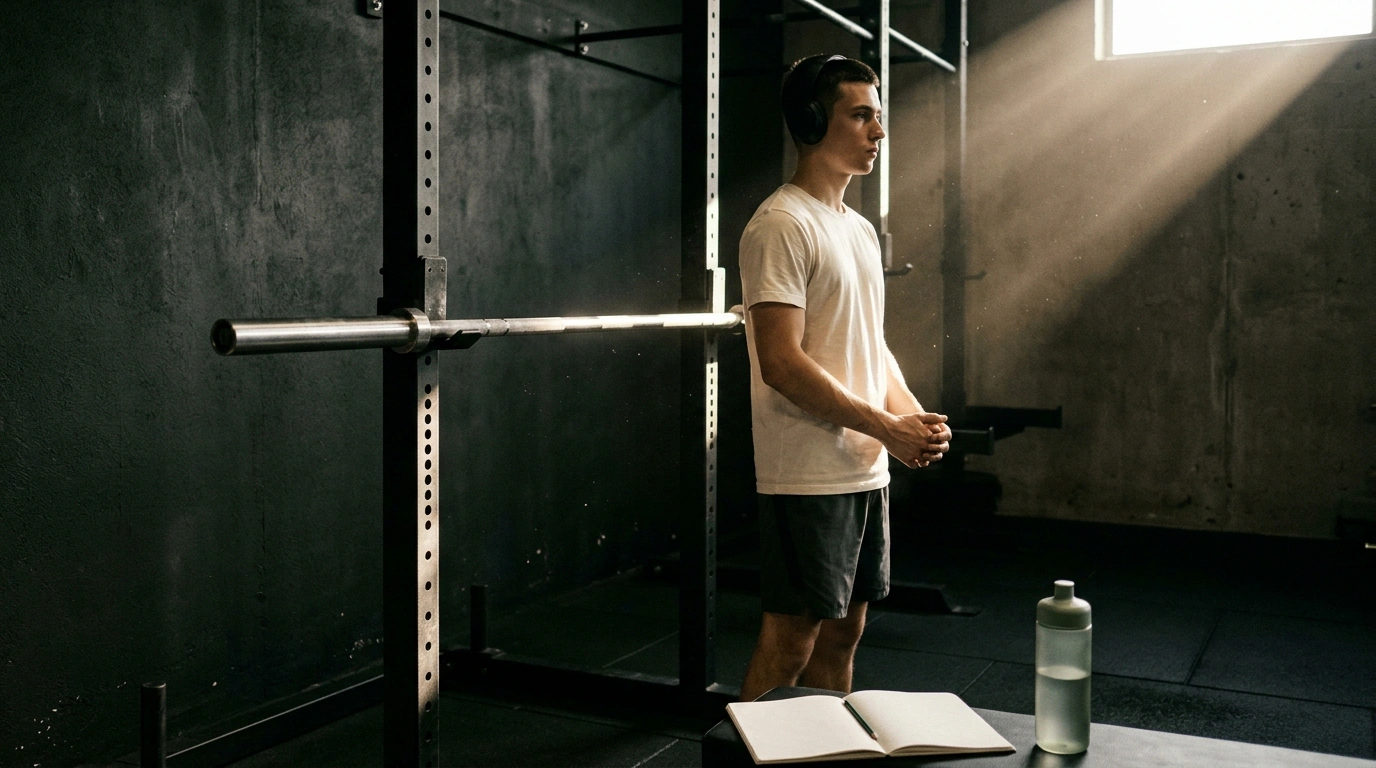
- Put on noise-canceling headphones—cutting out gym clatter locks your focus into your own bubble.
- Start a rest timer between sets and track your breathing instead of scanning the room for stares.
- Unsure about form? Ask a trainer or experienced lifter nearby—a direct question dissolves tension instantly.
Armed with that plan and a pair of headphones, Denis got through his first workout smoothly and walked out with a satisfying ache in his shoulders instead of guilt. Don't demand textbook form or big numbers on day one. In month one, your only real win is showing up in a plain T-shirt and getting your sets done. Once consistency turns into habit, the mirror starts working for your confidence faster than you expect.