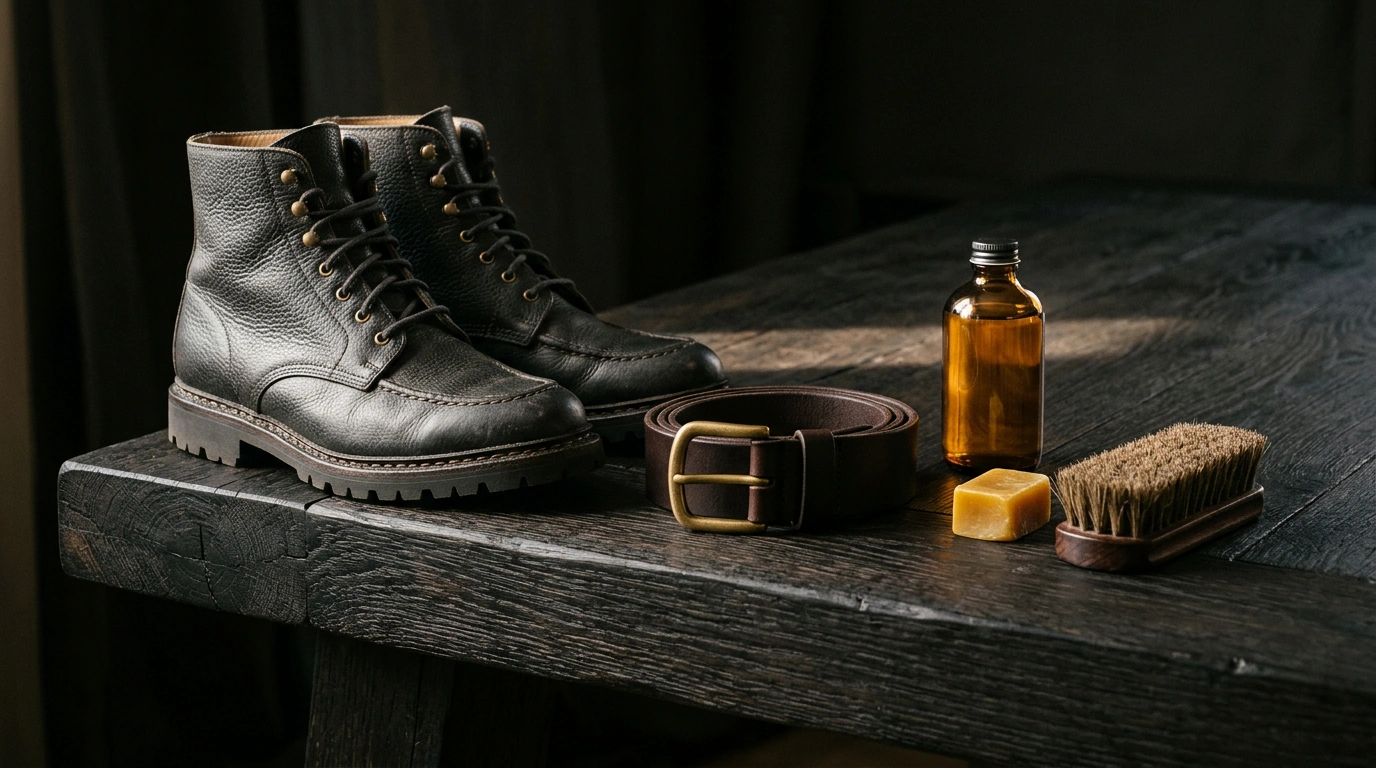
The moment you buckle a new belt with a shiny clasp or spray a hyped department-store cologne on your neck, the quiet physics of wear and tear kicks in behind the scenes. Underneath that thin plating sits brittle gray zinc waiting to rub off against your jeans. Inside a sleek winter boot, cold air is already creeping up through an uninsulated leather sole. Inside a 10,000-ruble bottle of cologne, the actual scented liquid often costs less than $5 to produce.
Your appearance works for you in the first three seconds of meeting a woman or walking into a new group. A peeling buckle, a worn-down heel, and a sharp alcohol cloud that vanishes in an hour kill that impression fast. Worse still is spending real money only to end up with disposable packaging.
Why a high price tag and a logo don't protect you from disposable gear
Menswear has long had a guiding idea called Buy It For Life—buying things built to last for years instead of falling apart by next season. It sounds like a hobby for collectors with unlimited credit cards, yet in practice this filter saves serious money in your early twenties when your budget is still tight.
A loud logo and a heavy box guarantee nothing. The market is full of 'disposable luxury,' where you pay extra for the nameplate while the inside uses the same cheap rivets and glued soles as fast fashion. Do the long-term math. Three pairs of cheap boots over three winters, two belts with flaking buckles, and a couple of forgettable cologne bottles add up to the cost of one solid piece. Meanwhile, you looked scruffy the whole time and kept running back to replace things.
You can tell a sturdy piece from a prop right in the store. Just check four areas: hardware metal, winter boot and leather construction, fragrance concentration, and classic outerwear cuts.
Solid metal vs. plating: where belts and bags fail first
The weakest link in men's accessories is small metal hardware. Belt buckles, bag clips, zipper pulls, and D-rings rub against fabric, leather, and keys every single day.
In mass-market and even many designer items, hardware is cast from ZAMAK alloy. Roughly 96% of it is zinc mixed with aluminum, magnesium, and copper. Manufacturers love it because it's cheap, casts easily into molds, and holds crisp raised logos. On its own, though, ZAMAK is dull gray, so it gets covered with a thin electroplated layer that looks like brass, chrome, or gold. With normal wear, that coating peels off within 1 to 5 years, exposing ugly gray patches. Cast zinc is also brittle and prone to tiny pores: drop your belt buckle on tile or yank a heavy bag by its clip, and the pin can snap clean off.
Solid brass (63–70% copper with zinc), stainless steel, or solid silver in jewelry sit in a different league. You can feel solid metal in your hand. Brass has a density of about 8.5 g/cm³ compared to 6.6 g/cm³ for ZAMAK, so a solid buckle feels noticeably heavier. Solid brass is also more ductile—if it takes a hit, it tends to dent slightly rather than crack. Best of all, there's nothing to peel because the metal is uniform all the way through. Small scratches polish out or age into a natural patina—a soft darkening and warm sheen that makes the piece look even better. A good solid brass buckle easily outlives the leather strap itself; you just move it onto a fresh strip of leather.
The same logic applies to luggage. A polycarbonate suitcase feels lighter on the store shelf, yet after a couple of rough baggage transfers at the airport, the plastic cracks. A solid aluminum shell on four smooth spinner wheels weighs a bit more, but dents and scuffs don't ruin it—they act like that same patina. A spotless suitcase without a single scratch belongs to someone who never flies.
Winter boots and leather: three details that save your feet in frost and slush
Cold-weather footwear is where guys get burned most often. Neat leather boots sit in the window with soft fur peeking out and a serious price tag, so you figure winter is handled. Then you step out in -10°C, stand at a bus stop for five minutes, and your toes go numb.
The first culprit is a bare leather sole with no insulation underneath. If shearling is only stitched along the sides, cold travels straight through the bottom into your foot. Proper winter boots line the entire interior with shearling or rabbit fur, including the insole.
Here's an unexpected trap, though. There shouldn't be fur on the inner heel counter. In practice, a furry heel acts like a slide: with every step, your heel slips upward and your sock bunches down under your arch. A well-made winter boot puts a smooth or suede leather patch at the heel to lock your foot in place.
The third checkpoint is how the upper joins the sole. A glued pair gets ruined after two winters of road salt and has to be tossed. Footwear built for years uses a leather welt—a sturdy strip of leather stitched to both the upper and the sole. When the outsole wears down, a cobbler simply strips it off and stitches on a fresh one.
Close-up of a Goodyear welt on a leather boot: the stitched leather strip joins the upper to the sole for easy resoling (Source: Wikimedia Commons)
For dry weather and shoulder seasons, a classic Goodyear welt (shown above) works great. The upper leather folds inward, and the cavity between the insole and outsole is filled with cork. It's comfortable and easy to resole. In harsh winters, however, cork stiffens up, and slush mixed with road salt can seep into the seam unless the welt has a raised storm lip (storm welt).
For snow and wet slush, shoemakers developed the Norwegian welt, originally built for mountain and ski boots. Thick, grained upper leather turns outward and gets stitched directly to the welt and midsole on the outside, leaving no hidden gap for salt water to sneak in. Still, the welt alone won't keep you from slipping on ice. You need a grippy rubber lug sole like Vibram or a chunky commando tread—or, for icy cities, a sole with retractable cleats.
Winter gloves follow a similar rule. Cheap smooth leather stiffens in the cold and cracks at the knuckles. The gold standard is peccary leather (from a wild South American mammal). It's supple, stretches naturally with your hand, and still resists tearing under heavy strain. Paired with a rabbit-fur lining, peccary gloves stay warm in deep frost, mold to your grip, and develop a rich patina.
Fragrance without the glass markup, and outerwear for ten years
Before a date, it's easy to fall for a heavy bottle and a famous fashion-house name. Look at the economics inside: in budget and mass-market colognes, the scented liquid itself often costs the maker under $5. The rest of your money pays for designer glass, packaging, retail shelf space, and ad campaigns.
The main spec that decides whether a scent lasts until evening is the concentration of fragrance oils in the alcohol base. Mass-market bottles often sit around a modest 10%, while dense niche formulas reach 30% or higher. Here are the standard industry benchmarks printed on bottles:
| Label on bottle | Fragrance type | Oil concentration | Average longevity |
|---|---|---|---|
| EDC (Eau de Cologne) | Cologne | 2–5% | 1–2 hours |
| EDT (Eau de Toilette) | Toilet water | 5–15% | 3–5 hours |
| EDP (Eau de Parfum) | Perfume water | 15–20% | 6–8 hours |
| Extrait de Parfum / Parfum | Pure perfume (extrait) | 20–30%+ | 8–12+ hours |
Treat these numbers as a practical guide, not a rigid law. Higher oil concentration mainly controls how long a scent stays on your skin, while projection depends on the specific aroma molecules. Still, a dense extrait goes further per bottle: a couple of sprays last all day, and you smell deeper rather than like every other guy on the subway.
Finally, look at the pieces that shape your silhouette. The cleaner and more classic the cut, the longer an item stays relevant. One solid wool overcoat in navy or charcoal for winter and a cotton gabardine trench coat for spring and fall easily last ten years, whereas loud, trendy jackets look dated in two seasons.
Add two everyday habits to that: eyeglass frames fitted to your exact bridge width and temple length (so they neither pinch nor slide), and basic maintenance. Even an expensive knife goes dull without sharpening, and a dense shaving brush turns morning shaving from a chore into a decent ritual. Things last when honest materials at the start meet simple care along the way.
What to check with your hands before buying
- Belt buckles and bag clips feel heavy and are made of solid brass or steel, not lightweight plated ZAMAK.
- Winter boots have fur under the insole, with smooth or suede leather—never fur—at the heel counter so your socks stay put.
- The sole is stitched through a welt (ideally a Norwegian welt for slush) and paired with a grippy rubber tread for ice.
- The fragrance bottle lists EDP or Extrait concentration if you want all-day longevity without paying purely for a brand name.
- Long-term outerwear uses dense wool or cotton gabardine in basic colors (navy, gray) instead of one-season statement cuts.