How do you put together a routine with strong actives without wasting money on duds or burning your face? The moment a guy starts caring for his skin, cookie-cutter advice flies in from everywhere: buy trendy retinol, apply acids strictly twice a week, and calm redness with over-the-counter hydrocortisone. Let's test each of those rules against reality.
Cosmetic retinol vs. pharmacy adapalene: why regulation beats fancy packaging
Retinoids are a family of vitamin A derivatives that speed up skin cell turnover and boost collagen production. The group includes gentle cosmetic retinol, pharmacy adapalene, and prescription-strength tretinoin and tazarotene.
Store-bought retinol comes with a catch: it's a cosmetic, not a regulated drug. Retinol breaks down fast when exposed to light and air, so grabbing a serum from a random brand is a gamble—you have no idea if the active ingredient is still potent inside the bottle. If you do buy cosmetic retinol, stick with brands backed by serious R&D labs. Dermatologists often point to Neutrogena Rapid Wrinkle Repair, CeraVe Retinol, and RoC. Among Korean brands, Beauty of Joseon stands out for using retinaldehyde, a closely related vitamin A form with similar results, while budget-friendly Gold Bond Retinol works well for the body.
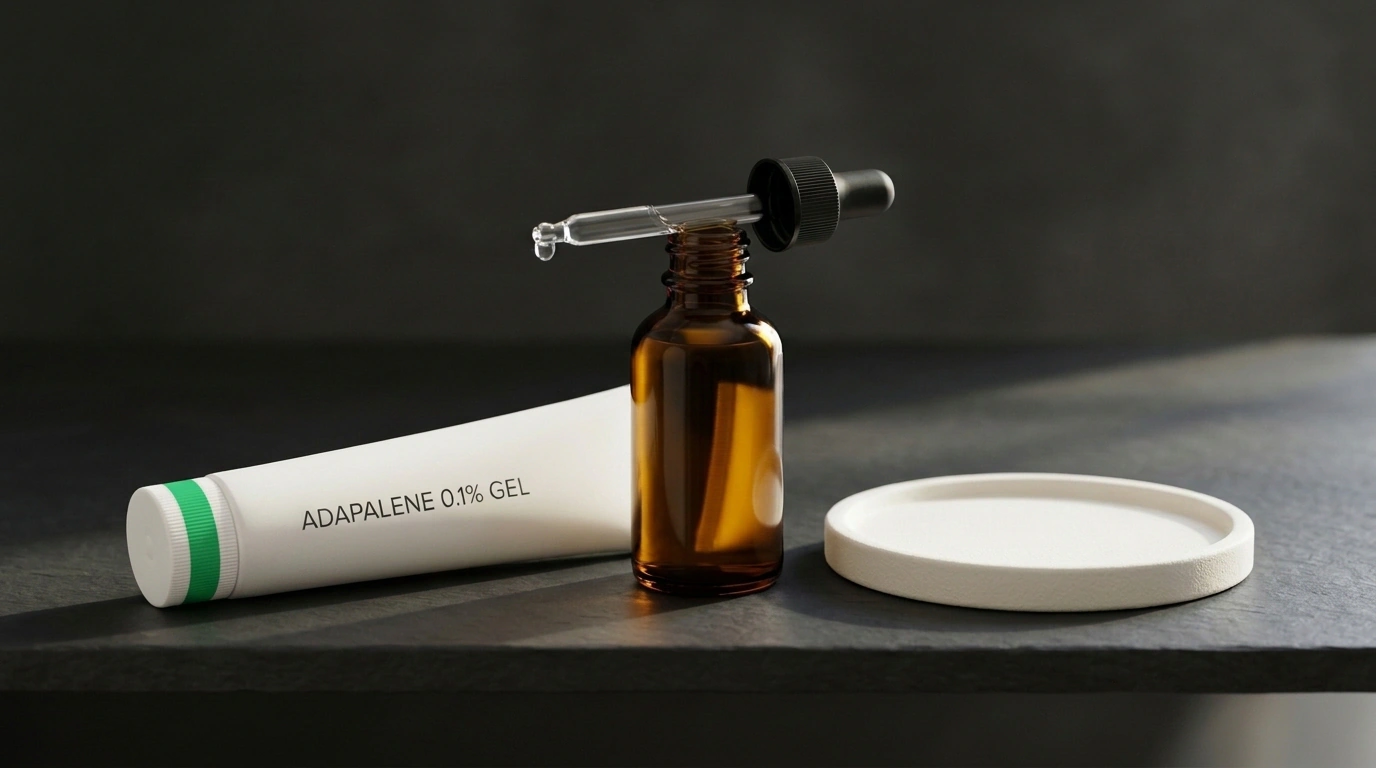
A far more predictable option is 0.1% adapalene gel from the pharmacy. In the U.S., the FDA approved it for over-the-counter acne treatment for ages 12 and up back in 2016, and in Russian pharmacies it's sold as Differin and its generics. A generic is a drug equivalent with the exact same active ingredient and strict dosage control, minus the brand markup. Here, the concentration is guaranteed by pharmaceutical standards: whatever the tube says actually reaches your skin.
There's one clear caveat: 0.1% adapalene's official approval is for acne, so using it for skin texture, dark spots, and fine lines is off-label. It also has less anti-aging research behind it than tretinoin simply because it hasn't been on the market as long. Still, randomized trials show noticeable improvements in texture, pigmentation, and fine lines after 4 to 6 months of steady use, and 0.3% adapalene matched 0.05% tretinoin with milder irritation. Dryness and flaking during the first 1 to 2 months are normal adjustment signs—manage them with a basic moisturizer and daily sunscreen.
Acids without dogma: what matters more than the 'twice a week' rule
Social media loves a strict rule: exfoliating acids like glycolic or salicylic acid should only be used 1 or 2 times a week. In reality, that number is pulled out of thin air.
Frequency depends on the acid percentage, the formula's pH, and the product format—alongside how your skin reacts. The pH measures acidity: the lower the pH and the higher the percentage, the stronger the peel and the longer the break you need. That's why safe schedules vary widely. For acne, gentle salicylic acid washes or lotions can easily be used once or twice a day to keep pores clear. By contrast, a strong leave-on peel with a low pH really does belong at 2 to 3 times a week, or strictly per the bottle's directions. When no schedule is listed, start with two evenings a week and watch your skin. No stinging or tightness? You can step it up. Spot irritation? Dial it back.
Hydrocortisone on your face: why self-treating causes dermatitis
When tretinoin, tazarotene, or razor burn leaves your face red, it's tempting to reach for pharmacy hydrocortisone cream. Chemically, steroids don't clash with retinoids, yet the rule is strict: never put hydrocortisone on your face unless a doctor prescribes it for a specific issue like short-term seborrheic dermatitis control.
Self-treating with steroid creams starts a vicious cycle. With repeated use, even over-the-counter corticosteroids thin the skin, disrupt blood vessel regulation, and suppress local immunity. Redness fades for a couple of days, then rebound hits as soon as you stop: vessels flare wider and burning sets in. You feel forced to apply more, and your skin gets hooked.
Don't use hydrocortisone to calm redness from retinoids, acids, or shaving. Quick relief on facial skin turns into steroid dependence and stubborn inflammation.
The end result of that habit is steroid rosacea and perioral dermatitis—an angry rash of tiny red bumps, pustules, and burning around the mouth, nose, or eyes. Clearing it up is tough. Dermatologists often have to prescribe a course of oral antibiotics like doxycycline alongside 'zero therapy,' stripping away all skincare products while your skin spends months recovering.