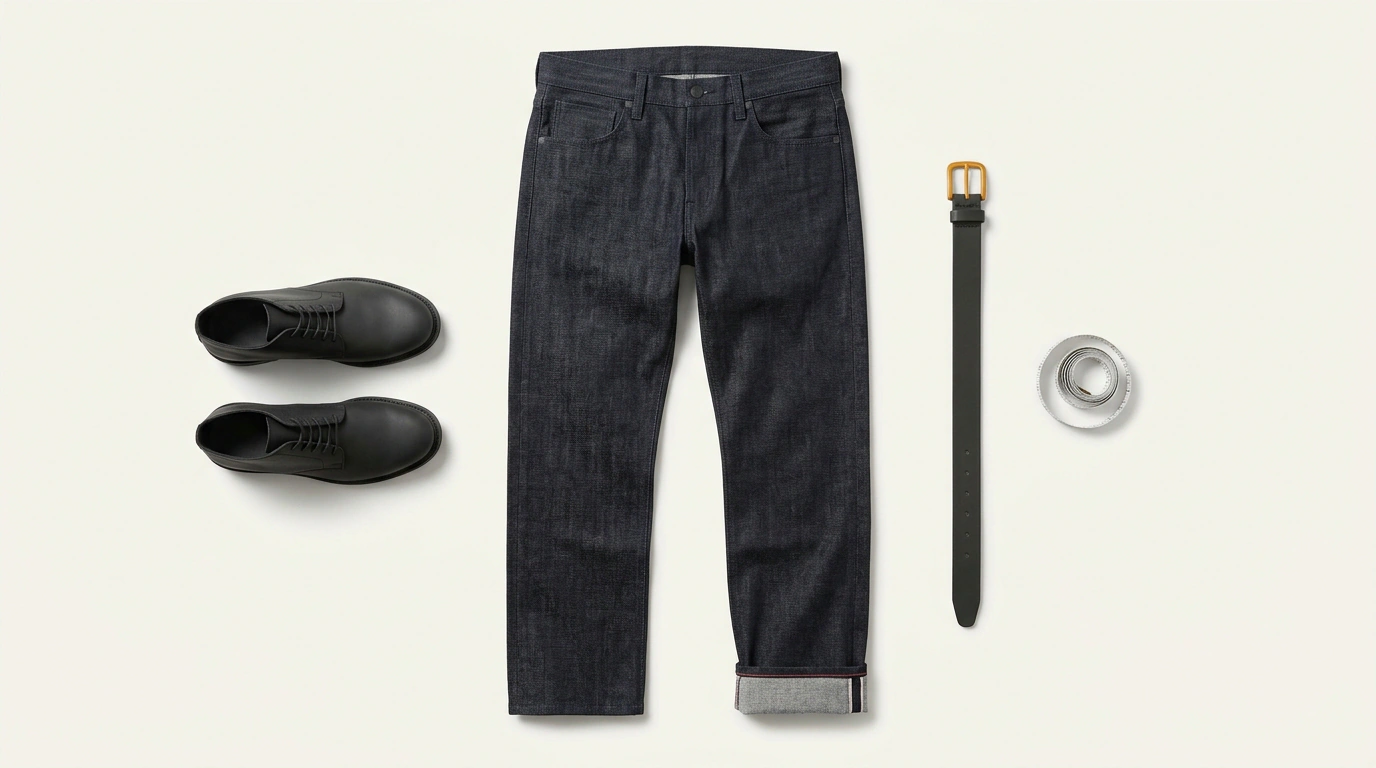
A good pair of straight-leg jeans sharpens your proportions in three seconds. Your legs look longer, your torso looks more put-together, and a plain T-shirt with simple boots suddenly reads like an intentional outfit. That only works when three things line up: rise, leg width, and length. The price on the tag comes second.
Why a straight cut holds its shape better than extremes
Skinny jeans turn legs into toothpicks, while ultra-baggy pairs in soft fabric quickly collapse into a sack. A relaxed straight cut hits the sweet spot: the leg clears your thigh comfortably and drapes straight down onto your shoes.
For an honest comparison, take a clear reference build: about 183 cm tall, 78 kg, and a baseline size 32×32. On that frame, you can see right away where a cut works and where fabric pulls at the hips or stacks awkwardly at the ankles. A solid straight pair sits at mid-to-high rise, leaves room in the thigh, and rests cleanly on top of your boots. Simple everyday geometry.
High street vs. Japanese denim: what you're actually paying for
Two philosophies compete here. The first gives you ready-to-wear pairs you grab off the rack and wear on a date tonight. The second gives you dense Japanese and designer denim bought for years ahead as a piece with character.
| Model | Segment / price | Fabric and weight | Fit note (at 183 cm / 78 kg) |
|---|---|---|---|
| Uniqlo × JW Anderson | High street, under £40 | Standard cotton, clean and distressed options | Size 32 fits well right off the rack |
| Abercrombie Relaxed Straight | Budget / mid-tier | Standard denim, many washes and inseams | Size 32×32 sits looser; brand runs slightly short |
| 3Sixteen RS-220X | Premium, £240 | Japanese raw selvedge, 14.5 oz | Size 32, high rise, extra length for cuffing or hemming |
| Kapital Monkey TH | Premium, ~£300 | Japanese denim, 14 oz (non-selvedge) | Size 32, relaxed cut, wears best unrolled |
| Our Legacy Third Cut | Designer | Italian selvedge, sewn in Portugal | Runs large (31 fits), widest cut, slightly curved leg |
High-street pairs keep life simple. Even the light, distressed Uniqlo × JW Anderson jeans are built smartly: the rips are reinforced from the inside so a knee tear won't blow open in a month. The only minor quibble is back-pocket shape, which comes down to taste. Abercrombie stands out for inseam options—whether you're tall or shorter than average, you get the right length without a tailor. Stepping up from 31×32 to a roomier 32×32 also removes tightness and lets the hem drape cleanly over boots.
In the second camp, you pay for three things: selvedge, raw denim, and fabric weight in ounces (oz). Selvedge (from self-edge) is woven on vintage narrow shuttle looms—27 to 32 inches wide instead of 60+ inches on modern factory looms. Lower yarn tension creates richer texture, and the fabric edge finishes in a clean woven band with a colored thread that won't fray and looks sharp when cuffed. Raw denim is unwashed fabric straight off the loom: stiff with starch at first, then over months of wear it softens, molds to your legs, and develops custom wear patterns called fades (whiskers at the hips and honeycombs behind the knees). Weight in ounces per square yard measures density: everyday denim sits around 12–16 oz, while the 14–14.5 oz sweet spot holds a crisp shape for years without the brutal break-in of 18–21 oz.
Finished selvedge denim edge on a cuffed jean hem, showing shuttle-loom construction (Source: Wikimedia Commons)
You feel the difference immediately. The 3Sixteen RS-220X with its high rise is a multi-year project (and the brand makes a slimmer version too). Kapital Monkey TH tests how closely you read labels: heavy Japanese denim with great texture, yet no selvedge ID on the seam. Our Legacy Third Cut strikes a balance between a fashion-forward curved leg and an everyday staple. Both camps can share one closet: basic pairs let you throw them on and go, while raw denim rewards patience.
Three fitting-room rules that save your silhouette
First, fit your thighs and leave the waist alone. When jeans run big like Our Legacy Third Cut, it's tempting to size down for a snug waistband. Don't do it. Tight thighs ruin a straight drape, whereas a little extra room at the waist disappears in two seconds with a belt.
Second, make friends with a tailor. Japanese denim often ships in a single long inseam, and that's by design. Selvedge pairs like 3Sixteen look great with one or two cuffs showing the woven edge, while heavy non-selvedge denim like Kapital looks much cleaner hemmed to your exact height and worn unrolled.
Third, match the weight and budget to the job. For light-wash jeans you wear occasionally or rotate fast, high-street denim makes sense—it's soft from day one. Paying extra for heavy raw denim only pays off when you're willing to tough out a stiff first month in exchange for a high rise, years of wear, and fades that belong only to you.