You've probably seen this classic drama before. It's evening, user traffic is at its peak, and transactions are flowing smoothly. Then an analyst or marketer decides to run a "quick" six-month summary report. One careless query with a few GROUP BY clauses and heavy aggregations pulls hundreds of millions of rows from disk, flushes the RAM buffer cache, and brings the entire production instance to its knees. Sound familiar?
I've debugged these incidents many times, and the root cause is straightforward. Classic PostgreSQL was designed from the ground up as a transactional database (OLTP). Its physical storage is row-oriented (heap pages): each row stores all its columns side by side, with a complex row-versioning layer on top, which we covered when looking at heap and MVCC architecture. To calculate the average order value across five million orders, the engine has to read every single field of every row into memory, from shipping addresses to internal comments.
Historically, teams solved this by building complex ETL pipelines that exported data overnight to ClickHouse or Greenplum clusters. That meant maintaining a zoo of systems, syncing access rights, learning a separate SQL dialect, and constantly watching for replication lag. Postgres Professional has released a major update to Postgres Pro AXE 2.0 (Analytical eXtension Engine), registered in the Unified Register of Russian Software under number 104, to solve this trade-off right inside the Postgres ecosystem.
Analytical Tables Without Changing Habits
The core idea behind AXE 2.0 is to make analytical tables first-class citizens of the database. Nothing changes for analysts or application developers. You still use the exact same SQL interface, the same BI connectors, drivers, connection poolers, and standard SELECT, INSERT, UPDATE, and DELETE commands.
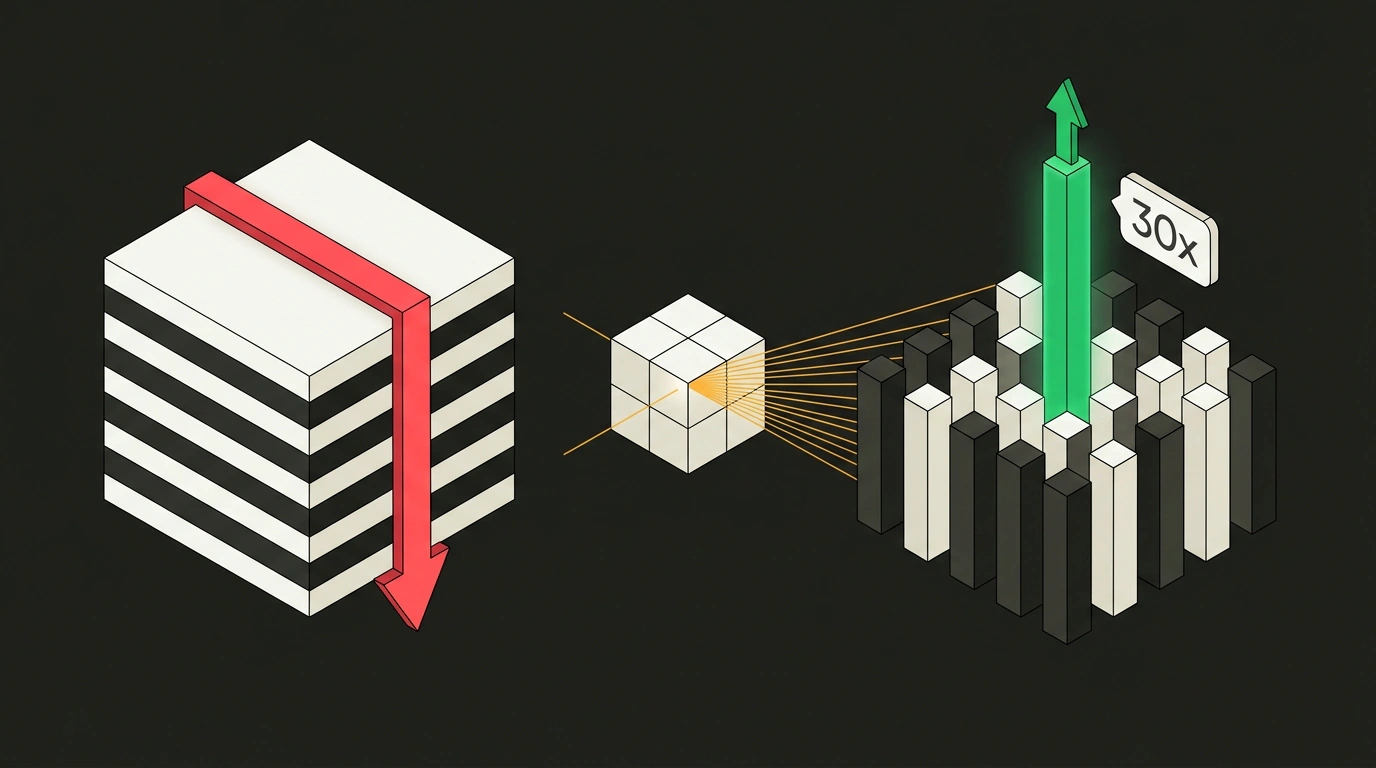
Under the hood, however, data in these tables isn't stored in standard 8 KB heap blocks. Instead, it's written in the open columnar Parquet format with dense block compression. When you query the sum of a single numeric column, the engine reads only the bytes of that specific column from disk. According to the developers, complex aggregation queries run up to 30 times faster than on the standard row-based engine.
The DuckLake Catalog: Metadata Without Scanning Disk
To navigate large sets of Parquet files quickly, AXE 2.0 uses the open DuckLake metadata catalog specification. The most interesting part is how it's implemented.
Table schemas, file lists, column layouts, partition boundaries, and checksums are stored directly in internal heap tables inside the same PostgreSQL instance. The engine doesn't have to scan and parse every Parquet file on disk to figure out which data ranges it holds. The query optimizer reads the metadata catalog with transactional guarantees, skips irrelevant files instantly, and reads only the target blocks. Even better, external Lakehouse tools like the DuckDB analytical engine can query that same Parquet layer directly without intermediate exports, echoing the approach we explored in archiving data to Parquet on S3.
Columnar files are great for reads, but they are expensive for frequent point mutations. An UPDATE on Parquet requires either rewriting an entire block or maintaining delta files for later compaction. That's why AXE 2.0 is built for batch loading and heavy analytical queries, not as a replacement for operational tables with constant single-row updates.
Unified Permissions Without Duplicate Accounts
The second major engineering advantage is security. When you move analytics to an external database, administrators have to duplicate role-based access control (RBAC) models. In AXE 2.0, access to operational tables and analytical Parquet marts is managed through standard GRANT and REVOKE commands. The same database user can read an operational queue and query last quarter's historical analytics within a single transaction.
If analytics workloads are already choking your production PostgreSQL instance, AXE 2.0 looks like a practical way to speed up reports without deploying and maintaining an entirely separate infrastructure.