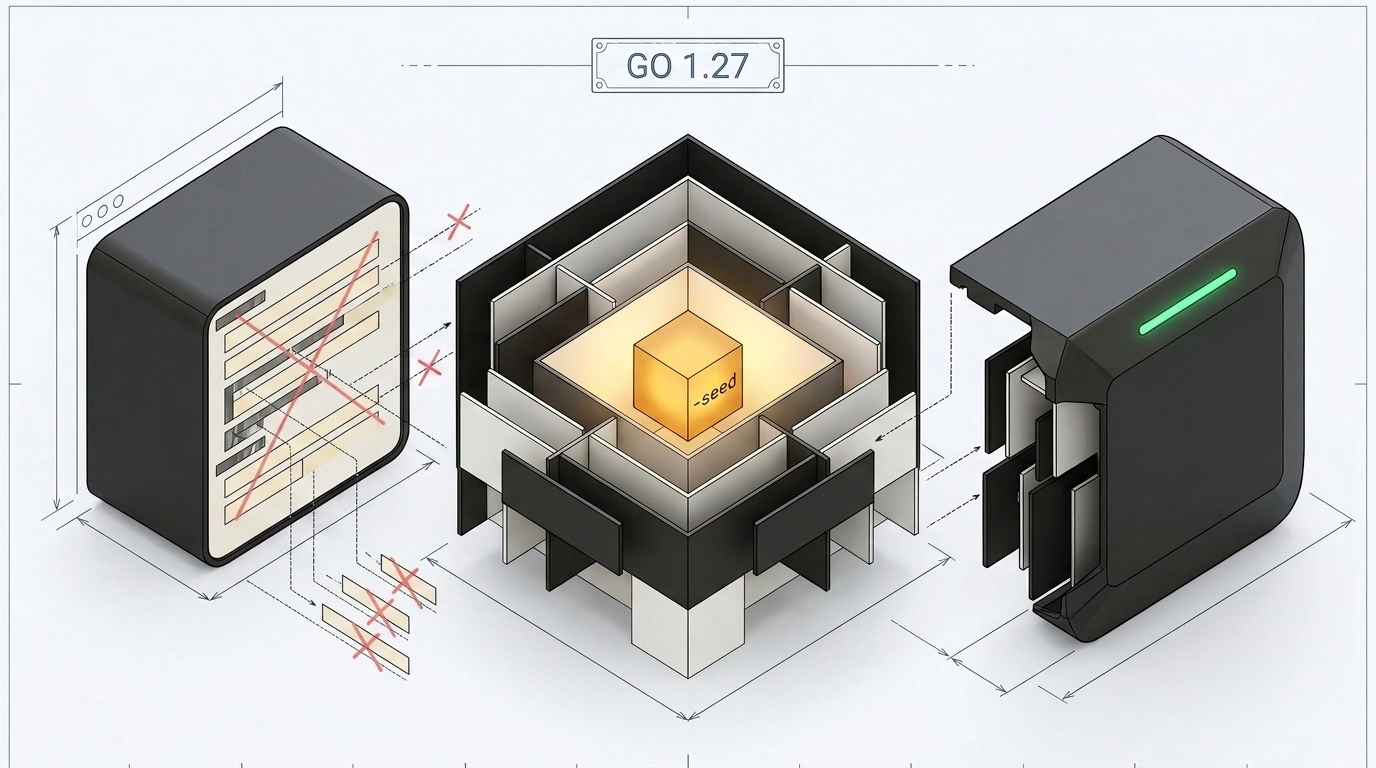
Have you ever opened a freshly compiled Go binary in IDA Pro or Ghidra, or even just run the basic strings command on it? The result is eye-opening. The executable cheerfully hands over full local source paths from your machine, every package and function name, struct signatures, and even internal error strings.
I still remember my surprise when I first saw how much debug detail Go ships to production. The Go runtime needs this metadata for reflection, garbage collection, and detailed stack traces during a panic. But if you're shipping a client CLI, a protected enterprise agent, or commercial software, that openness is a gift to reverse engineers.
The standard linker flag go build -ldflags="-s -w" only strips the DWARF table, leaving type names, package paths, and call graphs intact. That's why the Go ecosystem relies heavily on garble, the dedicated obfuscator by Daniel Martí (mvdan), which just received its major 0.18 update.
How garble Fools Decompilers
Unlike binary packers such as UPX that simply compress the whole executable (triggering constant antivirus false positives and unpacking easily with automated scripts), garble works at compile time. It intercepts Go toolchain commands, parses abstract syntax trees (ASTs), replaces readable identifiers with random cryptographic hashes, encrypts string literals, and swaps in a custom linker. The output is a completely standard, working ELF, PE, or Mach-O binary whose internal logic is turned into a maze.
Version 0.18 adds support for the Go 1.27 compiler (dropping Go 1.26). Build speed also improved by 10–15%: the modified linker now compiles in the background in parallel with package graph analysis instead of waiting until the end of the pipeline.
Build Example and Advanced Flags
You install garble through standard Go tooling and invoke it as a drop-in replacement for go:
# Install the latest version of the garble obfuscator
go install github.com/burrowers/garble@v0.18.0

# Basic binary build with encrypted string literals
garble -literals build -o protected-service ./cmd/server
If you need maximum protection along with reproducible builds in CI/CD:
# Reproducible build with control-flow flattening and aggressive stripping
garble -seed=random-crypto-seed-2026 \
       -literals \
       -tiny \
       build -o agent-minimal ./cmd/agent

# Restore the original crash stack trace from production logs
garble -seed=random-crypto-seed-2026 reverse crash.log
Control Flow Obfuscation and -tiny Mode
Release 0.18 introduces full reproducible control-flow obfuscation (//garble:controlflow). The engine can split basic blocks, insert dead branches, and flatten the control-flow graph. Thanks to the -seed flag, identical source code compiles into a byte-for-byte identical binary, which is essential for verifiable Reproducible Builds.
The -tiny mode is now even more aggressive. It strips fatal error messages from the standard library and removes C-compiler build IDs on Linux (on macOS, the Build ID is kept so the dyld system loader won't refuse to start the executable). In addition, a multi-pass type analysis now ensures that types accessed through the reflect package don't lose metadata or break the garbage collector at runtime.
Enabling -tiny completely strips panic output: when a server crashes, you'll get a meaningless list of hex addresses instead of file names and line numbers. You can only decode that stack trace with garble reverse if you safely stored the exact -seed used to build that specific release.
If you need to protect a Go binary from prying eyes without breaking platform mechanics, garble 0.18 remains the strongest and most reliable tool available today.