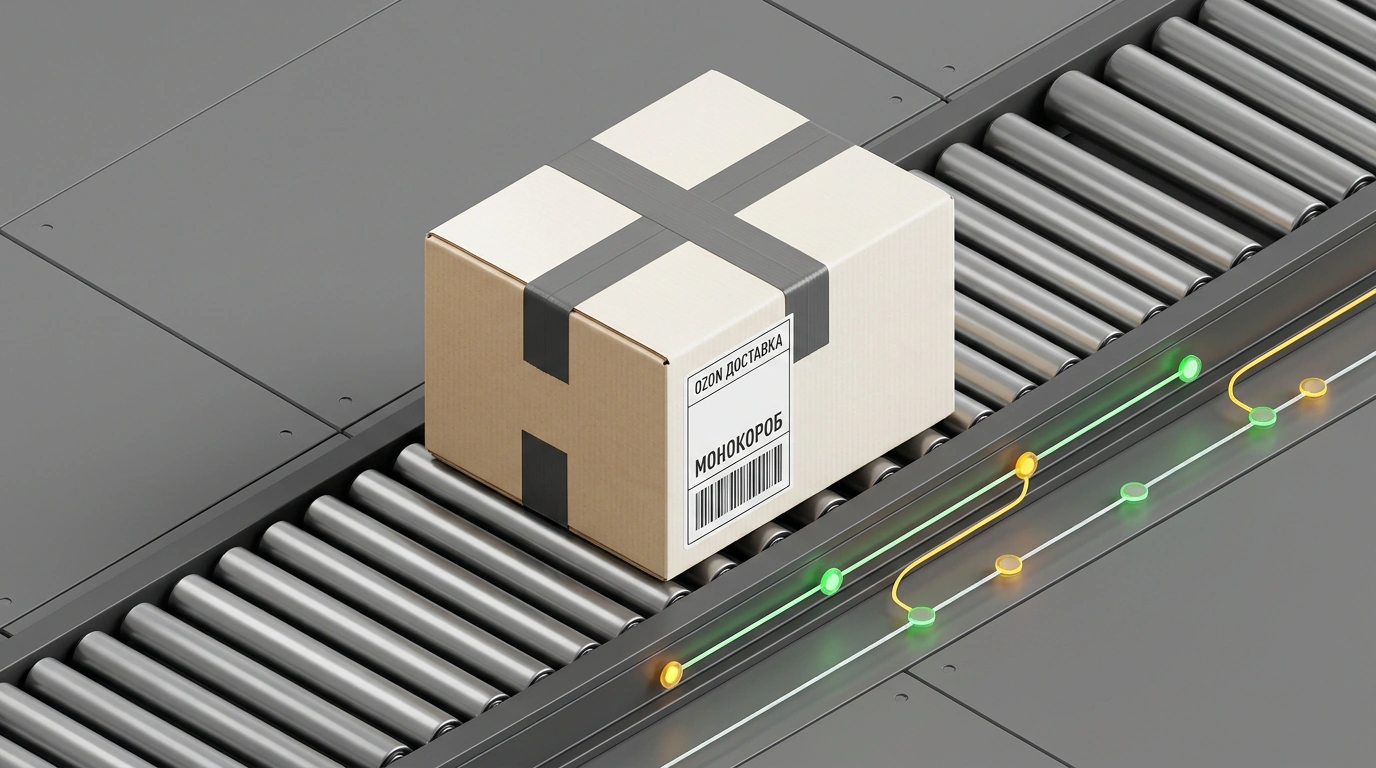
If you run your own online store, a growing social-media brand, or a B2B company, you've probably wondered how to scale nationwide delivery without building a logistics fleet from scratch. Juggling contracts with ten different couriers means constant rate headaches, unpredictable regional transit times, and endless customer complaints about missed deliveries. Right now, though, a massive shift is underway: Ozon is turning its colossal logistics machine into a full-fledged federal 3PL operator.
"Ozon Delivery for Business" is open to any merchant—even if you deliberately don't sell a single item on the Ozon marketplace itself. The infrastructure speaks for itself: over 50,000 branded pickup points and parcel lockers within walking distance in every Russian city, plus Ozon's own door-to-door courier network across 150 major metro areas. Thanks to massive freight volume synergies, the marketplace's trunk-line rates come in noticeably cheaper than traditional couriers.
In practice, however, plugging an external business into Ozon Delivery long hit two operational walls: complex API integration and exhausting queues when dropping off parcels at warehouses. Let's walk through the proven tool stack that turns this shipping channel into a smooth-running conveyor belt.
1. Integration Architecture via the ApiShip Multi-Carrier Aggregator
When developers look at Ozon Delivery's direct API docs, the typical estimate for wiring it into a CRM or storefront backend runs two to four weeks of dedicated engineering time. It's expensive, slow, and requires ongoing maintenance every time the marketplace updates its gateway.
A far cleaner and faster route is the ApiShip logistics aggregator. It acts as a universal integration gateway connecting dozens of carriers (Ozon Delivery, CDEK, Russian Post, Boxberry, Delovye Linii) through a single data protocol. Connecting Ozon Delivery through ApiShip takes roughly 15 minutes in no-code mode thanks to ready-made plugins for every popular CMS and ERP: 1C-Bitrix, InSales, MoySklad, WordPress (WooCommerce), Tilda, and 1C:Enterprise.
The step-by-step setup is dead simple:
- Register an ApiShip account while signing a direct contract for "Ozon Delivery for Business."
- In your Ozon Delivery dashboard, generate a pair of API credentials:
client_idandclient_secret. - Paste those keys into the Ozon provider settings inside the ApiShip control panel.
- Map your dispatch warehouses, handover methods (self-drop-off at a sorting center or Ozon courier pickup), and customer delivery options (pickup point or door-to-door).
- Once configured, the system automatically generates compliant Ozon shipping labels with barcodes straight inside your CRM whenever an order moves to "Ready to Ship," and customers get real-time tracking numbers.
2. How Trust Box Acceptance Works
Standard parcel handover at a sorting center—or passing packages to an Ozon line-haul driver—is slow and nerve-wracking. In normal mode, the receiving clerk has to scan every single parcel, verify dimensions, and weigh each box individually. If your batch has 150–300 orders, drop-off drags on for an hour and a half to two hours while drivers in line behind you lose their patience.
"Trust Box Acceptance" (consolidated master-box intake) eliminates that bottleneck by turning a batch into a single cargo unit:
- Individual customer orders or uniform SKUs are packed inside one large corrugated shipping master box.
- A consolidated master shipping label with a dedicated cargo-unit barcode is affixed to the outside of the box.
- At the Ozon warehouse, staff do not open the box or count parcels one by one. They simply scan the outer label, weigh the master box on a platform scale, and immediately sign the electronic waybill.
- As a result, dropping off 300–500 shipments drops from two hours to a record 5–10 minutes.
To activate this mode, submit an official request to Ozon Delivery support. Once your store demonstrates clean, mispick-free dispatches for two to three weeks, your account manager unlocks master-label generation.
3. Packaging Rules, Labeling, and Container Specs
Trust acceptance relies on strict box standards. The warehouse won't forgive sloppy packing because master boxes go straight onto automated conveyor lines:
- Cardboard strength: only heavy-duty three-layer or five-layer corrugated cardboard (grades T-23, T-24, or P-32) is allowed. Boxes with moisture damage, oil stains, creases, or old shipping labels get rejected at the gate.
- Cross-taping: the box must be taped in a cross pattern. Clear, brown, or custom store-branded tape is fine. Memorize one strict taboo: never use red tape—at Ozon warehouses, red tape is reserved exclusively for flagging damaged or defective cargo.
- Label placement: the 120×75 mm Ozon system label goes on a wide side wall so the barcode never wraps around an edge. Seasoned logistics managers always stick a duplicate label on the opposite side: if one gets scuffed on the conveyor, the scanner reads the backup without halting the line.
- Size and weight limits: a single master box cannot exceed 25 kg, and the sum of its three dimensions (length + width + height) is capped at 180 cm.
4. Dispute Evidence and Strict SLA Discipline
Under trust acceptance, the marketplace initially takes your declared parcel count at face value. The flip side is that if a dispute arises, the burden of proof falls 100% on your store.
If a buyer claims a missing item, an empty parcel, or transit damage at the pickup point, Ozon opens an internal investigation. The only legally valid evidence accepted by the warehouse is continuous video footage of the packing process:
- A high-resolution camera mounted directly overhead at the packing station.
- The frame must continuously and legibly capture the barcode of each item going into the customer polybag, the individual waybill number, and the bag being placed into the master box with the master box barcode clearly visible.
- Any jump cut, edit, or moment where the item leaves the frame invalidates the recording and gets the claim rejected.
The second critical factor is time-slot discipline. Ozon courier pickups and sorting-center drop-off windows are booked to the hour. Arriving more than 30 minutes late cancels the slot and pushes dispatch to the next day—which automatically delays customer delivery and drags down your internal reliability score. Looking at high-value Ozon removals and logistics challenges, combining proper packaging, ApiShip, and packing-table video turns Ozon Delivery into a serious growth engine for retail brands.
