When Moscow-area warehouses hit capacity during peak season and receiving slots vanish in minutes, building new boxes inside Russia seems like the obvious move. Yet Ozon and Wildberries are expanding beyond Russian borders at the same time, setting up right along key cross-border trade corridors. In effect, marketplaces are shifting from one giant central terminal to a network of border transfer hubs. When the main hub backs up, part of the flow can shift to border warehouses, while buyers in neighboring countries get orders from nearby stock. Recent news brings two clear examples—in northern Kazakhstan and near Tbilisi. Let's look at what's planned, what stage each project is in, and whether sellers should factor them in yet.
Kyzylzhar Hub in Petropavlovsk: 102,000 sq m for Ozon and Alibaba
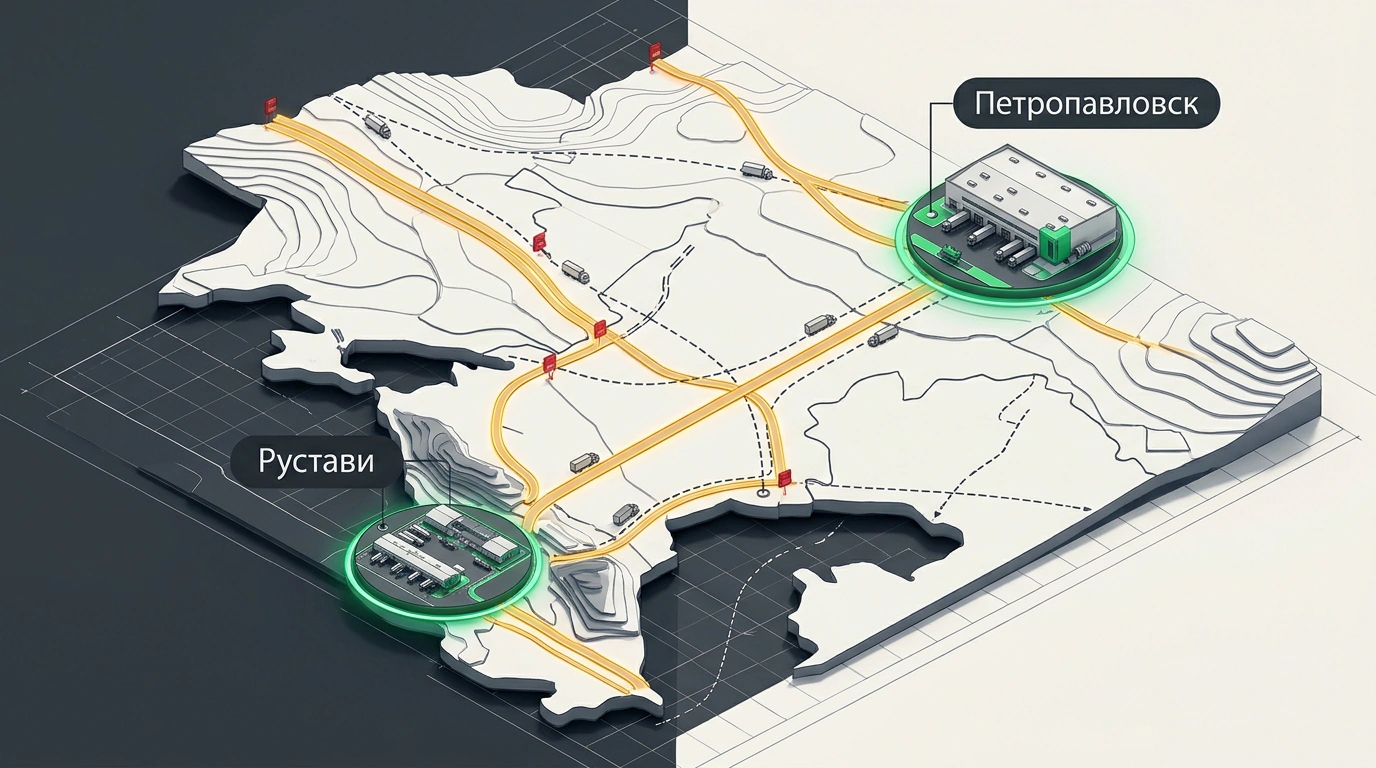
Petropavlovsk in North Kazakhstan Region sits right by the Russian border, at the crossroads of road and rail routes linking Russia, Kazakhstan, and Central Asia. Investors plan to build an international logistics center there called Kyzylzhar Hub—a major transit point to receive, sort, store, and distribute goods across countries.
The planned scale is ambitious: 102,000 sq m of space and more than 29 billion tenge (about $65.3 million) in investment. The project is backed by UAE investor Royal Investment International. On November 18, 2026, its founder Marat Salikhov discussed the concept with North Kazakhstan Region Governor Gauez Nurmukhambetov.
The project's economics rest on two pillars. First, developers want to place the hub in Subzone No. 8 of the 'Qyzyljar' Special Economic Zone (SEZ), which offers tax and customs breaks that cut launch costs. Second, the facility is designed for cross-border trade and customs clearance, with specialized storage for food and consumer goods, transshipment bays, and offices. The whole site is meant to handle storage, processing, and distribution for Ozon and Alibaba. At full capacity, it could noticeably shorten delivery legs between Russia, Kazakhstan, and Chinese imports.
Still, it's way too early to book trucks to Petropavlovsk. The project is only at the concept and SEZ subzone master-plan stage. No construction start or completion dates have been announced, and no signed contracts with Ozon or Alibaba have been made public. It's a long-term play, not a drop-off point for the upcoming season.
19.25 ha in Rustavi, Georgia: A Warehouse Complex and WB Taxi by Transkom Group
Down south, things are further along—the land is already bought. Wildberries' Georgian operator, Transkom Group (TKG), privatized four neighboring state plots back in January 2026 totaling 192,521 sq m (19.25 ha). The site sits at kilometer 17 of the Tbilisi–Red Bridge international highway near Rustavi, on the route toward the Azerbaijan border and close to customs infrastructure.
TKG hasn't shared a business plan or construction timeline. However, analysts at Georgia's Economic Policy Research Center (EPRC) point directly to the logic of the location: a large warehouse beside a highway and customs post isn't just for local orders. In their view, it can act as a backup loop where Wildberries routes part of its logistics during bottlenecks or supply-chain disruptions in Russia.
And the platform isn't starting from scratch. Wildberries' franchise has operated in Georgia since fall 2024, and TKG already leases capacity there: a nearly 13,000 sq m warehouse in Gamardzhveba (leased through June 2028, with a late-October tender to upgrade mobile coverage) and a facility in Gardabani opened in May 2025. Buying nearly 20 hectares looks like a shift from leased space to a permanent anchor hub.
Interestingly, the operator is building more than warehouses. In October 2026, TKG launched two tenders to brand cars for WB Taxi, including wrapping roughly 150 vehicles in Tbilisi. The ride-hailing service already runs in Belarus, Kyrgyzstan, and Uzbekistan, opened early access in Yerevan in September, and only needs local regulatory sign-off to launch in Georgia.
Both mega-hubs—in Petropavlovsk and Rustavi—are still in early stages with no launch dates, so there's no reason to rework your unit economics around them today. Still, the map shows where platforms are placing their bets: Northern Kazakhstan linking Russia and China, plus the South Caucasus opening into Georgia and Azerbaijan. If you already sell across the CIS or plan to test those markets, start through existing warehouses now so your listings and margins are proven by the time these new hubs open.