You've probably heard this argument in debates: "Modern medicine is trapped in a vicious cycle. Doctors invent the diseases, draw up the lab reference ranges themselves, and then use their own machines to prove their pills work. It's pure circular reasoning designed to sell us treatment forever."
It sounds catchy, doesn't it? Yet behind that neat slogan lies a fundamental misunderstanding of how scientific experiments work, where lab thresholds actually come from, and how a number on a printout differs from saving a human life. Let's walk through the mechanics calmly, without the hype.
The Null Hypothesis and Blinded Controls
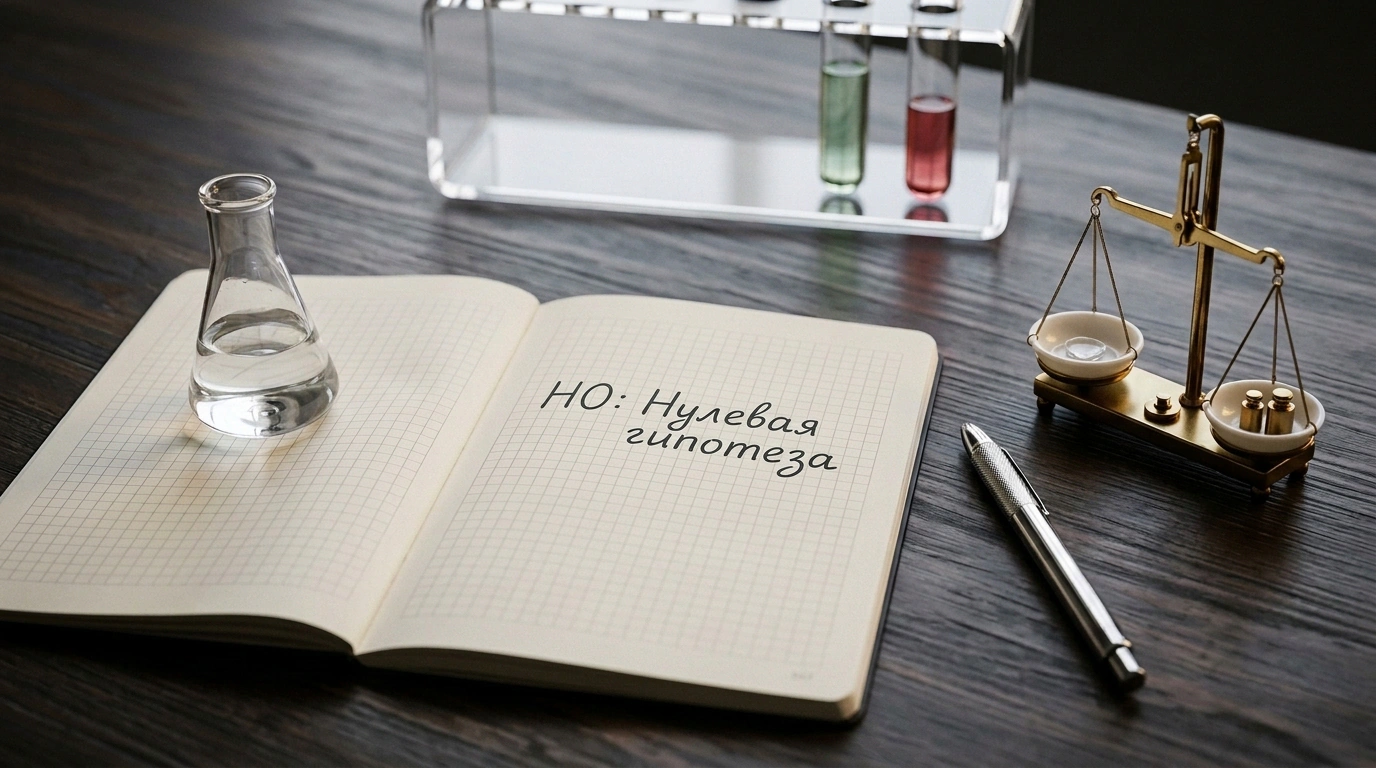
Here is the biggest divide between real science and quackery: in a clinical trial, a researcher never starts out assuming the treatment works. The bedrock of evidence-based medicine is the null hypothesis ($H_0$).
When a new molecule is tested in people, scientists assume the worst by default: the drug is useless, no better than chalk or plain water. The developers' job is to overturn that doubt in a fair, blinded contest.
That's why researchers run randomized double-blind controlled trials (RCTs):
- Neither the patient nor the doctor knows who is getting the active compound and who is getting a placebo. That strips out wishful thinking and bias.
- Patients are assigned to groups by a random draw.
- If the drug fails to beat placebo or the current standard of care, the trial is officially declared a failure and the compound gets shelved.
Studies in mice or Petri dishes are only an early safety screen. Animal results aren't proof for humans: we've already looked at why personal anecdotes so often mislead and why individual stories can't stand up to a double-blind protocol.
Surrogate Markers vs. Hard Outcomes
A skeptic might push back: "Sure, but those lab machines still belong to doctors!" That's why medicine draws a sharp line between surrogate markers and hard endpoints.
A surrogate marker is an intermediate number—like blood sugar or blood pressure. A hard endpoint is a real-world life event: did the patient survive, or avoid a heart attack, blindness, or amputation? If a drug polishes a lab number without protecting organs, regulators reject it. Take torcetrapib: it brilliantly boosted "good" HDL cholesterol by 70%, yet it increased deaths—so the entire program was shut down immediately.
How Lab Ranges Are Calibrated
Where did the fasting venous plasma glucose cutoff of 7.0 mmol/L come from? Experts from ADA/WHO (Diabetes Care, 2003; DOI: 10.2337/diacare.26.11.3160) matched blood sugar readings from thousands of people against stereoscopic photos of the back of the eye. Below 7.0 mmol/L, diabetic retinal damage (retinopathy) appeared in fewer than 0.5% of people. Cross 7.0 mmol/L, and the rate of eye-vessel damage spiked to 15–20% and higher. A lab cutoff isn't a backroom deal—it's the biological cliff where target organs start breaking down.
The Myth That Medicine 'Never Cures Anything'
The claim that "doctors only mask symptoms with pills" falls apart the moment you look at modern infectious disease care.
Take viral hepatitis C. Not long ago, a grueling year-long course of interferon cured only about half of patients. Today, an 8–12 week course of pangenotypic direct-acting antiviral pills does the job. Meta-analyses (Liver International, 2018; DOI: 10.1111/liv.13673) show that over 95–98% of patients achieve a sustained virologic response. Viral RNA disappears from the body for good, liver inflammation stops, and the person is genuinely cured. That is radical biological eradication, not "symptom masking."
If a number on your lab sheet is flagged, don't jump straight to panic. Ask your doctor: 'What does this shift mean clinically for someone my age?', 'Is there any risk to target organs?', and 'Should we retest in 2–4 weeks?' A single out-of-range result out of context is not a diagnosis.
Evidence-based medicine doesn't run on a closed loop of mutual back-scratching—it runs on relentless cross-checking and the willingness to admit when a hypothesis fails. That built-in skepticism is what keeps us alive.