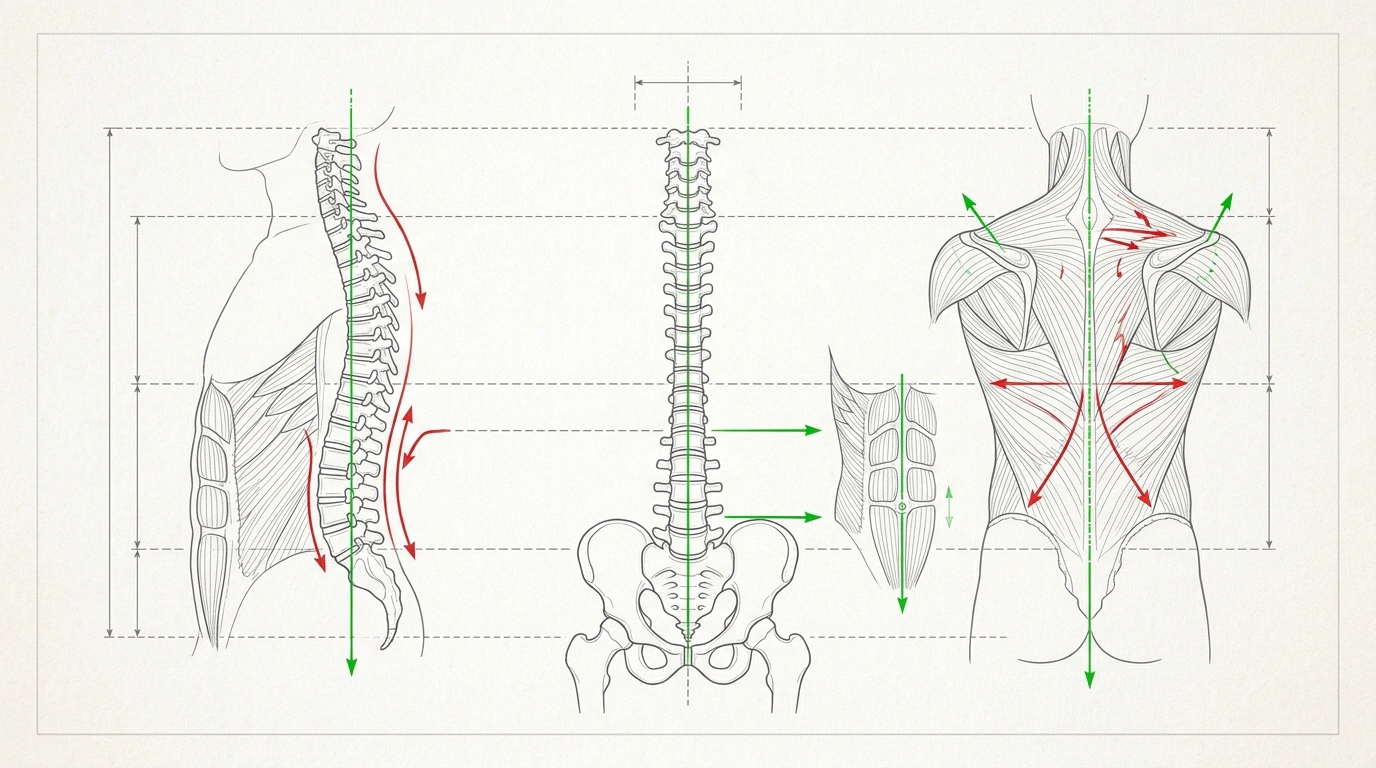
Look at yourself in a full-length mirror. Do you notice one shoulder sitting a touch higher than the other, your collarbones looking slightly uneven, or one pant leg always seeming to drag longer? Or maybe your bag strap stubbornly slides off the same shoulder every time you walk?
Subtle asymmetries like these show up in nine out of ten adults. In everyday life, we immediately slap a label on it: "I have scoliosis, I need to fix this." From there, most people pick one of two standard routes. Option one: buy an elastic posture corrector from the pharmacy. Option two: hit the gym and hold a 90-second plank to "build a muscular corset."
The biomechanical paradox is that both approaches aren't just unhelpful—when asymmetry is present, they often make the imbalance worse. Let's look at how muscle balance actually works and why you can't iron out a curve with symmetric exercises.
Two Kinds of Asymmetry: Bones vs. Habits
Before trying to fix anything, you need to know what you're actually dealing with:
- Functional asymmetry (reversible): This is a soft-tissue and movement-habit issue. For years, we sit cross-legged at a desk, sling a backpack over one shoulder, or type turned slightly toward a monitor. Your nervous system adapts: some muscles tighten into chronic spasm while others get stretched out. Often the root sits lower down—say, one foot arch collapses inward, tilting the pelvis so the spine builds a compensatory curve above it. This kind of asymmetry is fully reversible with smart movement therapy.
- Anatomical (structural) asymmetry: Here the root cause lies in bone: a true leg-length discrepancy or wedge-shaped vertebrae. Exercises can't reshape adult bone. Even so, targeted training still protects your joints and spinal discs from overload.
Why Classic Planks Only Lock In the Spasm
What happens when someone with an asymmetrical back tries to "strengthen their core" with standard planks or squats?
Picture a drawn bow. On the concave side of the curve, the bowstring is pulled taut—in your body, those are shortened muscles locked in constant tension. On the convex side, the muscles are overstretched and weak.
When you drop into a straight plank, your nervous system takes the path of least resistance: it recruits the fibers that are already firing—meaning the tight, spasmed side. The weak side barely clocks in.
Symmetric loading simply cements the imbalance: what's tight gets tighter, and what's weak stays stretched. We've already explained why you shouldn't force your back straight when muscular balance is off.
Schroth and SEAS: How Evidence-Based Rehab Corrects Asymmetry
In international scoliosis rehabilitation clinics, standard symmetric gym workouts aren't the tool of choice. The scientific society SOSORT relies on two evidence-backed approaches: the Schroth method and SEAS:
- Asymmetric positioning: The shortened side is gently lengthened while the weak side is placed in a position to stabilize.
- Schroth rotational breathing: You consciously direct your inhale into the sunken ribs, using internal air pressure to expand and derotate the rib cage.
- Active 3D self-correction (SEAS): You learn to engage deep postural muscles yourself and hold neutral alignment during everyday moves—walking, bending, or reaching overhead.
Why does your back look tall and even right after a great session, only for your shoulders to sag again by evening? Over the day, spinal discs lose up to 10–15% of their fluid under gravity, and deep postural fibers fatigue. Remodeling the collagen framework of fascia takes 3 to 6 months of consistent work. We traced that whole chain in our breakdown of the biomechanics of muscle tightness.
Rigid Chêneau braces are custom-molded from individual casts and prescribed by orthopedists strictly for growing children with progressive scoliosis above a 20-degree Cobb angle, to slow the curve before growth plates close. For an adult, an elastic pharmacy posture strap only causes muscle atrophy: it switches off your deep stabilizers, leaving your back even weaker once you take it off.
The Brace Illusion: Why Elastic Straps Weaken Your Muscles
Buying an elastic posture corrector feels like an easy shortcut: slip it on under your shirt and your shoulders pull right back.
For your body, though, it's a disservice. Your organism is thrifty—if an external strap holds your shoulder blades in place instead of your deep back muscles, your brain dials down muscle tone. Your stabilizers detrain. Take the brace off after a couple of hours and you slump even harder because your living support system has been sidelined. Tight straps also cinch the rib cage, restricting your diaphragm and breathing.
The only reliable brace is your own trained muscle and fascia. In our guide to the anatomy of stretching without body imbalances, we showed how mindful movement restores freedom without external clamps.
If you've noticed an asymmetry, skip the drugstore straps and start with a physical therapist or rehab specialist. Add myofascial release for tight areas, practice deep 3D breathing, and restore mobility to your feet and hips. Your body will naturally stack back into an effortless upright line.