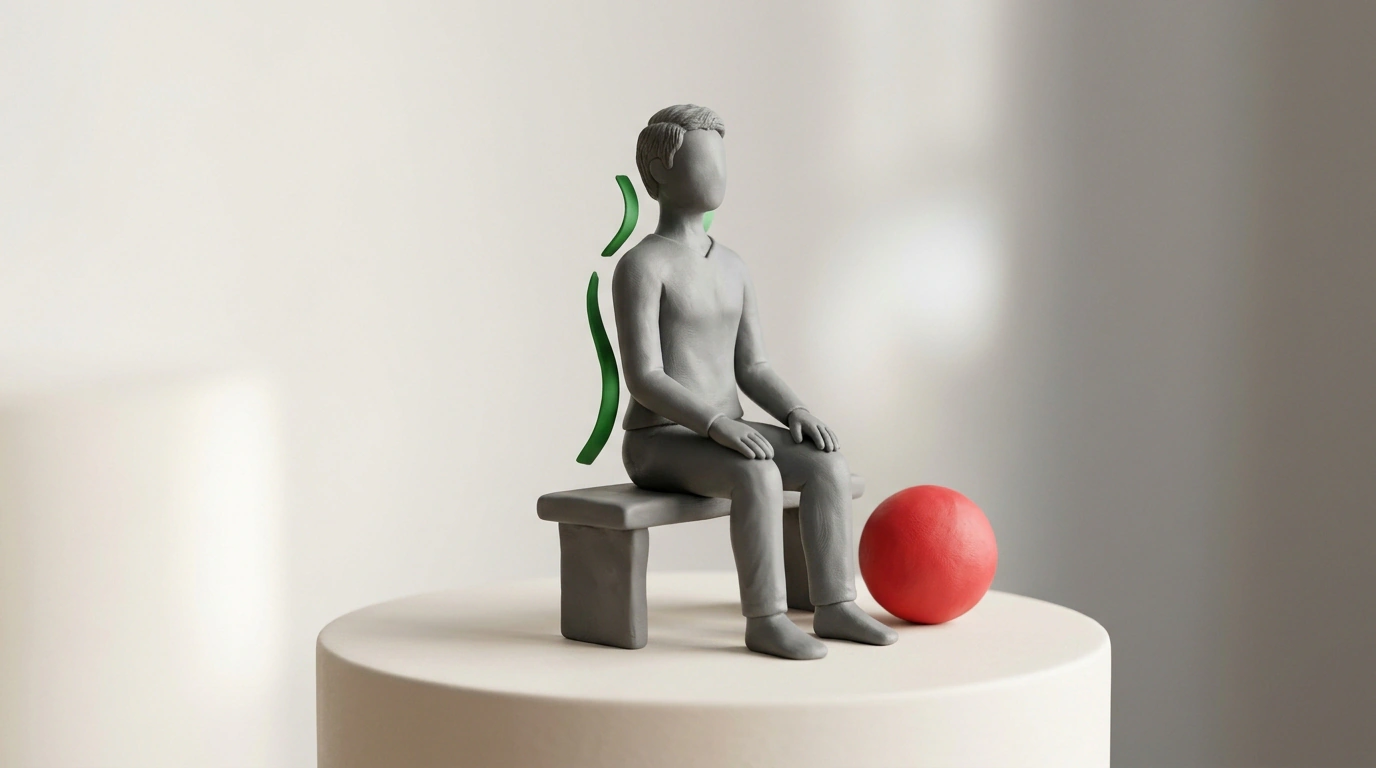
Think about how many times during a workday you catch yourself thinking, "Slouching like a question mark again!" You summon your willpower, snap your shoulders back, pinch your shoulder blades together, and try to sit upright like you're on parade. Exactly three minutes later, a dull ache starts throbbing in your neck, a burning tightness flares between your shoulder blades, your focus evaporates, and you gratefully slump right back toward the keyboard.
I made that exact mistake for years, trying to beat poor posture with sheer willpower. How hard could it be to just sit up straight? As it turns out, anatomy and biomechanics don't bend to willpower. Forcing your back straight isn't just pointless—it is physically hard on your musculoskeletal system.
Good posture isn't a stiff, wooden pose you hold by clenching muscles. It is a dynamic, reflexive balance of muscles and fascia that your nervous system is meant to run on autopilot.
Let's look at why the "squeeze your shoulder blades together" cue backfires—and how to actually bring ease back to your shoulders.
Upper Crossed Syndrome: Stepping on the Gas and the Brake at Once
In sports medicine and rehab, a rounded upper back with a forward-jutting head is known as upper crossed syndrome—an anatomical pattern first described last century by the legendary Czech neurologist Vladimir Janda.
When you spend hours hunched over a laptop or phone, a criss-cross pattern of muscle imbalance develops:
- Chronically tight, shortened muscles: the pectoralis minor and major, the upper trapezius (those rock-hard ridges at the base of your neck), and the levator scapulae. The pectoralis minor attaches to the coracoid process of the shoulder blade; when it spasms, it literally pulls your shoulders forward and down, compressing nearby nerves and blood vessels.
- Overstretched, "switched-off" muscles: the rhomboids between your shoulder blades, the middle and lower trapezius, and the deep neck flexors.
This is where a basic law of neurology kicks in—reciprocal inhibition. When your chest muscles stay chronically overactive, your nervous system reflexively dials down their opposing muscles on your back. Trying to force your shoulder blades together against tight chest fascia is like flooring the gas pedal with the parking brake still engaged. Those weak rhomboids instantly overload, the junction between your neck and upper back jams up, and your brain locks down the spasm even harder to protect your spine. We saw a similar mechanism in our piece on why regular massage doesn't save your back when breathing mechanics are stuck.
Four Steps to Free Your Shoulders: Ball, Ribs, and Shoulder Blades
To restore your body's natural upright alignment without pain or strain, physical therapists use a simple four-step sequence.
1. Myofascial Release for Trigger Points
Before asking your back to work, you have to release the "parking brake." Grab a firm rubber or cork ball (a lacrosse ball or even a tennis ball works). Press it into your pectoralis minor—diagonally between your shoulder joint and collarbone. Find a tender, dense spot and lean gently into it with your hand or against a wall for 20–30 seconds. Sustained pressure signals fascial receptors to let go, easing the spasm and freeing your shoulder blade.
2. Restore 3D Ribcage Breathing
Notice how you breathe when you're slouched: your chest is compressed, so with every inhale your shoulders creep up toward your ears. That's apical, neck-driven breathing. Place your palms on the sides of your lower ribs. Take a slow breath in through your nose, directing the air sideways and backward into your mid-back as if expanding your ribcage in 360 degrees. Keep your shoulders completely still. Just 4–5 of these breaths immediately take tension off your neck.
3. Activate Your Shoulder Blades by Gliding Down
Forget the cue to "pinch your shoulder blades together." The natural anatomical movement is gliding them straight down—imagine gently tucking the bottom tips of your shoulder blades into your back jeans pockets. At the same time, let the crown of your head float softly toward the ceiling, tuck your chin slightly back, and keep your lower back from overarching.
2-Minute Desk Reset
- Place your hands on your lower ribs and take 4 slow nasal breaths, expanding sideways and into your back without lifting your shoulders
- Glide your shoulder blades down and slightly wide, as if sliding their tips into your back pockets
- Give a gentle chin nod backward (a light double chin) to stack your ears back over your shoulders
- Check your screen height: the top third of your monitor should sit right at eye level
4. Everyday Ergonomics
All the mobility drills in the world won't stick if your monitor sits too low, forcing you to crane your neck forward like a turtle poking out of its shell. Raise your screen so the top third sits at eye level, and bump up your font size by 20%. When your eyes don't have to strain, your body has no reason to lean forward.
Give your body freedom of movement instead of a straitjacket of tension, and healthy posture will return naturally.