Picture this: you are touring a new apartment or country house, look out the window, and 150 meters away stands a row of towering high-voltage power pylons. The wires hum softly in damp weather, and alarming internet articles instantly flash through your head: "radiation destroys cells," "living near power lines causes tumors," "chronic headaches and insomnia are guaranteed."
I have heard panicked questions from friends more than once: "Should we even buy this place with power lines nearby? Won't we get irradiated?" Fear of invisible forces makes total psychological sense—anything we cannot see or touch feels inherently sinister.
Let's put on the lenses of physics and epidemiology to separate real, measurable risks from everyday radiophobia.
The Physics of Power Lines: Why EMFs Are Not Radiation
The most common mistake critics of power lines make is confusing ionizing and non-ionizing radiation. When people hear the word "radiation," they immediately picture Chernobyl fallout, X-rays, or gamma rays that knock electrons off atoms and shatter DNA.
High-voltage power lines work on an entirely different physical principle:
- Power lines generate extremely low-frequency electric and magnetic fields—50 Hz in Russia and Europe (60 Hz in the US).
- The wavelength of a 50 Hz electromagnetic field is a massive 6,000 kilometers.
- The energy of a single quantum (photon) at 50 Hz is vanishingly tiny—about $10^{-13}$ electronvolts (eV). Breaking a chemical bond in DNA or stripping an electron from an atom requires at least 10–12 eV.
That is a gap of hundreds of trillions of times! The electromagnetic field around power lines is strictly non-ionizing. Physically, it cannot cause genetic mutations, accumulate in your furniture, make your walls "radioactive," or leave any lingering contamination behind.
The GEOCAP Study and the Mysterious 2B Category
So where did the scary rumors come from? Back in 2002, the International Agency for Research on Cancer (IARC, part of the WHO) classified extremely low-frequency magnetic fields as Group 2B ("possibly carcinogenic to humans").
That sounds alarming until you look at what Group 2B actually means in science. Experts place factors here when there are weak, inconsistent statistical associations in a few human observational studies, but no evidence in animal models and no confirmed biological mechanism. For perspective, aloe vera extract, pickled vegetables, and ginkgo biloba extract sit in the exact same 2B category.
France's largest study on the topic, GEOCAP (published in the British Journal of Cancer), analyzed data on 45,000 children from the national pediatric cancer registry. Researchers did spot a weak statistical signal for higher leukemia risk in children under five living within 50 meters of ultra-high-voltage lines (225–400 kV).
Yet when scientists modeled and calculated the actual magnetic field strength at each home, a striking paradox emerged: there was no dose-response relationship. If magnetic fields were truly causing the illness, risk would rise steadily as field density in microteslas (µT) increased. The absence of that link points directly to confounding factors: busy highways with heavy exhaust fumes often run alongside power-line corridors, and cheaper housing near utility easements historically attracts lower-income families with poorer access to healthcare.
The Physics of Distance: How Magnetic Fields Fade
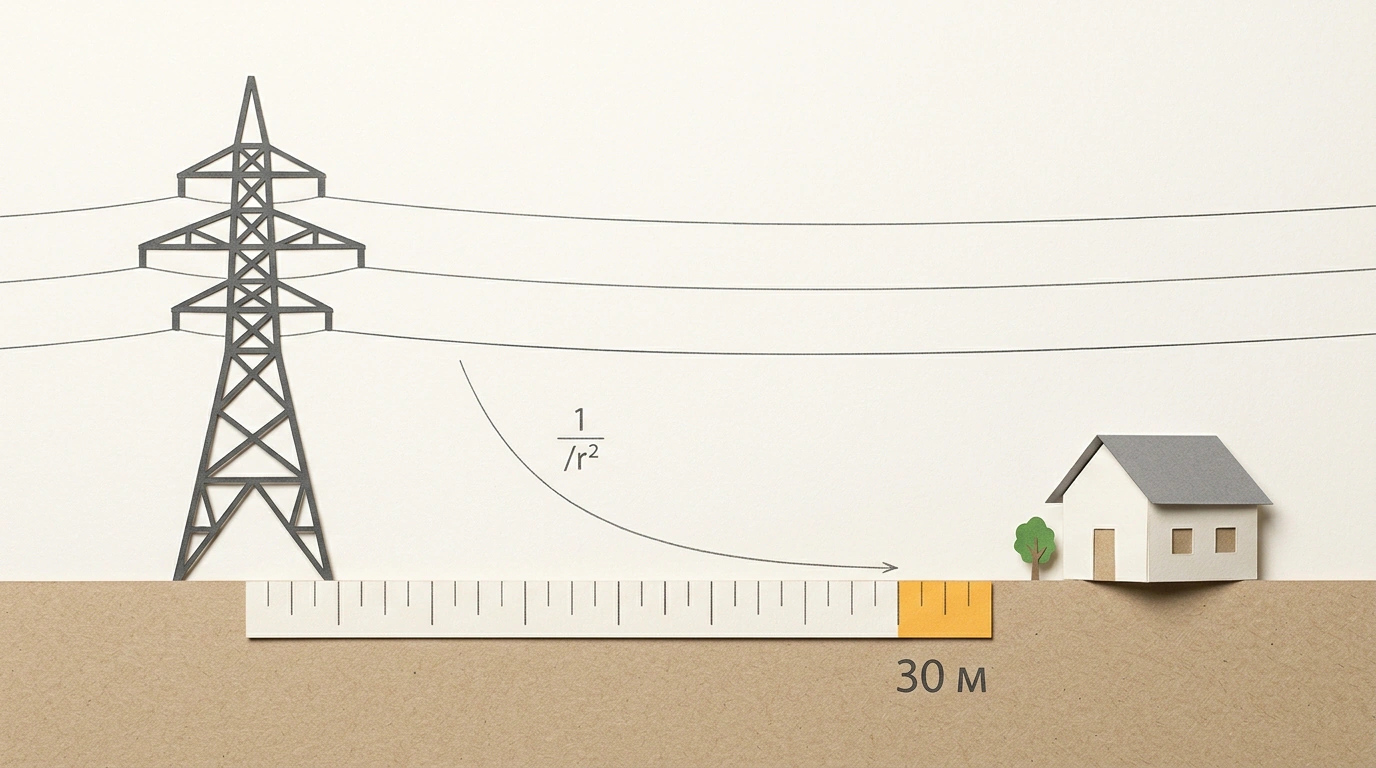
Magnetic field strength drops inversely with the square of the distance ($1/r^2$):
- Directly beneath 220–500 kV power lines, magnetic flux density can reach 5–20 µT.
- Just 30–50 meters away from the outermost wire, it falls to 0.2–0.4 µT.
- Inside an ordinary city apartment, a running hair dryer, microwave, or vacuum cleaner at 20–30 cm creates a local magnetic field of 2–5 µT.
Sanitary Buffers and the Nocebo Effect
To rule out even hypothetical risks, Russian sanitary regulations (SanPiN) enforce strict buffer zones where residential construction is prohibited:
- 110 kV lines — 20 meters from the outer wire's ground projection;
- 220 kV lines — 25 meters;
- 330 and 500 kV lines — 30 meters;
- Ultra-high-voltage 750 kV lines — 40 meters.
Outside these buffer corridors, magnetic flux density drops to tenths of a microtesla—hundreds of times below the WHO and ICNIRP safety limit of 100 µT.
And what about complaints of chronic headaches or ringing in the ears near power lines? In double-blind, placebo-controlled WHO trials, researchers repeatedly tested people reporting "electromagnetic hypersensitivity." Every single time, the results confirmed a classic nocebo effect: participants felt sick and reported pain when they believed the transmitter was turned on (even when it was unplugged), and felt completely fine next to an active generator when they thought it was off.
As long as a building sits outside the legal buffer zone—and every permitted residential development does—high-voltage lines outside your window pose no physiological threat. The real source of stress isn't the electromagnetic waves; it's the anxiety itself.