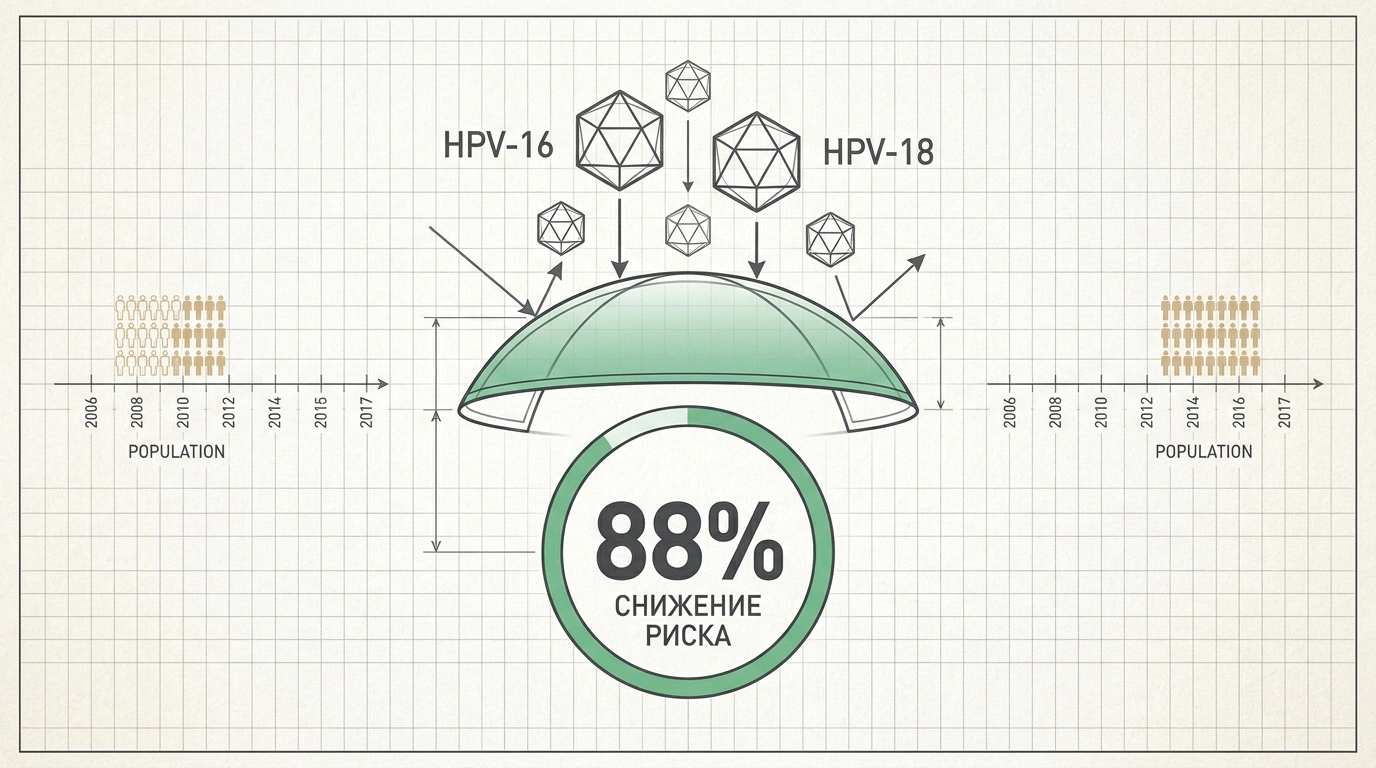
In health forums and social media comments, a clever-sounding pseudoscientific theory pops up from time to time: supposedly, getting vaccinated against human papillomavirus (HPV) is pointless and even dangerous. The skeptics' logic borrows from forest ecology: "If the vaccine wipes out the most common types 16 and 18, it leaves an empty biological niche, and other, even nastier rare cancer-causing strains will rush in to replace them. In the end, cancer rates will only go up."
That sounds plausible if we are talking about wolves and rabbits in the woods. But virology and clinical epidemiology play by different rules. I decided to pull the actual papers from the world's leading medical journals to see what happened in countries that have been vaccinating girls and boys nationwide for over fifteen years.
The facts are unambiguous: no strain replacement occurred, and rates of the deadliest tumors plummeted dramatically.
The Swedish Registry: 1.67 Million Women and 13 Years of Follow-Up
The most reliable way to test any medical hypothesis is to look at hard outcomes—real cancer cases—rather than theoretical models.
In 2020, one of the world's most prestigious medical journals, the New England Journal of Medicine (NEJM), published a landmark cohort study. Researchers analyzed Swedish nationwide registries covering 1,672,983 girls and women aged 10 to 30, following them continuously from 2006 to 2017.
The results speak for themselves:
- Among unvaccinated women, invasive cervical cancer was diagnosed in 538 people during follow-up.
- Among women who received the quadrivalent vaccine, only 19 cases were recorded.
- The overall cumulative risk of cancer across the entire vaccinated cohort dropped by 50%.
- And for girls vaccinated on time—before age 17—the incidence of invasive cancer fell by 88% (an incidence rate ratio of 0.12 compared with unvaccinated peers).
Even better, continuous monitoring over more than 13 years showed that this immune shield does not fade and continues to hold the disease at bay. This aligns with earlier evidence-based analysis on HPV prevention that dismantles common fears around cancer vaccination.
The UK Triumph and the 'Type Replacement' Question
Meanwhile, in the United Kingdom, The Lancet published a 2021 report on the ten-year results of the national vaccination program for 12–13-year-old schoolgirls. The numbers were even more striking: rates of severe cervical precancer (CIN3) plunged by 97%, and invasive cancer dropped by 87%. In the 20–24 age group, cervical cancer was virtually eliminated.
So what happened to that supposedly "empty ecological niche"? Why didn't more aggressive strains take over?
Epidemiologists studied viral type dynamics closely and identified two main reasons:
- No fierce competition: different HPV strains don't aggressively crowd each other out like competing predators. More than 200 types of the virus are known, yet types 16 and 18 alone cause over 70–75% of all cervical cancers. When a vaccine neutralizes the primary aggressors, the remaining types don't suddenly turn more dangerous or carcinogenic.
- Cross-protection: the L1 capsid proteins used in HPV vaccines trigger antibodies that partially neutralize closely related strains as well (notably types 31, 33, and 45). The vaccine doesn't just block its target types—it weakens their nearest viral relatives too.
In the rare studies where researchers spotted tiny shifts in other types, those were strains with extremely low malignant potential. Meanwhile, the one objective metric that matters most—invasive cancer incidence—is dropping everywhere, not rising.
- The ideal age for vaccination is 9 to 14 years (before sexual debut), when the body mounts the strongest protective antibody response.
- Vaccination is recommended for both girls and boys: it interrupts viral circulation in the population and protects men against oropharyngeal and anogenital cancers.
- Adults up to ages 26–45 can also benefit: the shot protects against viral types they have not yet encountered.
- Crucial reminder: vaccination does not replace regular screening (liquid-based cytology and HPV testing every 3–5 years), because it does not clear pre-existing infections.
Which Vaccines Exist and How to Protect Yourself
Today, three main types of HPV vaccines are used worldwide. All of them contain purified recombinant shell proteins (virus-like particles) rather than live virus, so they are physically incapable of causing an infection:
- Bivalent (Cervarix): protects against the two primary cancer-causing strains—16 and 18.
- Quadrivalent (Gardasil): covers types 16 and 18, plus 6 and 11 (which cause benign but very unpleasant anogenital warts).
- Nonavalent (Gardasil 9): an expanded formula (6, 11, 16, 18, 31, 33, 45, 52, 58) covering up to 90% of all high-risk variants.
Cervical cancer is one of the very few malignancies humanity has learned to prevent nearly 100% of the time with a simple shot in the arm and routine gynecological checkups. Skipping proven protection over theoretical internet scare stories is an unnecessary gamble with your life.