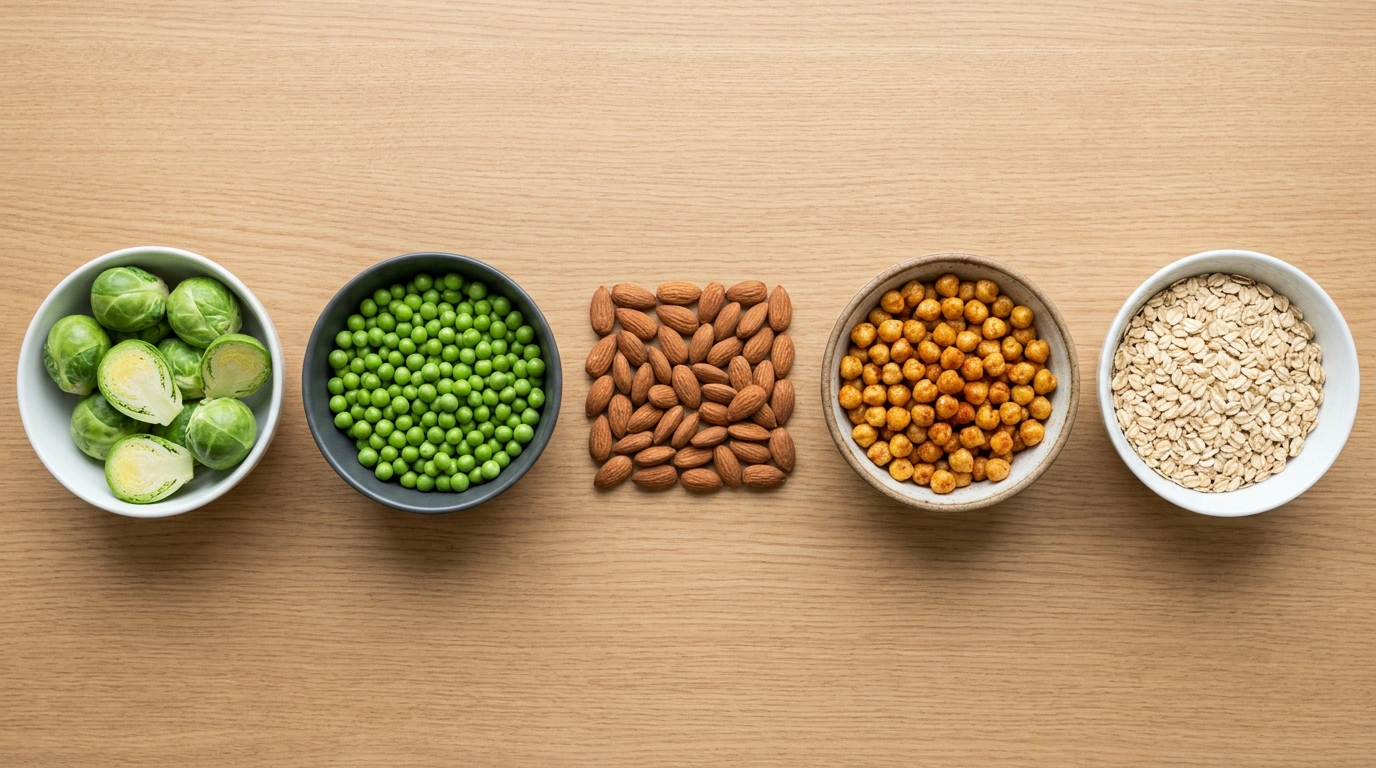
Admit it: how many times have you promised yourself to eat more vegetables for your gut health? Usually, a classic picture comes to mind: a crisp cucumber, a juicy tomato, a couple of lettuce leaves, and a sprig of herbs. It feels like eating a bowl like that at lunch checks off your daily fiber quota.
But if you look at nutrition data, that illusion fades quickly. Endocrinologist Maxim Kuznetsov often reminds patients: trying to hit the recommended 30 grams of fiber with watery vegetables alone leads to bloating, an overstretched stomach, and chronically falling short of the target.
A fresh cucumber is 96% water: pure fiber accounts for just 0.5–0.7 grams per 100 grams. To meet your daily requirement, you'd have to crunch through about 5 kilograms of cucumbers! Tomatoes have around 1.2 grams of fiber per 100 grams (you'd need 2.5 kg), and leaf lettuce has about 1.1–1.3 grams—you'd be chewing greens by the crate.
Meanwhile, without 30 grams of fiber a day, your gut microbiota goes hungry, "bad" cholesterol creeps up, and post-meal blood glucose spikes sharply.
The solution is simple: shift your focus to dense, accessible concentrates of plant fiber. Let's look at five unexpected foods that easily cover your daily target without culinary heroics.
Five Dense Sources: Building Your Quota Without Buckets of Greens
The main principle of a healthy diet is simplicity. Just add ready-made fiber concentrates to your usual meals:
1. Brussels Sprouts
100 grams of cooked Brussels sprouts contain 4–4.5 grams of dietary fiber.
A generous serving bowl (about 180–200 grams) delivers 8 grams of pure fiber right away—more than a quarter of your daily norm. As a bonus, you get a full day's worth of vitamin C, vitamin K, folate, and antioxidants (indole-3-carbinol and sulforaphane) that support liver enzymes. Frozen sprouts are available year-round and cook in ten minutes.
2. Canned Green Peas
Green peas are a convenient and underrated source of fiber: 5.5–6 grams per 100 grams of product.
One standard cup of peas (about 150 grams) adds 8 grams of fiber to your diet. No shelling or boiling required: open the can, drain the brine, and serve as a side with fish or an omelet. Mixing peas with rice significantly lowers the overall glycemic index of the dish. Just choose cans without added sugar.
3. Almonds
Almonds contain about 12–12.5 grams of fiber per 100 grams of raw nuts.
A small handful (about 30 grams, or 22–24 almonds) supplies 4 grams of fiber, 6 grams of plant protein, vitamin E (alpha-tocopherol), magnesium, and monounsaturated fatty acids. It's a dense snack that reliably prevents impulsive afternoon sugar cravings.
4. Roasted Chickpeas
Dry chickpeas contain a record 17–18 grams of fiber per 100 grams (cooked chickpeas have about 8–9 grams).
A portion of roasted chickpeas made from 70 grams of dry beans provides 12 grams of dietary fiber and 13 grams of plant protein.
Culinary trick: pat cooked chickpeas dry, drizzle with a spoonful of olive oil, sprinkle with paprika and salt, and roast at 200°C for 25 minutes. You get savory, crunchy snacks that completely replace chips and crackers.
5. Old-Fashioned Rolled Oats ("Геркулес")
We're talking about traditional rolled oats that take 15–20 minutes to cook (10–11 grams of fiber per 100 grams of dry oats).
A bowl of oatmeal made from 60 grams of dry oats gives you 6.5 grams of fiber. Its main treasure is the soluble polysaccharide beta-glucan, which actively regulates lipid metabolism.
In Protein and Fiber: Anatomy of the Two Main Satiety Regulators we examined how fullness works, and in Autumn on a Plate: 5 Balanced Meals for Satiety we shared seasonal dishes with whole grains.
| Food | Standard Serving | Fiber per Serving | Key Biological Benefit |
|---|---|---|---|
| Fresh cucumbers | 1 cucumber (120 g) | ~0.7 g | High water content, minimal fiber |
| Fresh tomatoes | 1 tomato (130 g) | ~1.5 g | Source of the antioxidant lycopene |
| Brussels sprouts | 1 bowl (180 g) | ~8.0 g | Vitamin C, indoles, dense structure |
| Green peas (canned) | 1 cup (150 g) | ~8.0 g | Ready to serve, versatile side |
| Almonds | 1 handful (30 g, ~23 nuts) | ~4.0 g | Monounsaturated fats, magnesium |
| Roasted chickpeas | 1 serving (70 g dry) | ~12.0 g | Plant protein, healthy snack swap |
| Rolled oats ("Геркулес") | 1 serving (60 g dry) | ~6.5 g | Soluble beta-glucan against cholesterol |
The building blocks come together effortlessly: oatmeal in the morning (6.5 g), a handful of almonds during the day (4 g), Brussels sprouts at lunch (8 g), and chickpeas or peas in the evening (8–12 g). You hit 28–30 grams without bowls of bland leaves.
What Happens Inside: Cholesterol, Satiety, and Butyrate
Why does the body need these tough plant cell walls if our own enzymes cannot break them down? They serve as fuel for trillions of bacteria in the large intestine.
A Trap for Cholesterol
Soluble oat beta-glucan forms a viscous gel when mixed with water. It traps bile acid and cholesterol micelles in the small intestine, blocking their reabsorption.
Losing bile acids, the liver is forced to synthesize new bile from the body's own blood cholesterol. Hepatocytes activate LDL receptors and pull "bad" cholesterol out of the bloodstream. A meta-analysis by Brown et al. (AJCN, DOI: 10.1093/ajcn/70.5.883) proved that 3 grams of oat beta-glucan per day consistently lowers LDL levels by 5–10%.
A Fatty Acid Factory
In the colon, bacteria ferment fiber to produce short-chain fatty acids:
- Acetate: fuels muscles and regulates satiety in the central nervous system.
- Propionate: travels to the liver and inhibits endogenous cholesterol synthesis.
- Butyrate (butyric acid): the primary fuel for colonocytes (the epithelial cells lining the colon), covering up to 70% of their energy needs. Butyrate strengthens the mucosal barrier and calms inflammation.
In addition, viscous fibers smooth out blood glucose rises, preventing insulin spikes, and stimulate the release of long-lasting satiety hormones—GLP-1 and PYY.
Safety Rules: How to Make Peace Between Your Gut and Fiber
If your diet has consisted of refined foods for years, your gut bacteria aren't ready for a sudden flood of roughage. Starting too fast will cause gas and cramping.
The rules for safe adaptation are simple:
- Gradual increase: add fiber in steps of 3–5 grams per week, giving your microbiota 2–4 weeks to adjust.
- Water: fiber works like a sponge. Without 1.5–2 liters of fluid a day (guided by thirst), fiber turns into a dry plug and causes constipation.
- Prepping legumes: bloating is triggered by oligosaccharides (raffinose and stachyose).
Before cooking, soak dry chickpeas or beans for 8–12 hours in cold water with a pinch of baking soda. The alkaline environment leaches out up to 60–70% of gas-forming oligosaccharides. Then drain the water, rinse the beans thoroughly, and boil until tender: digestibility improves dramatically.
Getting 30 grams of fiber a day is completely achievable. A handful of almonds, green peas, crispy chickpeas, and a bowl of oatmeal will keep your blood vessels and microbiota feeling great every day.