Anyone who has ever tried to clean up their diet or drop a few pounds knows modern fitness's favorite slogan by heart: "Eat more protein!" We're told from every direction that protein is a miracle nutrient that revs up metabolism, melts fat while we sleep, and prevents every craving.
So an enthusiastic beginner overhauls their menu overnight: a four-egg-white omelet for breakfast, plain chicken breast for lunch, a protein bar for a snack, and a tub of fat-free cottage cheese for dinner. Grains, fruit, and vegetables get labeled "dangerous carbs" and banished from the plate.
Within a week, though, enthusiasm curdles into quiet misery. A brick-like heaviness settles in the stomach, bathroom trips turn rare and painful, a strange chemical taste lingers in the mouth, and by evening an irresistible urge hits to raid the nearest bakery. Why does standard gym advice backfire so badly?
In an in-depth expert broadcast from the School of Nutrition, endocrinologists and dietitians walked through digestive physiology and showed that protein only unlocks its best properties in an inseparable biochemical partnership with plant fiber. Apart, each nutrient creates trouble; together, they form an ideal team for effortless appetite control and gut health.
1. The 'Protein Cult' Illusion: Where a One-Sided Diet Breaks Down
To see why things go wrong, look honestly at modern food marketing. Today "High Protein" gets stamped on everything from yogurt and pudding to chips, bread, and oats. Companies love selling protein: it signals health and athleticism and lets them double or triple the price tag.
Steered by those ads, people assume more protein automatically means faster fat loss, pushing intake to 2.5–3 grams per kilogram of body weight. Yet the human digestive tract evolved over millions of years on a mixed, largely plant-and-protein diet—it simply isn't built for relentless protein overload.
Here is the physiological domino effect triggered by missing dietary fiber:
First, the gut loses motility. A food bolus (chyme) made purely of digestible protein and animal fat has tiny physical volume and zero bulk. Peristaltic waves can barely grip such a dense, sticky mass. The result is spastic or atonic constipation, leaving waste sitting in the colon for three or four days instead of the normal 24 hours.
Second, bacterial putrefaction kicks in. Stomach and small-intestine enzymes can fully break down only so much protein in one sitting—roughly 30–45 grams on average, depending on body size and protease activity. Any undigested surplus spills into the cecum and ascending colon, where opportunistic putrefactive microbes (Clostridium, Bacteroides, and proteolytic E. coli strains) feast on it. As they break down amino acids, they release foul-smelling, toxic compounds: ammonia, hydrogen sulfide, indole, skatole, mercaptans, plus biogenic diamines like cadaverine and putrescine. That drives bloating, nausea, persistent lower-abdominal discomfort, and extra strain on the gut mucosal barrier.
Third, the "carb craving" paradox hits. Your stomach is packed with dense meat, yet your brain keeps demanding food. Why? Because satiety centers in the hypothalamus track not just plasma amino acids, but also blood-glucose stability and serotonin production—which requires carbohydrates. Sensing a deep imbalance, your body fires off an urgent alarm that we experience as an overpowering sweet tooth.
Finally, your urinary system pays a price. Amino-acid metabolism ends with deamination in the liver, producing urea. The kidneys are forced into continuous glomerular hyperfiltration to clear excess nitrogen waste, uric acid, and protons. If you also skimp on water, the risk of kidney stones and gout flares climbs sharply.
2. The Two-Phase Anatomy of Satiety: How Your Brain Reads Fullness
Building a genuinely satisfying diet starts with understanding how appetite physiology works. Fullness isn't a single light switch ("ate, now full"); it is a two-phase neurohumoral cascade unfolding over several hours.
Early Mechanical Phase (The Stomach Sensor)
When food enters the stomach, its smooth-muscle walls begin to stretch. Embedded in that muscle layer are thousands of sensitive mechanoreceptors—stretch receptors.
These sensors respond strictly to physical volume, not calorie count. Along the vagus nerve (nervus vagus), a brisk stream of impulses shoots up to the brainstem's solitary tract nucleus (nucleus tractus solitarii) and on to the arcuate nucleus of the hypothalamus. The brain gets an instant update: "Food has arrived, volume is adequate—hit the brakes on foraging!"
Here the main flaw of pure-protein meals becomes obvious: 100 grams of boiled chicken breast or a scoop of whey isolate takes up barely the volume of a tennis ball in your stomach. Stretch receptors barely register it. Filling your stomach on meat alone until you feel full would take half a kilo of fillet, overloading your kidneys and liver. Add bulky fiber—say, 200 grams of broccoli or leafy greens—and the stomach stretches gently for minimal calories, signaling safety to the brain.
Late Neurohumoral Phase (The Intestinal Brake)
Stomach stretch doesn't hold the fort for long: within 40–60 minutes wall tension eases, and if chemical reinforcement hasn't arrived, hunger roars back.
That is when the second line of defense—the ileal brake—takes over. Endocrine L-cells line the mucosa of the ileum and colon. When slowly digested peptides and fermented plant fibers reach them, L-cells release potent satiety hormones into the bloodstream:
- Glucagon-like peptide-1 (GLP-1) — an incretin hormone that slows gastric emptying so food doesn't dump too fast into the duodenum, improves peripheral insulin sensitivity, and binds directly to hypothalamic receptors to curb appetite.
- Peptide YY (PYY) — a dedicated hunger blocker secreted in proportion to incoming fatty acids and dietary fiber. It suppresses neuropeptide Y in the brain, extending calm fullness for four to five hours.
Protein supplies the amino acids that trigger these hormones, while fiber slows chyme transit and gives L-cells a steady substrate to respond to. It is true synergy: protein provides the chemical spark, and fiber stretches the signal over time.
3. Plant-Fiber Architecture: Soluble vs. Insoluble Fiber
People often toss around the word "fiber" as a vague label for something healthy. To assemble a smart plate, though, you need to tell apart two fundamentally different classes of dietary fiber, each with its own job.
Insoluble Fiber (The Mechanical Frame)
Insoluble fibers include cellulose, hemicellulose, and lignin—found in bran, apple and cucumber skins, seeds, cabbage stems, celery, and whole-grain hulls.
What insoluble fiber does:
- It resists breakdown by human stomach acid and digestive enzymes;
- It travels through the GI tract intact, acting like a gentle sponge or brush;
- By mechanically nudging gut-wall receptors, it stimulates smooth-muscle peristalsis, speeding transit and preventing stagnation;
- It adds dry bulk to stool, helping form normal, well-structured bowel movements.
On a protein-only diet, stool has nothing to build on. Insoluble fiber supplies the scaffolding—without it, the bowel simply goes to sleep.
Soluble Viscous Fiber (The Biochemical Filter and Prebiotic)
Soluble fibers include pectin (apples, berries, pumpkin, carrots), beta-glucan (oats, barley), inulin (Jerusalem artichoke, chicory, asparagus), gums, mucilage (flax and chia seeds), and psyllium husk.
Inside the stomach and small intestine, soluble fiber behaves completely differently:
- On contact with water, it swells into a thick, gel-like hydrocolloid;
- That gel coats carbohydrate and fat molecules, sharply slowing enzymatic breakdown and absorption by enterocytes;
- Glucose enters the bloodstream smoothly in steady trickles, preventing sharp blood-sugar spikes and crashes;
- Cholesterol and bile acids get trapped in the gel matrix and leave the body naturally, lowering atherogenic lipoproteins in plasma.
Even better, once that gel reaches the large intestine, it becomes a feast for trillions of friendly gut microbes—especially bifidobacteria and anaerobic genera like Faecalibacterium, Roseburia, and Eubacterium.
Through anaerobic fermentation, bacteria break those polysaccharide chains into short-chain fatty acids (SCFAs):
- Butyrate (butyric acid) — the primary fuel for colon cells (colonocytes), supplying up to 70% of their energy needs. Butyrate seals tight junctions between cells to prevent increased gut permeability, calms inflammation, and has proven cancer-protective effects.
- Acetate (acetic acid) and propionate (propionic acid) — travel via the portal vein to the liver, where propionate modulates gluconeogenesis, while acetate circulates to peripheral tissues and crosses the blood-brain barrier to act directly on the hypothalamus and dial down central appetite.
That is why a plate rich in soluble fiber leaves you deeply, calmly satisfied in a way a plain protein shake never can.
4. Three Ways a Plate Goes Off Balance: Typical Clinical Mistakes
To make the most common traps easy to spot, clinicians point to three everyday patterns they see in consultations all the time.
Scenario A: The 'Protein Desert'
- Typical menu: Egg-white omelet with zero oil or veggies for breakfast; 200 g boiled turkey with peeled cucumber for lunch; dry 0% cottage cheese for a snack; pan-seared chicken breast for dinner. Protein tops 160–180 g, while daily fiber barely hits 5–7 g.
- What happens inside: For two or three days, rapid water loss on the scale feels thrilling. By day four, bowel movements stop cold. Bloating builds and breath takes on a stale, putrid edge. By evening six, an exhausted nervous system snaps—and you find yourself at the fridge polishing off a pack of cookies and chocolate spread.
- Diagnosis: Intestinal stasis, dysbiosis dominated by proteolytic flora, and a rebound binge driven by brain carb starvation.
Scenario B: The 'Herbivore Trap'
- Typical menu: Someone decides to "detox" and eat ultra-light: a giant bowl of lettuce, tomatoes, arugula, grated carrot, apple smoothies, and celery, with almost no protein—maybe three lonely cubes of tofu or half a boiled egg tossed on top.
- What happens inside: During the meal, leafy volume fills the stomach and fakes fullness. Just 45 minutes later, insoluble fiber settles, water moves on, and no amino acids arrive to activate intestinal L-cells. Blood sugar dips, your stomach growls, weakness and irritability hit, and you end up grazing on nuts, dried fruit, or crackers every 90 minutes.
- Diagnosis: Shortage of structural building blocks, missing hormonal gut satiety, and wide glycemic swings.
Scenario C: 'Protein Fast Food'
- Typical menu: Too busy to cook, an office worker grabs a trendy protein bar for lunch, protein cookies in the afternoon, and a canned protein shake before the gym. The wrapper proudly boasts: "20 g protein and 10 g fiber!"
- What happens inside: Pure marketing sleight of hand. The "fiber" in those bars is usually refined synthetic polyols (maltitol, sorbitol, isomaltooligosaccharides) that pull water into the gut and ferment rapidly—causing gas, cramps, and diarrhea. Meanwhile, hydrogenated fats often bind the bar together, pushing calories to 250–300 kcal—on par with a regular candy bar—without delivering real whole-food fullness.
- Diagnosis: Osmotic dyspepsia, hidden calorie creep, and whole-food micronutrient gaps.
5. The Satiety Plate Builder: Proven Formulas and Proportions
How do you pair protein and fiber in real life without spreadsheets or a kitchen scale? Evidence-based nutrition offers a simple, visual plate method built for busy schedules.
Infographic breakdown of a healthy eating plate clearly divided into protein, complex carbohydrates, and plant fiber
Individual Physiological Targets:
- Protein target: For adults with moderate daily activity and light fitness, 1.2–1.6 grams per kilogram of normal body weight per day is plenty (if carrying significant excess weight, calculate using your target weight, not current weight).
- Fiber target: A solid adult baseline is 25–35 grams per day (or at least 14 grams per 1,000 kcal), ideally keeping roughly a 3:1 or 2:1 ratio of insoluble to soluble fiber.
The Visual Satiety Plate for Every Main Meal:
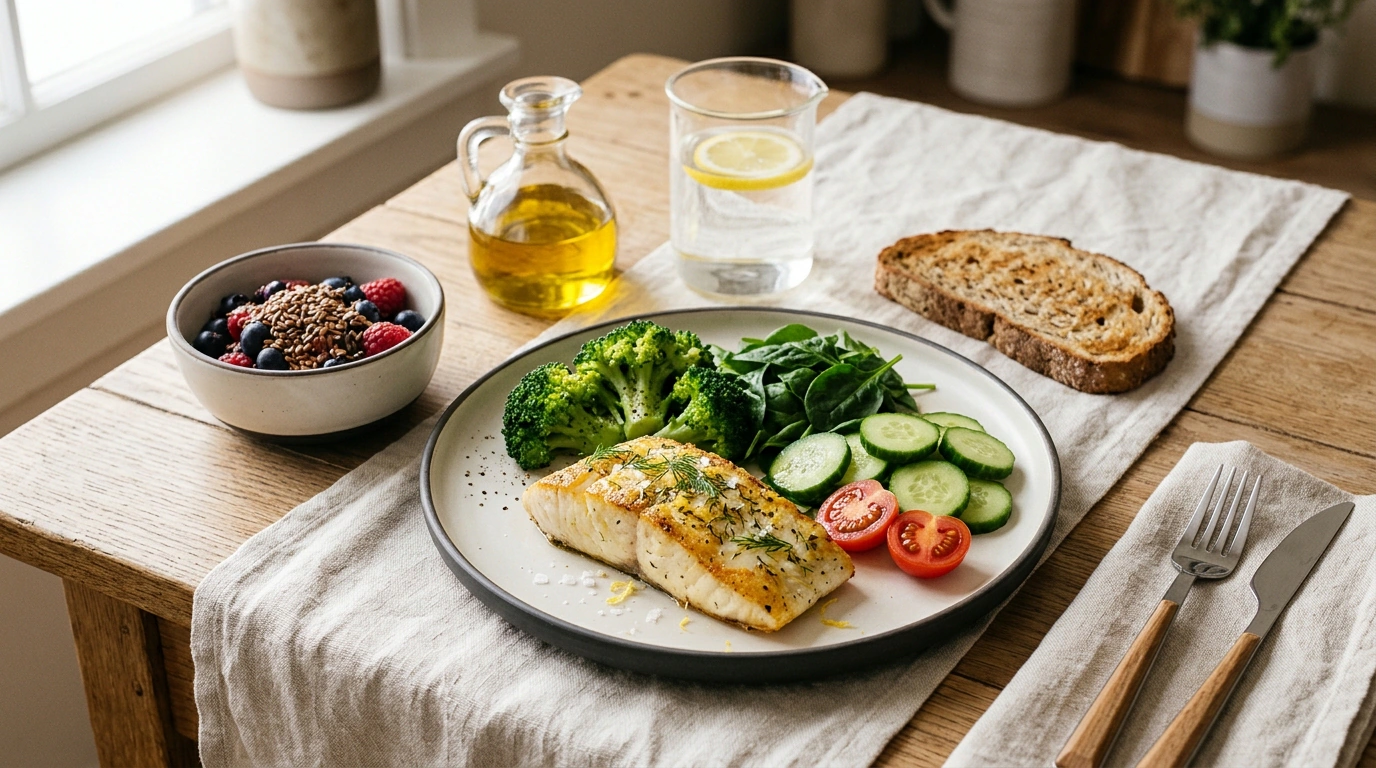
- One quarter of the plate (25%) — Quality whole protein: Baked or poached fish (pollock, cod, pink salmon, mackerel, herring), skinless poultry, eggs, lean meat, medium-fat cottage cheese, tofu, or tempeh. This digests steadily and delivers essential amino acids for tissue repair.
- One quarter of the plate (25%) — Fiber-rich complex carbs: Boiled or jacket-baked potatoes (rich in resistant starch), buckwheat, pearl barley, quinoa, brown or wild rice, whole-wheat pasta, lentils, chickpeas, or beans. They provide a steady glucose trickle and support serotonin without insulin spikes.
- Half of the plate (50%) — Both kinds of plant fiber: Pair crisp raw vegetables and greens (cucumbers, lettuce, arugula, radishes) with sources of soluble pectin and fermented foods (sauerkraut, stewed zucchini, roasted pumpkin, broccoli, green beans).
Three Reliable Weekday Combos:
- Champion's breakfast: Two-egg omelet with herbs and a handful of spinach, plus slow-cooked whole-grain oats topped with a tablespoon of ground flaxseed and frozen currants. Keeps you full for 4–5 hours.
- Balanced lunch: Herb-baked turkey fillet or white fish (150 g) + cooked lentils or buckwheat (150 g cooked) + a generous salad of grated carrot, cabbage, and cucumber dressed with cold-pressed vegetable oil.
- Ideal evening balance: One large jacket-baked potato + 150 g unsweetened sauerkraut + 150 g poached pollock, cod, or grainy cottage cheese.
Everything here comes from an ordinary grocery store, skips gram-by-gram math, and puts an end to nightly battles with your appetite.
6. Safety Limits, Tolerance, and Gut Adaptation
As powerful as protein and fiber are, jumping onto the healthy bandwagon overnight can backfire. Respect a few metabolic safety rules so you don't quit on day one.
Ease Your Microbiome Into Fiber
If your diet has centered on white pasta, sandwiches, and sweets for years, your gut is populated by bacteria geared toward fast sugars, while polysaccharide-fermenting microbes are outnumbered.
Suddenly eating 40 grams of fiber in a day—piling on bran, a bowl of beans, and a kilo of apples—will make your gut revolt with fierce bloating, cramps, and diarrhea. Your bacteria simply cannot process that much substrate overnight.
Gastroenterology's golden rule: ramp up fiber gradually, adding no more than 5 grams per week. Start with cooked, gentle vegetables (stewed zucchini, pumpkin, roasted cauliflower, cooked carrots), which are far easier to tolerate than raw cabbage or raw legumes.
Hydration Is Non-Negotiable
Remember one ironclad rule: fiber without enough water turns into concrete.
Soluble fiber only works when it has fluid to absorb. If you load up on vegetables, beans, or psyllium while surviving on two cups of coffee a day, swollen fibers form hard fecal plugs instead of a soft gel, triggering stubborn constipation.
Drink enough plain water throughout the day—roughly 30 ml per kilogram of body weight, counting soups and tea—and use urine color as a simple gauge: it should stay pale straw-colored and clear.
Clinical Caveats
Certain conditions require personalized adjustments with your doctor:
- Active flares of inflammatory bowel disease (IBD), ulcerative colitis, or Crohn's disease: During acute mucosal inflammation, coarse insoluble fiber is temporarily paused in favor of mechanically and chemically gentle pureed meals;
- Small intestinal bacterial overgrowth (SIBO): Fermentable fibers (FODMAPs) can trigger severe gas in the wrong section of the gut and may need temporary restriction until the small intestine is treated;
- Chronic kidney disease (CKD stage 3 and above): When glomerular filtration rate drops, excess protein is strictly contraindicated due to azotemia risk; protein intake is typically kept at 0.6–0.8 g/kg under a nephrologist's supervision.
The Bottom Line: Nutrients Work as a Team
Healthy eating is never a war of one macronutrient against another—not protein versus carbs, and not an obsessive calorie-counting contest.
Real comfort, steady energy, and healthy body composition grow out of smart physiological pairings. Protein supplies the building blocks for enzymes, hormones, and muscle, steadies evening appetite, and protects against tissue loss in a deficit. Plant fiber keeps digestion moving smoothly, feeds trillions of helpful gut bacteria, flattens blood-sugar spikes, and shields arteries from cholesterol overload.
Skip the extremes and stop turning your plate into a lab experiment. Put a good piece of fish or poultry on it, pile on cooked veggies you enjoy, add a couple of jacket potatoes and a forkful of sauerkraut. Your gut will thank you, the scale will trend down steadily, and late-night cravings will fade on their own.