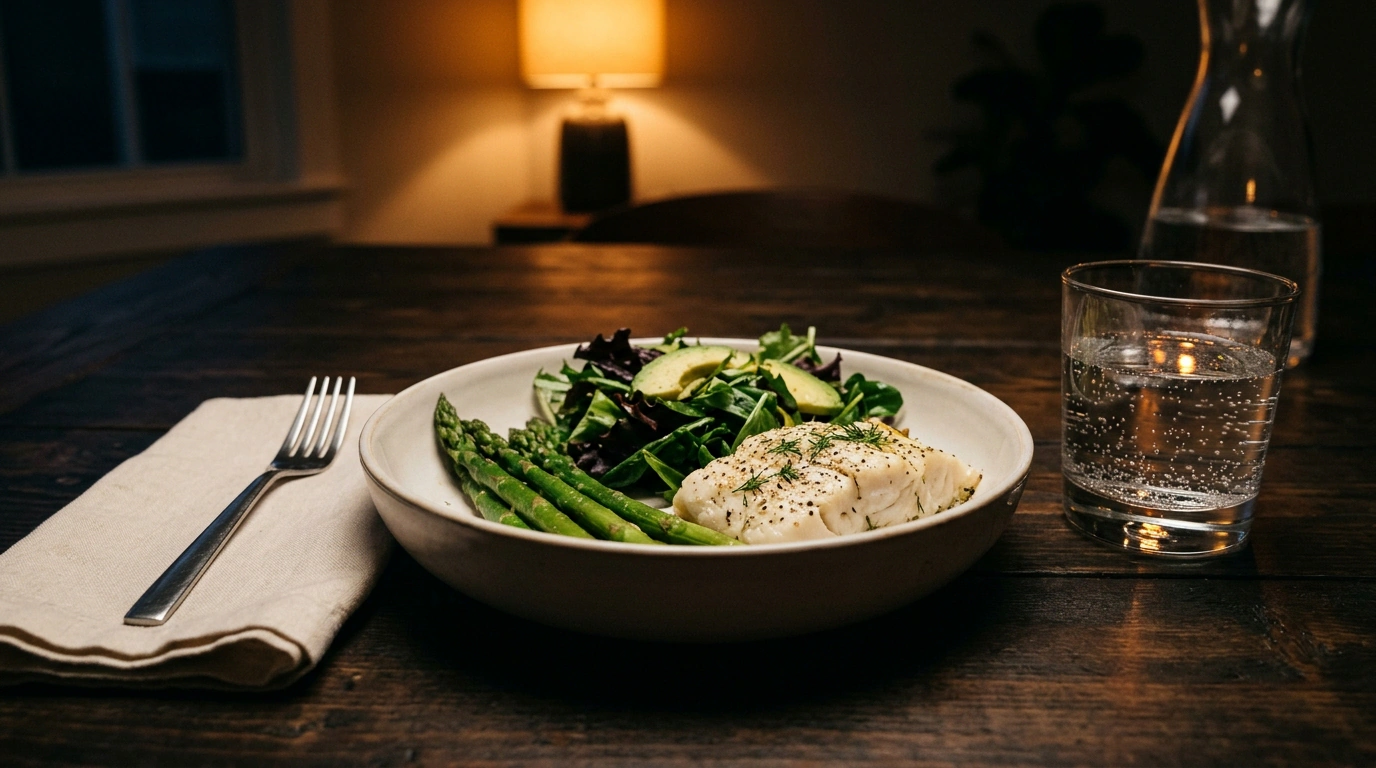
For anyone watching their health or weight, dinner is usually the trickiest meal of the day. In the morning we're full of resolve: oatmeal, green tea, waving away office pastries. By 8 p.m., after a demanding workday, traffic, and chores, mental reserves are empty.
Your body wants relief from the day's stress. You open the fridge and stare gloomily at a lone tub of nonfat cottage cheese or a bland cucumber. Trying to silence evening hunger with "diet emptiness" almost always ends the same way: an hour later you're having tea with cookies, cheese, and deli meat.
Endocrinologist Maxim Kuznetsov is convinced that white-knuckling your way past 6 p.m. backfires. Instead of torturing yourself with curfews, work with the biochemistry of evening appetite and build a dinner designed for maximum fullness at a modest calorie cost.
Evening Appetite Physiology: Why You Crave Calorie Bombs
Late-day cravings follow natural circadian rhythms. Toward evening, stress-hormone cortisol tapers down and brain serotonin dips. Subconsciously, your body looks for the fastest way to restore comfort neurotransmitters—and the oldest evolutionary shortcut is raising blood glucose and fatty acids.
If lunch was skimpy or rushed, the hypothalamus hits the panic button by evening. At that point, pep talks over a bowl of plain greens won't work: your stomach demands real volume, and your taste buds want richness.
Go to bed short on both calories and volume, and you'll fall asleep with a growling stomach, toss through shallow sleep, and get jolted awake at 3 a.m. by a norepinephrine surge hunting for a snack.
An ideal dinner needs to solve three concrete tasks:
- Physically fill the stomach with a large volume of low-calorie-density food, switching off mechanical hunger sensors;
- Provide a slow, steady trickle of glucose without sharp insulin spikes so melatonin synthesis stays smooth;
- Feed the gut microbiome with fermented fibers that prevent overnight fermentation and stagnation.
Rehabilitating the Potato: Busting Nutrition's Biggest Stereotype
The centerpiece of this formula is a food fitness gurus spent years demonizing: the humble potato.
Potatoes were branded public enemy number one—"pure starch," "carb bomb," "instant belly fat." Yet hard scientific data tells a startlingly different story. In Dr. Susanna Holt's classic University of Sydney study (Satiety Index of Common Foods), which measured how full different foods keep people per calorie, boiled potatoes took first place by a landslide.
Their satiety score hit 323% (with white bread set as the 100% benchmark)—outperforming beef, eggs, apples, legumes, and every grain.
The secret lies in a unique trio of water, starch polysaccharides, and fiber:
- Boiled or jacket-baked potatoes pack only 70–80 kcal per 100 grams—compared with roughly 110 kcal for cooked buckwheat, 120–130 kcal for boiled rice, and 140–160 kcal for pasta.
- One large 200-gram baked potato costs just 150–160 kcal, yet takes up substantial physical space in the stomach, delivering instant warmth and comfort.
- When cooked potatoes cool slightly, part of their starch retrogrades into resistant starch, which escapes small-intestine amylase, behaves like soluble fiber, and feeds butyrate-producing gut microbes.
The catch is simple: potatoes aren't the problem—deep-frying them in vats of oil or whipping them with butter and heavy cream is. A skin-on baked potato with a pinch of salt and herbs is a legitimate nutrition powerhouse.
Sauerkraut: A Fermented Shield for Your Microbiome
The second pillar of the evening plate is traditional sauerkraut made without added sugar.
This classic pantry staple outperforms plenty of pricey supplements:
- Its energy density is tiny—just 18–22 kcal per 100 grams. You can pile 150–200 grams onto your plate for only 30–40 kcal;
- During natural lactic fermentation, Lactobacillus plantarum bacteria convert sugars into organic acids (lactic and acetic acid) alongside vitamin C;
- Lactic acid gently nudges colonic motility, helping prevent sluggish mornings;
- Cabbage fiber stretches stomach walls, reinforcing ghrelin suppression.
Protein Balance: Lean Fish, Poultry, or Eggs
To make the satiety triad fire on all cylinders, carbs and veggies need quality protein. In the evening, pick options low in heavy saturated fats so digestion doesn't drag past midnight:
- Poached or baked white fish fillet (pollock, cod, haddock, zander, hake) — around 150 grams;
- Lightly salted lean herring or pink salmon for valuable omega-3 fatty acids;
- Two soft-boiled eggs or a two-egg omelet;
- A serving of grainy cottage cheese up to 5% fat.
Protein triggers intestinal satiety peptides (cholecystokinin and peptide YY) that give a meal a calm, lasting finish.
Practical Blueprint for the Ideal Dinner
Put the pieces together on one plate:
- One or two jacket-baked potatoes (around 200 g) — 150 kcal;
- A generous mound of sauerkraut (150–200 g) — 35 kcal;
- Baked pollock or cod fillet with herbs (150 g) — 120 kcal;
- Half a teaspoon of unrefined vegetable oil drizzled over the sauerkraut — 40 kcal.
The bottom line: a visually abundant, deeply satisfying plate weighing nearly half a kilogram comes in at around 350 kcal.
You leave the table genuinely full, without heaviness, wrapped in comfortable warmth. Sweet cravings never show up because your brain got steady glucose from the potatoes and your stomach is physically satisfied.
Aim to eat this dinner 2.5 to 3 hours before bed—plenty of time for food to clear the stomach and avoid nighttime reflux, while carrying comfortable fullness straight through to morning.