Sleep is the most accessible—and most underestimated—recovery tool we have. In an endless race against deadlines, we casually shave an hour or two off our night, promising ourselves we'll "catch up on Saturday." Then on the weekend we linger half-asleep for ten hours, wondering why our head feels heavy by noon and our energy never really came back.
Endocrinologist Maxim Kuznetsov broke down sleep physiology hour by hour, showing how each extra cycle in bed affects your cardiovascular system, metabolism, and brain.
The Hourly Scale: From Vascular Storm to the Gold Standard
Restorative sleep runs in cycles lasting about 90–100 minutes each, moving sequentially through light sleep, deep slow-wave delta sleep, and rapid eye movement (REM) sleep.
Here is what happens depending on how long you stay in bed:
- 1–4 hours: Disaster mode. Your sympathetic nervous system stays wired and cortisol shoots through the roof. You miss a vital physiological event: the normal 10–20% nighttime dip in blood pressure (the non-dipping phenomenon). Blood vessels remain constricted, and the risk of acute ischemic stroke and heart attack jumps by a third.
- 5–6 hours: The metabolic pit. Deep sleep stages get cut short. The brain's glymphatic system doesn't have enough time to clear beta-amyloid and metabolic waste. Satiety hormone leptin drops by 15% while hunger hormone ghrelin surges by 20%—meaning the next day you unconsciously overeat by 300–400 kcal, gravitating toward fast carbs.
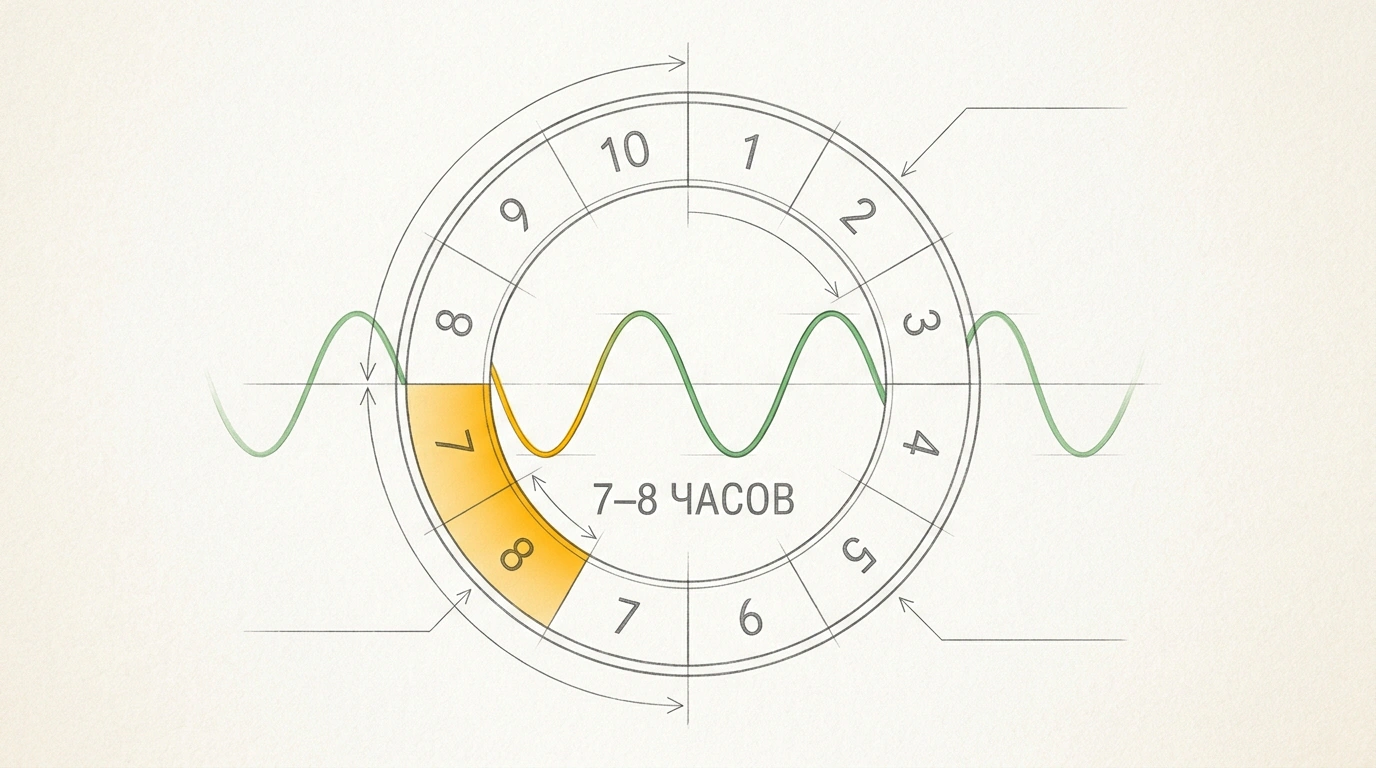
- 7–8 hours: The physiological gold standard. Your body completes four to five full 90-minute cycles. Deep sleep wraps up growth-hormone release and tissue repair, while REM sleep consolidates memory and steadies your emotional baseline.
The 9–10 Hour Paradox: Why More Isn't Better
It sounds logical: if eight hours is good, ten hours should make us superhuman. Yet major cardiology meta-analyses—including Kwok et al. in the Journal of the American Heart Association—reveal a strict U-shaped curve between sleep duration and mortality.
The lowest risk of heart attacks, strokes, and metabolic syndrome sits squarely in the 7.0–8.0-hour window. Regularly sleeping more than 9–10 hours raises statistical cardiovascular risk back up by 30–40%.
Crucially, the mechanisms at the two ends of that U are completely different:
- With short sleep, the link is direct causation: sleep deprivation mechanically damages blood vessels and drives inflammation (raising C-reactive protein and interleukin-6).
- With long sleep, reverse causation is at work: a person doesn't sleep ten hours because sleep itself is toxic, but because their body is desperately trying to compensate for a hidden condition. Most often, constant sleepiness masks obstructive sleep apnea (nighttime breathing pauses), subclinical hypothyroidism, anemia, or clinical depression.
Practical Benchmark
For most adults, the sweet spot is 7 to 8.5 hours of sleep on a consistent schedule—waking up at roughly the same time even on weekends.
If you regularly spend more than nine hours in bed and still wake up groggy and drained, don't force yourself to sleep even longer. Get a basic checkup: check ferritin and TSH, and if you snore, see a sleep specialist for respiratory sleep monitoring.