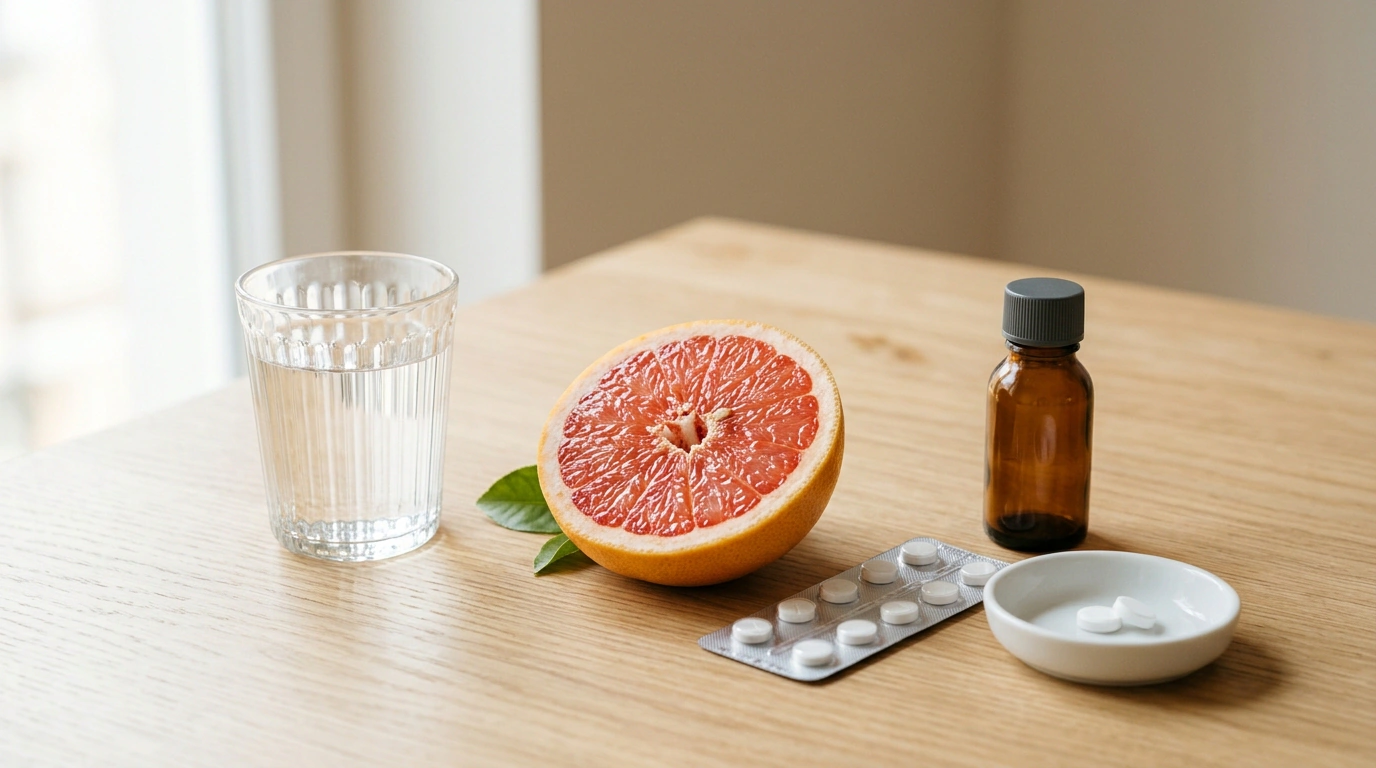
Do you check the package insert for your daily pills before dropping a bag of juicy citrus into your shopping cart? When a cardiologist prescribes statins to control cholesterol and protect blood vessels, most people diligently track the dosage on the blister pack, yet rarely think that a fruit bowl on the kitchen counter can alter a drug's effect more strongly than a doctor's dose adjustment.
Endocrinologist Maxim Kuznetsov broke down the hidden clash between cholesterol therapy and grapefruit on his podcast. I wanted to compare his observations with FDA guidance to find out: can people taking daily statins eat grapefruit, and why does a glass of morning juice turn a carefully calibrated treatment plan into an overdose?
Why an Ordinary Citrus Fruit Acts Like an Active Drug
Doctors' caution has nothing to do with acidity or vitamin C—it comes from the plant's own chemical defense. Grapefruit pulp and white pith contain special compounds called furanocoumarins. For the tree, they are a shield against pests; in our digestive tract, they act like a powerful biochemical kill switch.
According to pharmacologists in a PMC review, grapefruit interacts with more than 85 medications—from statins to blood pressure pills (we covered how this fruit crashes blood pressure in our breakdown of amlodipine dosing rules). The biggest myth here revolves around "washing it down": many assume it's enough to swallow the pill with water and eat grapefruit a couple of hours later. Unfortunately, that gap doesn't help, because furanocoumarins shut down the gut's filter for several days.
Anatomy of a Broken Filter: How the Enzyme Lock Works
Inside the cells of the small intestine and liver sits the enzyme CYP3A4—a kind of customs checkpoint. When you take an atorvastatin tablet, this filter normally breaks down most of the compound on the way in, letting only the intended fraction (about 14%) into the bloodstream—the exact share the pharmacy dose is calibrated for.
When furanocoumarins from grapefruit meet CYP3A4, they trigger an irreversible blockade: the citrus molecules lock tightly onto the enzyme and disable it, like superglue in a keyhole. Cells cannot repair that lock—the intestine has to synthesize fresh enzyme molecules from scratch, which takes 24 to 72 hours.
Take a real clinical scenario: a patient is prescribed 20 mg of atorvastatin daily to stabilize vascular plaques. At breakfast, they eat half a fresh grapefruit or drink a glass of juice (200–250 ml), while washing the pill down with water. Because the filter is offline, plasma atorvastatin concentration jumps by 80% (up to the level of a double dose of 36–40 mg), while with simvastatin and lovastatin it surges by 200–300% (an average of up to 260%), tripling the load. If you drink the juice daily, the drug accumulates, overloads the liver, and causes muscle pain—up to rhabdomyolysis, a dangerous breakdown of muscle fibers that hits the kidneys.
Workarounds: Which Statins and Citrus Fruits Are Safe
Does statin therapy mean giving up all citrus? Not at all—everything depends on the active ingredient in the drug and the variety of fruit.
First, water-soluble rosuvastatin (like pravastatin) works differently: 90% of its dose is excreted unchanged, and the remaining 10% bypasses the CYP3A4 enzyme, so grapefruit has no effect on it. Second, as Maxim Kuznetsov and FDA experts emphasize, mandarins, clementines, and sweet oranges contain no active furanocoumarins, and a slice of lemon in tea is completely safe. By contrast, hiding on the "blacklist" alongside grapefruit are its relatives and hybrids: pomelo, minneola, tangelo, and bitter Seville oranges. For other food-and-pill conflicts, read our guide on how to organize your medicine cabinet.
Still, if you take atorvastatin and accidentally drank half a glass of grapefruit juice at a friend's house yesterday, there's no need to panic. Maxim Kuznetsov notes that a one-off 80% bump won't cause a liver catastrophe—technically it's comparable to taking two pills instead of one—and if you rarely want a couple of sips of juice, a 12-hour gap separates the absorption peaks. The golden rule of common sense: never stop taking statins for the sake of fruit, because protecting your heart from a heart attack matters more than dessert. Check your medication box: if you take atorvastatin or simvastatin, swap regular grapefruit and pomelo for sweet oranges and mandarins, or talk to your cardiologist about switching to rosuvastatin. And if you develop muscle pain, leg weakness, or dark urine, see a doctor right away.