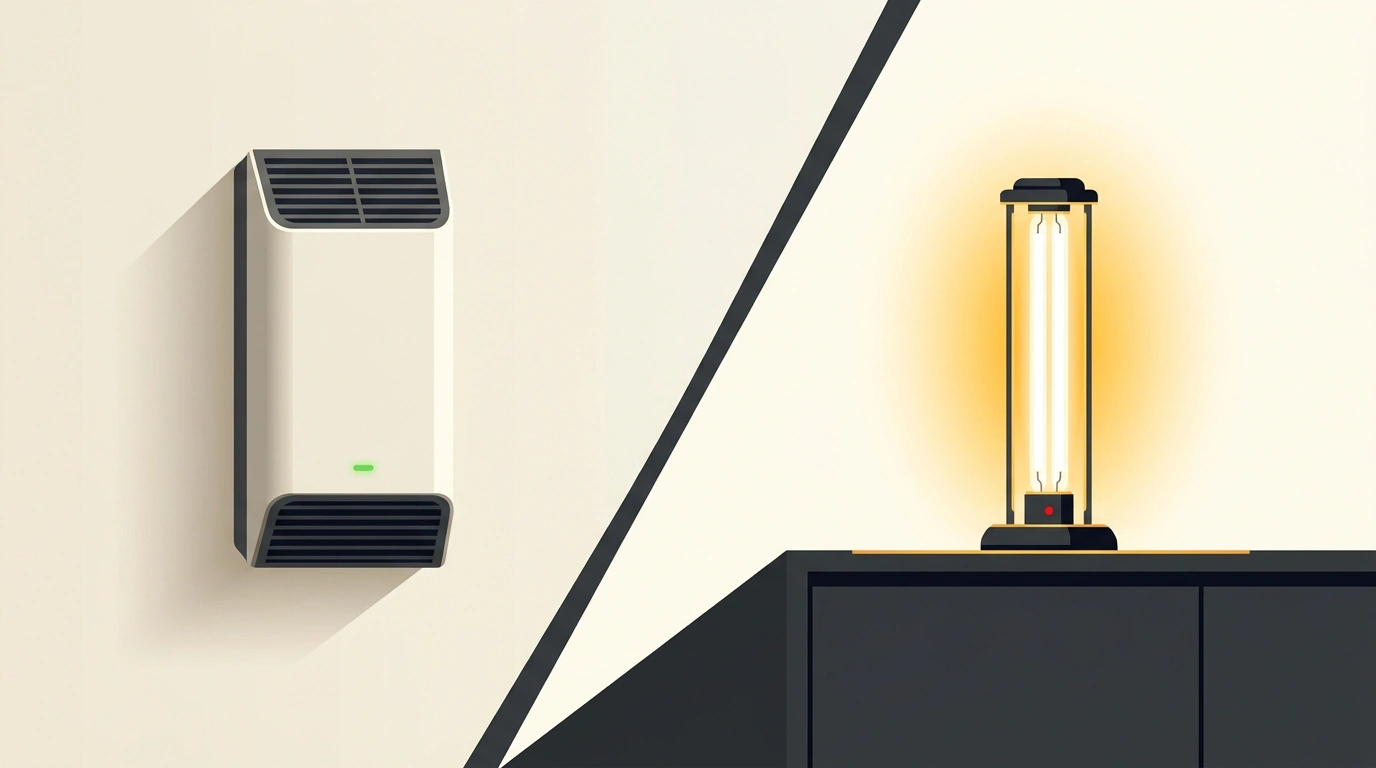
In autumn, when everyone around is sneezing, it's tempting to reach for home devices "for prevention." You turn on a tabletop open lamp in the kids' room for half an hour while a schoolchild works on exercises in a notebook: the tube glows with a soft bluish light, gives off no heat, doesn't dazzle, and looks like a harmless nightlight. Your child finishes the homework, and you switch off the device feeling proud—the air is supposedly cleared of viruses.
Yet in the middle of the night, four hours after the session, your child wakes up with stabbing pain, unable to open their eyelids and crying even from a dim nightlight. What struck me in Dr. Iolanta's breakdown (the «Dr.iolanta» channel) and CDC NIOSH materials is how easy it is to confuse medical devices with one another. Is it dangerous to stay near a running UV sanitizer, and why do similar-looking boxes hum on clinic walls right next to patients?
The Trap of Hard UV: Why a Corneal Burn Strikes 4–12 Hours Later
The cause of the nighttime injury is short-wave ultraviolet light in the UVC spectrum at 200–280 nm (germicidal lamps peak at 253.7–254 nm). We never encounter it in nature: solar UVC is 100% blocked by the ozone layer and atmospheric oxygen. Our eyes and skin have no defense against these rays, and beach sunscreens with SPF are designed only for the softer UVA (315–400 nm) and UVB (280–315 nm) spectra. I explained why quartz-lamp irradiation of mucous membranes does not treat respiratory infections in my breakdown of the Soviet «Солнышко» irradiator.
The main trap people stumble into at home is the complete absence of pain while the lamp is running. UVC rays destroy DNA and RNA not only in microbes, but also in the surface cells (epithelium) of our cornea. There are no heat receptors there to sound an immediate alarm. While a child sits a meter away from an open bulb and glances at the blue tube, corneal cells quietly die. After 4–12 hours, the damaged layer sloughs off, exposing nerve endings, and an acute burn—electroophthalmia (photokeratitis)—flares up with stabbing pain, a "sand in the eyes" sensation, tearing, and eyelid spasms.
If you notice stinging, tearing, light sensitivity, or blurred vision after using a lamp, move the person into a dark room (or put on dark wraparound sunglasses), place a cool dry compress over closed eyelids through a cloth, apply preservative-free lubricating eye drops, give ibuprofen or paracetamol, and see an ophthalmologist. Do not rub the eyes, use anti-redness drops, or rinse the eyes with tea. With proper care, the cornea heals within 24–72 hours.
Quartz Glass vs. Uviol Glass: Where Toxic Ozone Comes From
Open irradiation also carries a second hidden cost—the air in the room. In everyday speech, any blue tube is called a "quartz lamp," yet the glass of the bulb makes all the difference. An electric discharge in mercury vapor inside the lamp emits two lines: the germicidal 253.7 nm wavelength and a shorter 185 nm wavelength.
Regular window glass blocks UVC, whereas pure quartz glass lets the entire spectrum pass through. Rays at 185 nm split oxygen in the room and turn it into ozone. That sharp "hospital smell" after quartz irradiation is a Class 1 hazardous oxidizing gas that irritates the lungs and bronchi; after running such a lamp, the room must be ventilated for 30–60 minutes. "Ozone-free" lamps use uviol glass: it cuts off wavelengths shorter than 200 nm (blocking the 185 nm line) while letting the working 254 nm rays through. You can read more about how different wavelengths affect tissues in our article on real and imagined risks of household radiation.
Open Irradiator vs. Closed Recirculator: How to Check Your Device
This is why air sanitizers fall into two fundamentally different types. An open lamp (even one made of ozone-free uviol glass) shines in every direction, disinfecting air and surfaces, but the price of running it around people, pets, and plants is eye and skin burns.
In clinics and offices, the units mounted on walls are different—closed recirculators. Inside them, an ozone-free uviol-glass lamp is completely sealed inside an opaque housing, while a fan draws room air through a disinfection chamber. No UVC rays escape outside, so a properly functioning recirculator is safe around people.
Take a look at your home or office sanitizer today and check its manual. If the glass bulb is exposed, run the device strictly in an empty room using a timer or smart plug, and ventilate afterward. If it is a closed recirculator, simply check that the housing and protective grilles are intact and that no blue light leaks out.