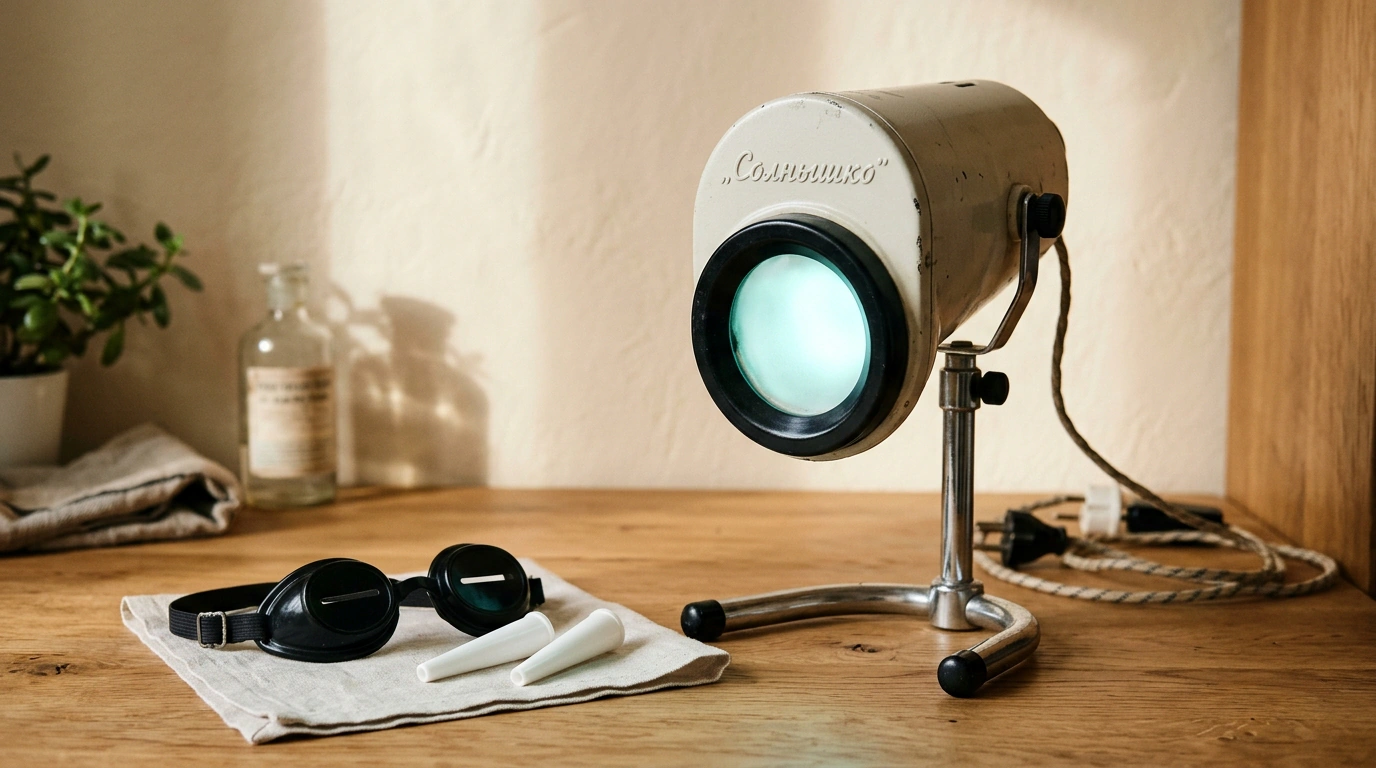
Dark protective goggles with narrow slits, a bluish glow, the sharp tang of ozone, and a white plastic cone you had to hold inside a nostril or your mouth for five minutes. For anyone who grew up in the Soviet or post-Soviet era, the home ultraviolet lamp "Solnyshko" ("Little Sun")—or its bulky cousins in the local clinic's physiotherapy room—remains one of childhood's warmest nostalgic memories.
It was treated as gospel: the moment your throat felt scratchy or your nose started running, pull out the UV lamp, warm up your nasal passages, and the cold would back off. The science-popularizing desk Health on Sports dug into medical archives and uncovered a striking paradox: a device that saved an entire generation of children from disability a century ago turned out to be completely useless—and even risky—for seasonal colds.
Triumph Over Rickets: Saving Children in 1918 Berlin
The idea of treating people with artificial ultraviolet light wasn't born in ENT clinics at all. Its roots go back to the grim winter of 1918–1919. After World War I, starving, devastated Berlin was swept by a severe epidemic of childhood rickets: industrial smog, lack of sunlight, and meager rations left toddlers' bones soft and deformed.
German pediatrician Kurt Huldschinsky decided to test a bold hypothesis by installing mercury-quartz lamps in his ward. The results stunned the medical world: X-rays showed active mineralization and healing along deformed bone zones.
Even more remarkably, Huldschinsky noticed that shining UVB light on just one of a child's arms triggered calcification and bone repair across the entire body—in the other arm and both legs! That proved the light wasn't "warming" bones locally. Instead, the rays sparked a photochemical reaction in skin cells that split cholesterol to synthesize vitamin D3. That vitamin entered the bloodstream and traveled throughout the skeleton to help absorb calcium. Riding that triumph, quartz UV lamps became a global standard in nurseries and sanatoriums.
The Biological Flaw: Why Viruses Are Out of Reach for Quartz UV
So how did quartz lamps migrate into cold treatment? That's where a classic category mistake happened. Home devices switched to harsh germicidal UVC light (wavelength around 254 nm). That spectrum genuinely shreds microbial DNA and RNA, stopping germs from multiplying—which is why hospitals use it to sterilize air and tiled walls in empty operating rooms and ICUs.
Your living nasal lining, however, is not bathroom tile!
Respiratory viruses (rhinoviruses, adenoviruses, influenza) don't sit politely on the surface of your mucous membrane waiting to be zapped. Within minutes of entering your airway, a virion slips inside a living epithelial cell and starts replicating right there. Meanwhile, UVC rays are absorbed within microscopic fractions of a millimeter at the very top layer of tissue. To reach a virus hiding inside a cell, the light would have to burn the host cell itself!
Instead of wiping out infection, shining quartz UV up your nose and throat scorches the ciliated epithelium. Delicate microscopic hairs whose job is to sweep mucus and bacteria outward clump together and die off. You end up with reactive swelling, dry bloody crusts, and a higher risk of secondary bacterial complications—not to mention the danger of corneal burns if a child accidentally nudges their goggles.
Neither the clinical guidelines of the Russian Ministry of Health nor international medical standards include nasal UV irradiation for treating colds—putting it in the same unproven bucket as megadoses of vitamins and immune boosters or harsh folk remedies with boiling steam and mustard plasters.
Keep the vintage quartz cone as a fond childhood memory. Real, evidence-backed relief for a seasonal cold is simple: plenty of warm fluids, rinsing your nose with plain pharmacy saline solution, and cool, humidified bedroom air (40–60%). Your immune system just needs a little time and gentle support.
