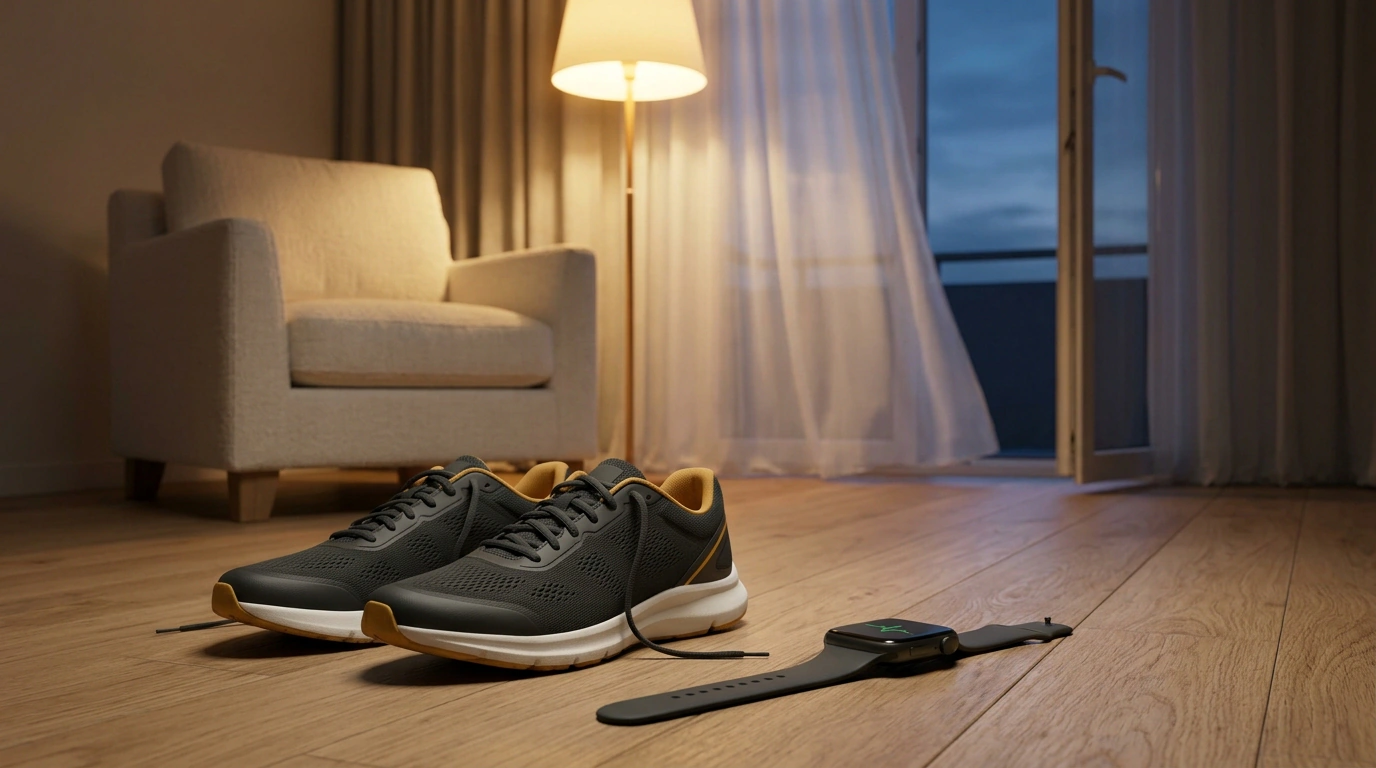
If your workday wraps up at seven or eight in the evening, you've probably faced this frustrating dilemma more than once. On one hand, after sitting in front of a screen all day, your body is begging to move—you want to loosen a stiff back, lace up your sneakers, and head out for a run or hit the gym. On the other, a strict internet fitness guru echoes in your head: "No workouts after 6 p.m.! You'll overstimulate your nervous system, wreck your circadian rhythms, and stare at the ceiling until three in the morning."
So you end up either skipping exercise altogether or working out with a side of guilt over "ruining your sleep." But is evening training really that dangerous?
Experts from the running community Run Simply highlighted a landmark study published in Nature Communications (April 2025, DOI: 10.1038/s41467-025-58271-x). An international team from Monash University, Harvard Medical School, and the biometric platform WHOOP pooled a full year of data from nearly 15,000 physically active adults. Analyzing more than four million nights of sleep finally drew the real line between healthy movement and insomnia risk.
The Evening Exercise Dogma: Why Old Bans Are Outdated
The blanket ban on late-day workouts didn't appear out of thin air: early sleep-lab studies often tested small groups of 10–20 college students in artificial settings, forcing them to pedal stationary bikes at all-out exhaustion right before bedtime.
Naturally, after an extreme stress test like that, the body couldn't wind down instantly. Extrapolating those artificial lab experiments to everyday life, however, was a methodological mistake.
In the real world, people train at wildly different intensities: one person goes for an easy 30-minute recovery jog, another does stretching or a relaxed dumbbell circuit, while someone else truly empties the tank with grueling intervals. Until recently, sports science lacked large-scale objective data separating light movement from heavy anaerobic strain. Modern wearable biosensors finally let researchers peek into thousands of bedrooms without wires or scalp electrodes.
Physiology of Nighttime Recovery: Gas Pedal, Brake, and Core Temperature
To understand what happens after an evening session, let's look at two core biological circuits: autonomic balance and thermoregulation.
Two branches of your autonomic nervous system are constantly at work:
- Sympathetic branch (the "gas pedal"): kicks in during any physical or emotional load. Adrenaline and norepinephrine surge, heart rate climbs, blood vessels narrow, blood pressure rises, and blood shifts toward working muscles.
- Parasympathetic branch (the "smooth brake," via the vagus nerve): takes over at rest. It slows your pulse, supports digestion, lowers blood pressure, and prepares your body for deep sleep.
Heart rate variability (HRV) acts as an objective mirror of that tug-of-war. A healthy heart doesn't tick like a metronome; the gaps between beats shift microscopically from second to second. High nighttime HRV means your parasympathetic brake is working smoothly, recovery is underway, and your nervous system is calm. Low HRV means the sympathetic system is still keeping your heart on edge.
The second critical factor is core body temperature. An hour and a half to two hours before bedtime, your body starts cooling down naturally, dropping internal organ temperature by roughly 0.5–1 °C. That gentle cool-down is the key trigger for releasing the sleep hormone melatonin.
What happens during a hard workout? During tempo runs or heavy lifting, working muscles generate enormous heat, pushing core temperature up to 38.5–39.5 °C. Dissipating that heat through widened skin capillaries and sweating takes two to four hours. Climbing into bed while still overheated predictably trims deep sleep stages, something we covered in our review of circadian rhythms and sleep regularity.
The Nature Communications Verdict: The Four-Hour Rule and Heart Rate Zones
Researchers used a standardized measure of cardiovascular strain—the Summed Heart Rate Zone Score (SHRZS)—which tracks not just workout length, but the exact minutes spent in high heart rate zones above the anaerobic threshold.
Data from four million nights yielded three clear takeaways:
- Light and moderate workouts are safe anytime: Low- to moderate-intensity activity (brisk walking, easy Zone 1–2 jogging, Pilates, yoga, or gentle mobility work) finished even one to two hours before bed does not delay sleep onset or drag down HRV. Better yet, regular exercise finished 6 or more hours before bedtime measurably increases total sleep duration and makes waking up easier.
- The "four-hour rule" for hard training: Clear negative effects on sleep show up only after high-intensity interval sessions (HIIT, sprints, races, heavy CrossFit metcons) performed within 4 hours of bedtime.
- The cost of late-night overload in numbers:
When someone pushes near maximum heart rate less than 4 hours before bed:
- falling asleep takes an average of 36 minutes longer;
- total sleep time shrinks by roughly 22 minutes;
- resting nighttime heart rate stays elevated by several beats per minute through the first half of the night, and HRV dips.
The sympathetic system simply doesn't have time to hand control back to the parasympathetic brake, and an overheated body fights excess heat instead of dropping into restorative sleep.
A Practical Compromise: How to Train at Night Without Hurting Rest
Does this mean you should quit evening workouts? Not at all! If 7:30–9:00 p.m. is your only free window, skipping movement is the worst choice. Any activity beats couch-bound sedentariness by a mile, and brief movement protects brain health, as shown in data on how regular exercise boosts deep sleep.
To get the upside of evening training while protecting your night's rest, follow a simple four-step playbook:
- Match intensity to the clock: If you're training 2–3 hours before bed, stick to a conversational pace: an easy aerobic jog, joint mobility, stretching, or relaxed laps in the pool. Save sprints and intervals for mornings or weekends.
- Help your body cool down faster: Take a warm shower 60–90 minutes before bed. It sounds paradoxical, but warm water dilates blood vessels in your hands and feet, triggering rapid heat dump from your core outward—a vascular cooling shunt.
- Dial in your bedroom climate: Air out the room before sleeping. The sweet spot for quality sleep is 18–20 °C. Cooler air helps a warm body shed residual heat faster.
- Don't go to bed starving, but keep dinner light: After an evening session, muscles need building blocks to recover: a modest serving of protein (cottage cheese, eggs, lean fish) plus complex carbs steadies blood glucose and prevents nighttime cortisol spikes.
If you're choosing between a calm evening jog and zero movement all day, pick the jog every time. Losing 15 minutes of sleep is easily outweighed by the cardiovascular payoff—especially if the workout feels good and melts away a day's worth of work stress.