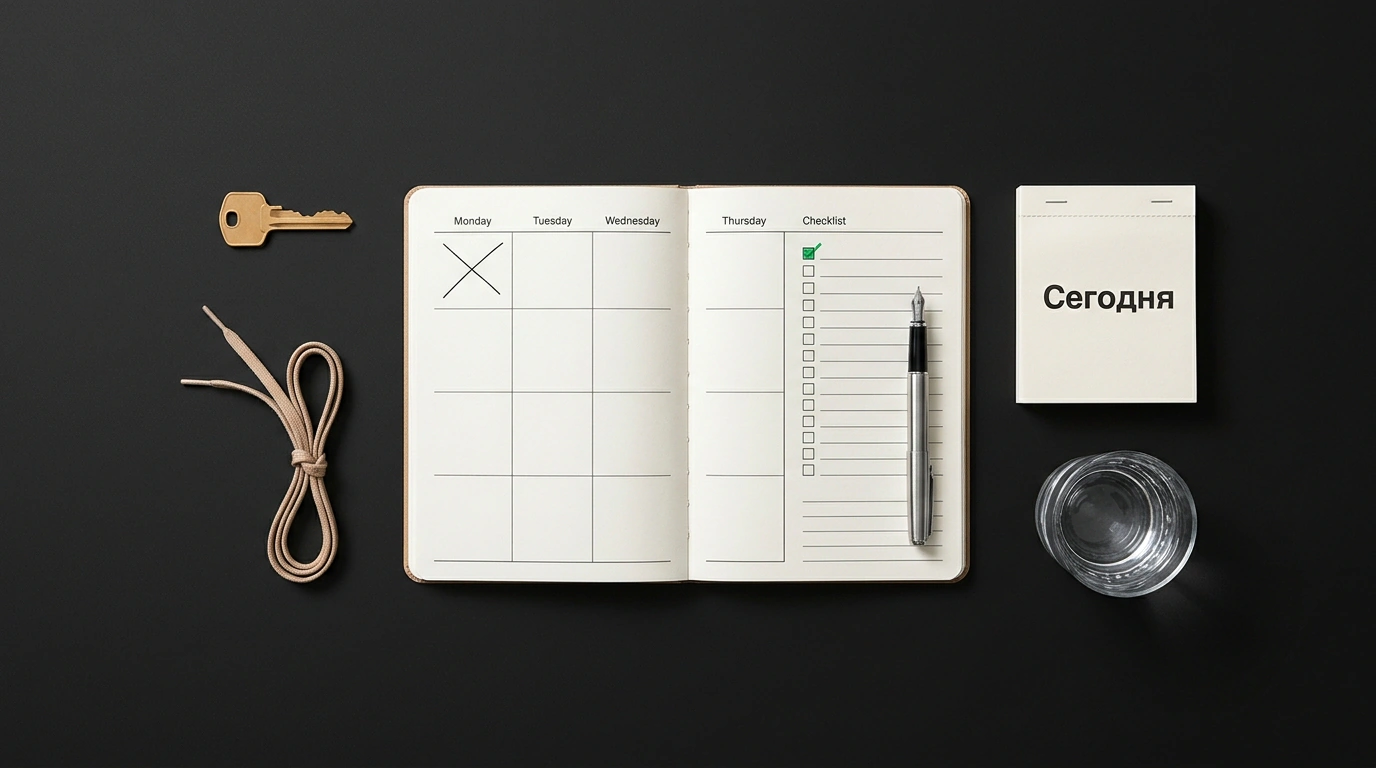
"Starting Monday, I'm turning over a new leaf: morning runs, zero sweets, in bed strictly by 11:00 p.m., and studying English." It's a script everyone knows by heart: on Sunday night you feel unstoppable and ready to move mountains; Monday morning you wake up feeling heroic; by Wednesday evening the spark has vanished without a trace. Come Friday, all that's left is fatigue, guilt, and the familiar thought: "Well, this week didn't pan out—I'll start fresh next Monday."
Why do we keep walking into the exact same trap year after year? Endocrinologist Dr. Pavlova spotlighted a new large meta-analysis that explains the paradox through behavioral psychology and neurobiology.
In science, this phenomenon is known as the "fresh start effect," first mapped in detail by Professor Katy Milkman. Our brains love clean dates and symbolic landmarks: the first day of the week, the first of the month, a birthday, or New Year's Day all feel like invisible psychological dividing lines.
A Meta-Analysis of 31 Studies: High Emotion, Low Follow-Through
To find out how much a neat calendar kickoff actually helps people change habits in real life, researchers from Jilin and Chuxiong Universities pooled 31 independent studies covering 13,765 participants. The meta-analysis was published in Acta Psychologica (DOI: 10.1016/j.actpsy.2026.107747).
The findings were telling:
- A symbolic milestone genuinely triggers a statistically significant surge in emotional optimism and self-belief (effect size g = 0.332). People sincerely believe that this time will be different.
- Yet statistical heterogeneity across the data is sky-high (I² = 90.8%). In plain English, "Monday" on its own has virtually no reliable connection to actually sticking with your plans over time.
Where does the trap snap shut? First, the moment you make the promise, your brain performs a psychological split—distancing itself from your "past self." You tell yourself: "Whoever ate pizza before bed and lounged on the couch yesterday was the old, lazy me. Come Monday, I'm an ideal hero." Your brain gets a generous hit of dopamine just from daydreaming about future success!
Second, you hit the "intention-behavior gap." Sunday night's emotions don't wire new neural pathways in your cortex. When an ordinary Tuesday workday hits, routine fatigue builds up, willpower dips, and old automatic habits take the wheel again.
Third, false-hope syndrome kicks in: you set an unrealistic bar (working out an hour every single day), hit the first bump, decide "it's all ruined," and tumble into a downward spiral of restriction and burnout.
From Start-Date Illusions to Habit Architecture
How do you turn an impulsive burst of motivation into steady action without endless Monday resets? Behavioral psychologists recommend ditching calendar magic and building a solid system instead:
- The "If... Then..." formula (implementation intentions): Swap a vague vow like "I'll go running" for a concrete environmental cue: "If the clock hits 7:15 a.m., then I put on the workout clothes laid out on the chair and go for a 15-minute walk." Your brain doesn't have to debate a decision while half-asleep.
- Strip out friction: Set up your space ahead of time: chop veggies into a container the night before, pack your gym bag by the door, put a book on your pillow instead of your phone. The fewer obstacles between you and the action, the higher the odds you'll follow through—a principle we explored in our guide to a sustainable start in fitness.
- The micro-step rule: Make the action so small it feels absurd to skip: not an hour-long sweat session, just five squats; not a rigid diet, just adding one tomato to lunch. Consistency beats heroic intensity every time.
Stop waiting for the first of the month or next Monday. Start right now—on a random Tuesday or Thursday afternoon. Do one tiny healthy action without fanfare or dramatic vows. A quiet small step today changes your life more reliably than a dozen abandoned grand plans.